
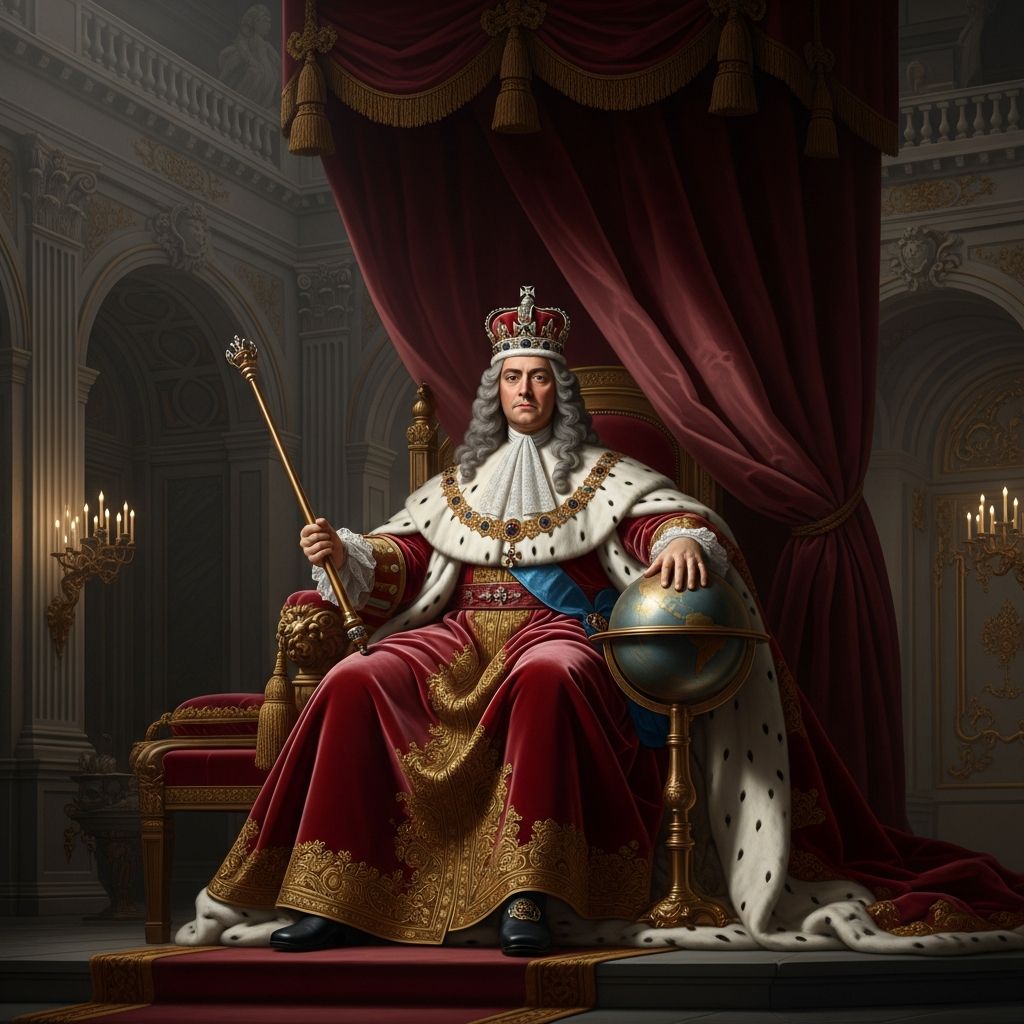
Absolutism represented a pivotal shift in European governance during the 16th to 18th centuries, where monarchs centralized authority, diminishing the influence of nobles, churches, and regional bodies to create unified nation-states.
Defining the Core Principles of Absolutist Rule
At its heart, absolutism meant a monarch’s power was unrestrained by institutions like parliaments, nobility, or religious authorities. Rulers claimed sovereignty derived from divine right, positioning themselves as God’s chosen representatives on earth. This ideology justified overriding feudal traditions, customary laws, and fragmented power structures inherited from the Middle Ages.
Key characteristics included the establishment of standing armies loyal directly to the crown, bureaucratic systems bypassing noble intermediaries, and mercantilist policies to bolster state wealth. Monarchs unified legal codes, standardized taxation, and integrated the church under state control, fostering national identity over local loyalties.
- Centralized Administration: Power consolidated in the royal court, with officials appointed based on loyalty rather than birthright.
- Military Reforms: Permanent forces replaced feudal levies, enabling expansion and internal control.
- Economic Control: State-directed trade and industry to fund grandiose projects and warfare.
Historical Context: From Feudalism to Centralized States
The transition to absolutism emerged amid the Reformation’s religious wars, the Thirty Years’ War (1618–1648), and economic upheavals that weakened feudal lords. The Peace of Westphalia in 1648 reinforced state sovereignty, encouraging princes to assert dominance over fragmented territories.
In the late medieval period, power was dispersed among kings, nobles, clergy, and towns. Absolutism reversed this by dismantling feudal partitions, where nobles held semi-autonomous fiefdoms. By the 16th century, monarchs in Spain, France, and emerging powers like Prussia began curbing these influences to forge cohesive realms.
This era coincided with the decline of the Holy Roman Empire’s universal authority and the rise of nation-states. Intellectuals like Jean Bodin argued for indivisible sovereignty vested in the king, while Thomas Hobbes later defended absolute rule to prevent civil chaos.
France: The Pinnacle Under Louis XIV
France epitomized absolutism through Louis XIV (r. 1643–1715), known as the Sun King, who declared “L’état, c’est moi” (I am the state). He centralized power at Versailles, a lavish palace symbolizing royal magnificence and noble containment.
Louis revoked the Edict of Nantes in 1685, subordinating Protestantism and unifying religion under Catholicism. His minister Colbert implemented mercantilism, building a navy, roads, and colonies to enrich the treasury. A professional army grew to over 400,000 men, securing borders and suppressing revolts.
Despite wars draining resources, Louis’s reign showcased absolutism’s grandeur but sowed seeds of discontent through heavy taxes on peasants, sparing nobles who attended court.
Absolutism in Spain: Philip II’s Golden Age
Spain’s Philip II (r. 1556–1598) unified the Iberian Peninsula by annexing Portugal in 1580, creating a vast empire spanning the Americas, Asia, and Europe. He defended Catholicism against Protestants and Ottomans, funding the Armada.
Philip centralized via councils like the Inquisition, controlling church and state. However, overextension, bankruptcies from American silver influx mismanagement, and defeats like the Armada (1588) eroded Spanish dominance, though absolutist structures persisted.
Prussia’s Militarized Absolutism
In Prussia, Frederick William, the Great Elector (r. 1640–1688), forged absolutism through compromise. His 1653 “Great Compromise” granted nobles serf control and land monopolies in exchange for taxes and a standing army, transforming Brandenburg-Prussia into a military powerhouse.
Successors like Frederick William I (r. 1713–1740) and Frederick the Great (r. 1740–1786) emphasized drill, discipline, and expansion. By 1772, Prussia partitioned Poland with Austria and Russia, rivaling greater powers despite limited resources.
| Ruler | Key Reforms | Outcomes |
|---|---|---|
| Great Elector | Standing army, tax rights | Noble loyalty, military rise |
| Fred. William I | Soldier recruitment, bureaucracy | Europe’s strongest army |
| Fred. the Great | Enlightened reforms, wars | Territorial gains, Silesia |
Russia: From Ivan IV to Peter the Great
Russia’s absolutism began with Ivan IV (r. 1533–1584), the Terrible, who crowned himself Tsar in 1547. He created the oprichnina, a brutal force terrorizing nobles (boyars), centralizing via a new bureaucracy and army.
Peter the Great (r. 1682–1725) modernized ruthlessly, building St. Petersburg as a “window to Europe,” imposing Western dress, and taxing beards. He crushed noble autonomy, founding Russia’s first standing army and navy, expanding into the Baltic.
Theoretical Foundations and Justifications
Philosophers bolstered absolutism. Jean Bodin (1530–1596) defined sovereignty as absolute, perpetual, and indivisible. Thomas Hobbes’s Leviathan (1651) portrayed the sovereign as a mortal god preventing anarchy. Jacques-Bénigne Bossuet linked monarchy to divine order.
These ideas countered feudalism and religious strife, promising stability amid crises.
Challenges and Variations Across Europe
Absolutism varied: Austria’s Habsburgs balanced multi-ethnic empire with military focus; Sweden’s briefly peaked under Charles XI. England resisted, with the 1688 Glorious Revolution establishing constitutional limits.
Critics noted hypocrisy—monarchs often consulted advisors—but centralization undeniably built modern states.
Decline and Legacy of Absolutist Governance
Absolutism waned by the late 18th century due to Enlightenment ideas, financial strains from wars, and rising middle classes demanding representation. The French Revolution (1789) toppled Louis XVI, inspired by American independence.
Its legacy endures in strong central governments, bureaucracies, and nationalism. Prussia’s model influenced unified Germany; Russia’s autocracy persisted until 1917.
Frequently Asked Questions (FAQs)
What distinguished absolutism from feudal monarchy?
Absolutism centralized all power in the monarch, eliminating noble vetoes and feudal divisions, unlike shared feudal authority.
Did any absolute monarchs face successful opposition?
Yes, England’s Charles I lost a civil war (1642–1651), leading to his execution and parliamentary supremacy.
How did absolutism impact economy and society?
Mercantilism spurred trade but burdened peasants with taxes, widening inequality while funding cultural patronage.
Was absolutism truly ‘absolute’ in practice?
Rarely; monarchs relied on nobles and bureaucrats, and financial needs forced compromises, though ideology claimed totality.
Which country best exemplified absolutism?
France under Louis XIV, with Versailles as a control mechanism and comprehensive state reforms.
References
- Absolutism (European history) — Wikipedia. 2023-10-15. https://en.wikipedia.org/wiki/Absolutism_(European_history)
- Absolutism | Definition, History, & Examples — Encyclopædia Britannica. 2024-01-20. https://www.britannica.com/topic/absolutism-political-system
- European Absolutism — Epic World History (blog). 2012-07-01. http://epicworldhistory.blogspot.com/2012/07/european-absolutism.html
- Volume 2, Chapter 8: Absolutism — NOVA Open Publishing (pressbooks.nvcc.edu). 2023-05-10. https://pressbooks.nvcc.edu/wcchv2/chapter/volume-2-chapter-8-absolutism/
- Age of Absolutism: AP® European History Crash Course — Albert.io. 2023-08-22. https://www.albert.io/blog/age-of-absolutism-ap-european-history-crash-course/

Medha Deb is an editor with a master's degree in Applied Linguistics from the University of Hyderabad. She believes that her qualification has helped her develop a deep understanding of language and its application in various contexts. Medha specializes in the areas of beauty, health, sports, and wellness and is committed to ensuring that the content on the website is…