
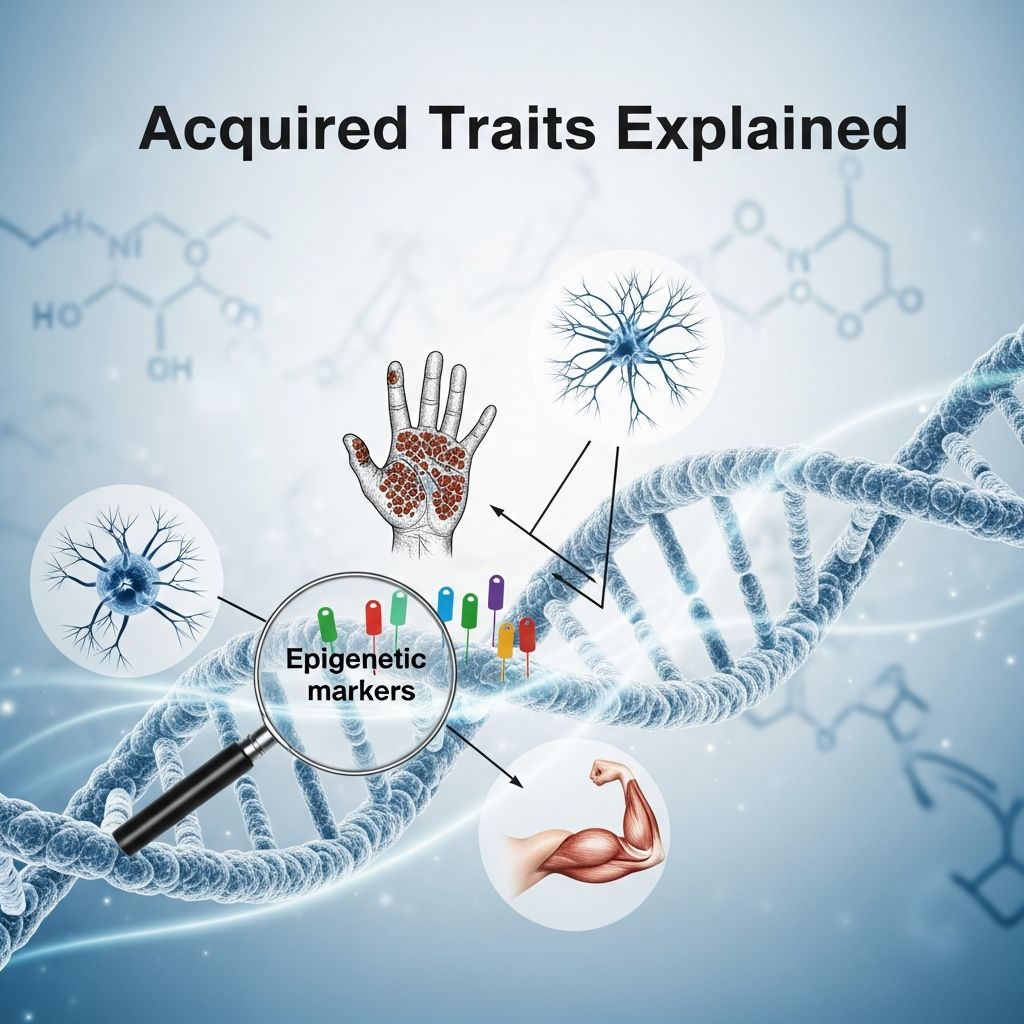
Acquired traits represent changes in an organism’s structure, function, or behavior that develop after birth due to environmental influences, experiences, or deliberate actions, rather than being encoded in DNA from conception. These traits distinguish themselves from inherited characteristics by their non-genetic origin and general inability to pass to offspring, shaping our understanding of adaptability and evolution.
Defining Acquired Traits in Modern Biology
In biological terms, an **acquired trait** emerges postnatally from factors like injury, repeated use of body parts, learning, or external pressures, altering phenotype without modifying genotype. Unlike genetic traits fixed at birth, these modifications reflect an organism’s interaction with its surroundings, highlighting life’s plasticity.
Historically, French naturalist Jean-Baptiste Lamarck proposed that such traits could be inherited, suggesting organisms pass on changes like a giraffe’s elongated neck from stretching for leaves. Though largely disproven by genetics, this idea persists in debates, especially with epigenetics revealing nuances.
Core Differences: Acquired vs. Inherited Traits
Understanding acquired traits requires contrasting them with inherited ones. The table below summarizes key distinctions:
| Feature | Acquired Traits | Inherited Traits |
|---|---|---|
| Origin | Environmental influences, experiences, or behaviors during lifetime | Genetic material (DNA) from parents at conception |
| Timing | Develop after birth | Present from birth or predisposed genetically |
| Heritability | Typically not passed to offspring (changes not in DNA) | Passed to offspring via reproduction |
| Examples | Muscle from exercise, learned skills | Eye color, blood type |
| Mechanism | Phenotypic changes only | Genotypic transmission |
This comparison underscores why acquired traits emphasize nurture over nature, though overlaps exist in complex traits influenced by both.
Categories of Acquired Traits: Physical and Behavioral
Acquired traits fall into two primary categories: physical modifications to the body and behavioral adaptations shaped by learning.
Physical Acquired Traits
These involve observable changes to an organism’s anatomy or physiology from use, disuse, injury, or environment. Common instances include:
- Muscle hypertrophy: Bodybuilders develop larger muscles through training, not genetics alone.
- Calluses or scars: Skin thickens from friction or heals with marks from wounds.
- Tattoos or piercings: Deliberate body alterations (though some debate if cosmetic changes qualify as true traits).
- Bone adaptations: Tennis players’ serving arms show denser bones from repetitive stress.
- Weight gain/loss: Obesity or slimness from diet and lifestyle, not solely inherited metabolism.
In animals, an elephant losing a tusk to poaching or a bird’s beak worn from foraging exemplifies physical shifts without genetic basis.
Behavioral or Mental Acquired Traits
Mental traits arise from learning, practice, and adaptation, reshaping cognition and habits:
- Language skills: Multilingualism from immersion, absent in newborns.
- Playing instruments: Proficiency in piano via years of practice.
- Habits like riding a bike: Motor skills honed through repetition.
- Cultural knowledge: Traditions or professions learned socially.
- Phobias or preferences: Fears from trauma or tastes from exposure.
These underscore neural plasticity, where brains rewire based on experiences, distinct from innate instincts like a spider’s web-spinning.
Everyday Examples Across Species
Acquired traits manifest universally. In humans, athletes’ physiques or surgeons’ steady hands result from training. Children learn walking through trial and error, a milestone not genetically preset but environmentally facilitated.
For plants, a tree branch bending toward light (phototropism via growth, arguably acquired) or leaves scarred by herbivores. Animals show migration routes memorized over seasons or hunting techniques refined by survival needs.
Consider a table of diverse examples:
| Organism | Acquired Trait | Cause |
|---|---|---|
| Human | Sun-tanned skin | UV exposure |
| Dog | Tricks like rolling over | Training |
| Tree | Thicker bark | Repeated rubbing |
| Bird | Song variations | Learned from flock |
| Athlete | Endurance | Consistent workouts |
Why Acquired Traits Aren’t Inherited: The Genetic Barrier
Central to biology is that acquired traits alter soma (body cells) but not germline (sperm/egg) cells carrying DNA to offspring. Environmental tweaks change protein expression or cell structure phenotypically, leaving genotype untouched.
For instance, a mouse exercised to bulk muscles passes standard genes, not enhanced physique, to pups. This Weismann barrier, proposed by August Weismann, solidified Mendelian genetics over Lamarckism.
Challenging the Status Quo: Epigenetics and Inheritance
Recent discoveries question strict non-inheritability. **Epigenetics** involves chemical tags on DNA (e.g., methylation) that switch genes on/off without sequence changes, potentially heritable across generations.
Studies show:
- Rats exposed to stress pass anxiety-like behaviors via sperm epigenome changes.
- Humans: Dutch Hunger Winter famine offspring exhibited metabolic shifts two generations later.
- Immune tolerance in mice transmitted neonatally.
While not rewriting DNA, these ‘soft inheritance’ mechanisms revive Lamarckian echoes, impacting evolution by enabling rapid adaptations like pesticide resistance in insects. A 2010 review in The American Biology Teacher highlights cases where acquired traits influence offspring, broadening heredity’s scope.
Yet, mainstream view holds most acquired traits non-heritable; epigenetic effects often fade after generations.
Implications for Evolution and Medicine
Acquired traits drive individual survival—fitter bodies or skills evade predators—but evolution acts via selectable genetic variation. Epigenetics adds layers, allowing environmental cues to shape populations quickly.
In medicine, understanding aids treatments: lifestyle-acquired obesity informs prevention over genetic blame. Epigenetic therapies target cancer or aging by tweaking gene expression.
Frequently Asked Questions (FAQs)
Can acquired traits ever be inherited?
Traditionally no, but epigenetics shows limited transmission in some cases, like stress responses, though not permanent genetic changes.
Are tattoos acquired traits?
Yes, as deliberate physical modifications post-birth, not genetic.
How do acquired traits develop in animals?
Through environmental pressures, learning, or injury, like a scarred fin or learned foraging paths.
What’s the role of epigenetics here?
It enables some acquired influences to affect gene expression in offspring without DNA alteration.
Do plants have acquired traits?
Yes, such as wound-induced thickening or directional growth toward resources.
References
- Acquired characteristic – Wikipedia — Wikipedia contributors. 2023-10-15. https://en.wikipedia.org/wiki/Acquired_characteristic
- 101 Acquired Traits Examples (2026) — Helpful Professor. 2026-01-20. https://helpfulprofessor.com/acquired-traits-examples/
- Inherited & Acquired Traits: A Comprehensive Guide — MindMap AI. 2024-05-12. https://mindmapai.app/mind-mapping/inherited-traits-and-acquired-traits
- Acquired trait Definition and Examples — Biology Online Dictionary. 2023-11-08. https://www.biologyonline.com/dictionary/acquired-trait
- Acquired and Inherited Traits — BYJU’S. 2024-02-14. https://byjus.com/biology/acquired-and-inherited-traits/
- Inherited Vs. Acquired Traits Mini Lesson — Future Zoologist Academy. 2023-09-01. https://www.futurezoologistacademy.com/science-resources/mini-science-lessons/inherited-vs-acquired-traits
- Acquired Traits Revisited — The American Biology Teacher (UC Press). 2010-02-01. https://online.ucpress.edu/abt/article/73/2/86/18293/Acquired-Traits-Revisited

Medha Deb is an editor with a master's degree in Applied Linguistics from the University of Hyderabad. She believes that her qualification has helped her develop a deep understanding of language and its application in various contexts. Medha specializes in the areas of beauty, health, sports, and wellness and is committed to ensuring that the content on the website is…