
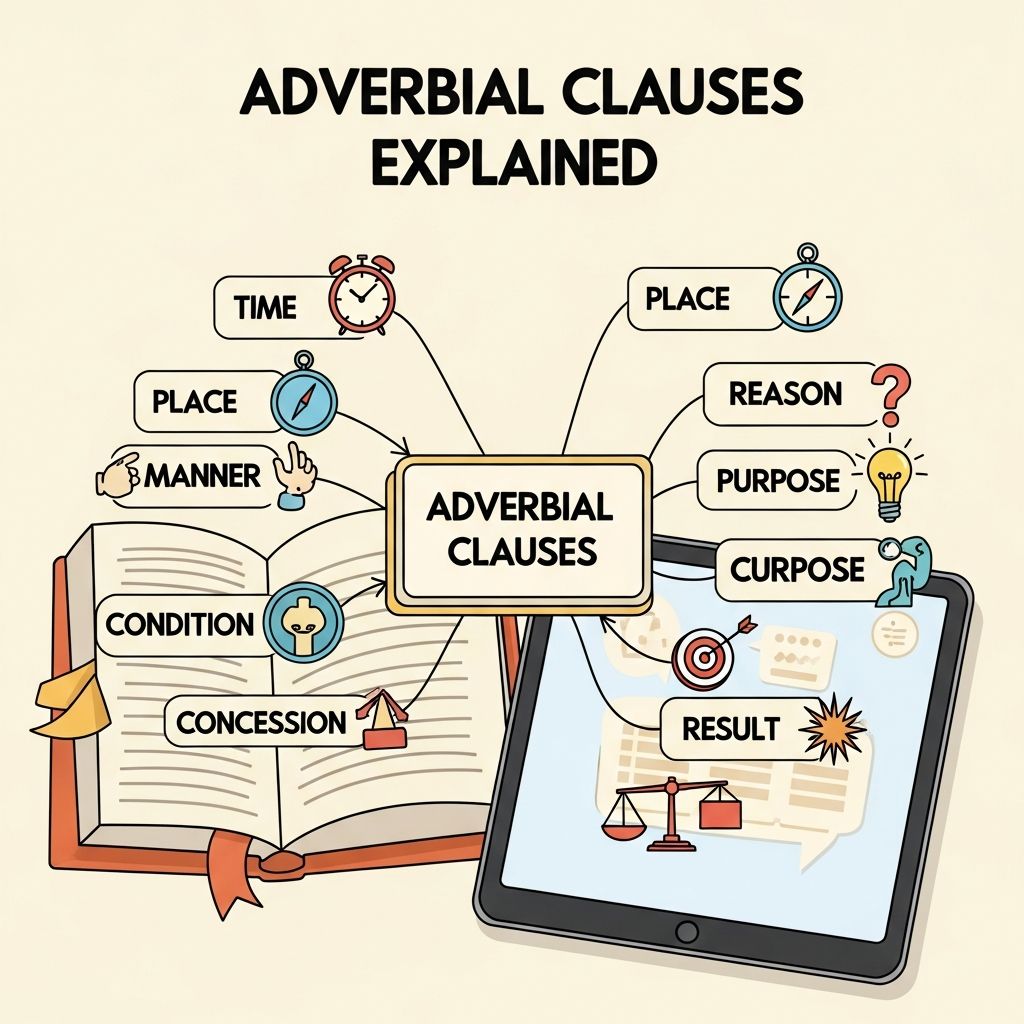
Adverbial clauses enrich sentences by providing essential details about actions, adding layers of meaning that single adverbs cannot match. These dependent structures modify verbs, adjectives, or other adverbs, answering key questions like when, where, why, or how events unfold.
Defining Adverbial Clauses in Modern Grammar
An **adverbial clause**, also known as an adverb clause, consists of a subject and verb but cannot stand alone as a complete sentence. It functions like an adverb, attaching to an independent clause to offer context or explanation. For instance, in \”She left early because she felt ill,\” the clause \”because she felt ill\” explains the reason for leaving, making the sentence more informative.
Unlike simple adverbs such as \”quickly\” or \”yesterday,\” adverbial clauses provide fuller descriptions through their complete grammatical structure. They always begin with subordinating conjunctions like because, although, or while, which signal their dependent nature. This dependency ensures they enhance rather than overshadow the main idea.
Core Characteristics and Identification Tips
To spot an adverbial clause, look for a group of words with its own subject and verb that modifies another part of the sentence. It answers interrogatives: when? (e.g., \”after the meeting ends\”), where? (e.g., \”wherever you go\”), why? (e.g., \”since it rained heavily\”), or how? (e.g., \”as if nothing happened\”).
- Contains a subject and finite verb.
- Introduced by subordinating conjunctions.
- Dependent: Cannot form a standalone sentence.
- Modifies verbs, adjectives, adverbs, or whole clauses.
Distinguishing them from adverbial phrases is crucial. Phrases lack a subject-verb pair, e.g., \”with great care\” versus the clause \”as she took great care\”.
Primary Types of Adverbial Clauses
Adverbial clauses fall into categories based on the information they convey. Understanding these helps in crafting precise, varied prose[10].
Time Clauses: Sequencing Events
These indicate when an action occurs, using conjunctions like when, before, after, while, or until. Example: \”We will eat dinner after you finish your homework.\” Here, the clause sets the timeline.
- Before: \”Before the sun sets, we hike.\”
- While: \”While she reads, the kids play.\”
- Whenever: \”Call me whenever you arrive.\”
Place Clauses: Specifying Location
Less common but vital, these describe where actions happen, often with where or wherever. Example: \”Plant the seeds where the soil is richest.\” They add spatial context.
Reason and Cause Clauses: Explaining Motivations
Conjunctions such as because, since, or as introduce causes. \”He stayed home because he was sick\” clarifies the motivation. These are frequent in persuasive writing.
Condition Clauses: Hypothetical Scenarios
Using if, unless, or provided that, they outline conditions. \”If it rains, the game cancels\” presents a contingency.
Manner, Purpose, and Concession Clauses
Manner: As or as if (\”She sings as though an angel.\”). Purpose: So that or in order that (\”Study hard so that you pass.\”). Concession: Although or even though (\”Although tired, he continued.\”)[10].
Punctuation Rules for Seamless Integration
Placement affects punctuation. Introductory adverbial clauses require a comma after them: \”Because it was late, we hurried home\”. Terminal clauses often omit the comma: \”We hurried home because it was late.\”
| Position | Punctuation | Example |
|---|---|---|
| Beginning | Comma after clause | After dinner, we relax. |
| Middle | Commas around clause | The team, though exhausted, won. |
| End | No comma (usually) | We relax after dinner. |
Exceptions apply if the clause is essential or short.
Adverbial Clauses Versus Phrases and Other Clauses
Adverbial phrases (e.g., \”in silence\”) lack subjects/verbs, offering brevity. Adjective clauses modify nouns (\”The book that I read…\”), while noun clauses act as subjects (\”What she said surprised me\”).
- Adverbial Clause: \”While we waited, it rained.\”
- Adverbial Phrase: \”In the rain.\”
- Adjective Clause: \”The wait that was long ended.\”
Practical Applications in Writing and Speech
These clauses elevate writing from basic to sophisticated. In academic essays, they link ideas fluidly; in narratives, they build tension (\”Just as the door opened, the lights went out.\”). Avoid overuse to prevent run-on sentences.
In spoken English, they convey nuance: \”I’ll go if you’re joining.\” Practice varies sentence rhythm for engagement.
Common Errors and How to Avoid Them
Mistakes include comma splices (treating clauses as independent) or fragments (isolating them). Fix by attaching to main clauses or using coordinators. Dangling modifiers occur if subjects mismatch: Wrong: \”Running late, the bus left.\” Correct: \”Running late, I missed the bus.\”
- Ensure subject-verb agreement within the clause.
- Use appropriate conjunctions for type.
- Test dependency: Can it stand alone? If yes, it’s not adverbial.
Exercises to Master Adverbial Clauses
Strengthen skills with these:
- Identify the clause: \”She whispered softly so that no one heard.\” (Answer: so that no one heard – purpose)
- Add a time clause: \”The concert ended _____ .\” (e.g., before we arrived.)
- Combine: \”It rained. We stayed inside.\” → \”We stayed inside because it rained.\”
Advanced: Rewrite paragraphs using three types.
Frequently Asked Questions (FAQs)
What distinguishes an adverbial clause from a regular adverb?
An adverbial clause has a subject and verb, functioning dependently to modify; single adverbs are independent words.
Can adverbial clauses start a sentence?
Yes, as introductory clauses, followed by a comma for clarity.
How many types of adverbial clauses exist?
Typically 7-9, including time, place, reason, condition, manner, purpose, and concession[10].
Do all adverbial clauses need commas?
No, only when introductory or interrupting; end-position often doesn’t.
What’s the role of subordinating conjunctions?
They link the dependent clause to the main one, signaling its adverbial function.
Advanced Techniques for Seasoned Writers
Reduce clauses to phrases for conciseness: \”Because it rained\” → \”In the rain.\” Stack clauses sparingly for emphasis: \”Although challenged, and while doubting, she persevered.\” Analyze literature for models, like in Austen: \”She danced as if her life depended on it.\”
Word count expansion: Delve into historical evolution—adverbials trace to Old English, evolving with conjunctions. In ESL contexts, they bridge simple to complex proficiency. Computational linguistics uses them for natural language processing, parsing dependencies.
Teaching tip: Use visuals—diagrams showing main clause as trunk, adverbials as branches. Interactive quizzes reinforce via apps.
References
- What Is an Adverbial Clause? | Definition & Examples — QuillBot. 2023-10-15. https://quillbot.com/blog/adverbs/adverbial-clause/
- Adverbial Phrases (& Clauses) | Definition & Examples — Scribbr. 2023-05-20. https://www.scribbr.com/sentence-structure/adverbials/
- Adverbial Clause: Defined With Examples — Grammarly Blog. 2024-02-10. https://www.grammarly.com/blog/parts-of-speech/adverbial-clause/
- Adverbial clause — Wikipedia. 2024-01-05. https://en.wikipedia.org/wiki/Adverbial_clause
- How to Identify Adverbial Clauses — Study.com. 2023-11-12. https://study.com/skill/learn/how-to-identify-adverbial-clauses-explanation.html

Medha Deb is an editor with a master's degree in Applied Linguistics from the University of Hyderabad. She believes that her qualification has helped her develop a deep understanding of language and its application in various contexts. Medha specializes in the areas of beauty, health, sports, and wellness and is committed to ensuring that the content on the website is…