
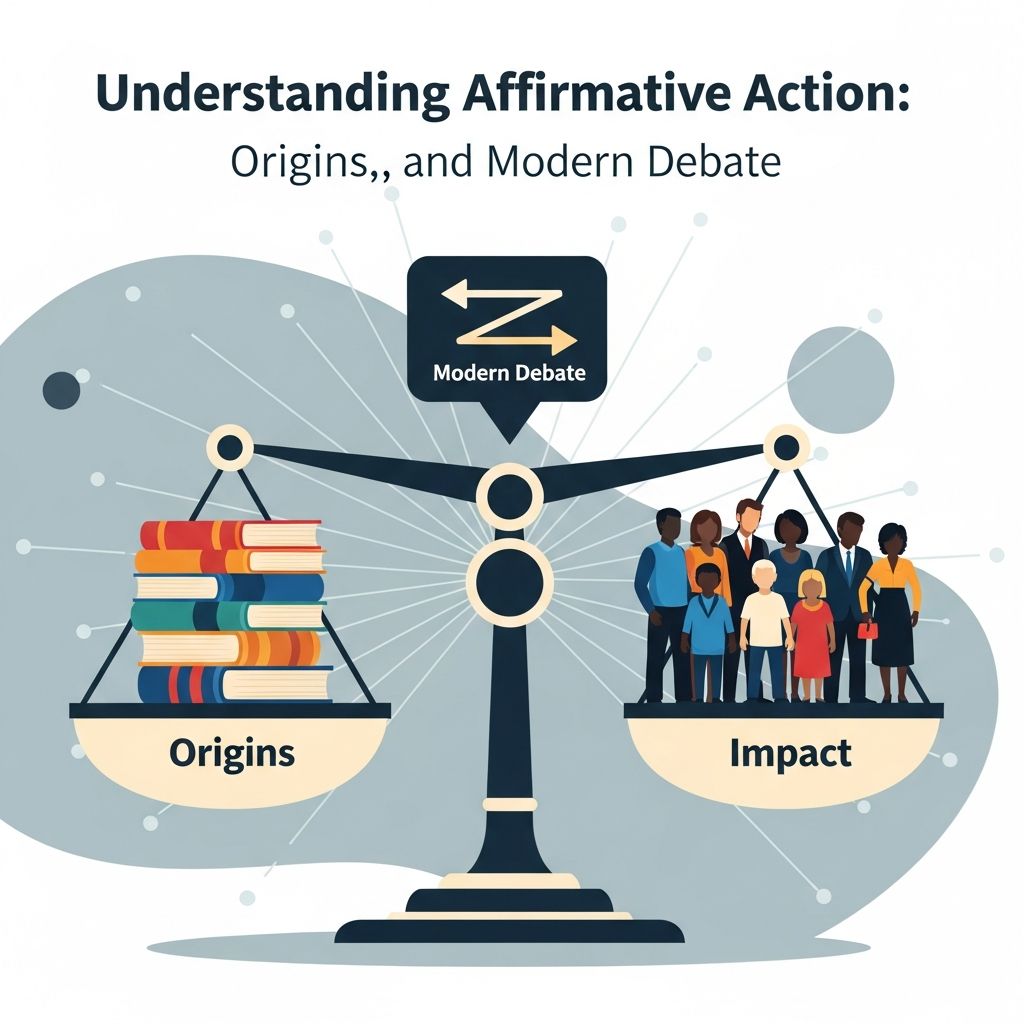
The Foundation and Evolution of Equal Opportunity Initiatives
Affirmative action represents one of the most significant and contentious policy interventions in American history. Born from the struggle for civil rights and equality, these initiatives emerged as a recognition that simply prohibiting discrimination was insufficient to remedy centuries of systemic exclusion. The concept evolved from the premise that historical injustices required proactive, deliberate measures to level an unequal playing field. Understanding affirmative action requires examining both its philosophical foundations and its practical applications across employment, education, and government contracting.
The trajectory of affirmative action reflects broader American conversations about justice, opportunity, and the proper role of government in addressing historical wrongs. From its initial framing as a tool for non-discrimination to its transformation into a comprehensive policy framework, affirmative action has consistently prompted debate about fairness, merit, and the methods by which society should pursue equality.
Setting the Stage: Pre-Civil Rights Era Efforts
The roots of affirmative action extend deeper than commonly recognized. During World War II, President Franklin Roosevelt issued an executive order prohibiting discrimination in the federal government and by defense contractors. This action, taken to prevent a planned march on Washington organized by labor leader A. Philip Randolph, established the first Fair Employment Practices Committee. However, these early compliance programs suffered from significant limitations: they were routinely understaffed, underfunded, and lacked meaningful enforcement authority. This initial attempt at addressing workplace discrimination would serve as a precursor to the more comprehensive initiatives that emerged two decades later.
The Catalyst: Civil Rights Movement and Kennedy Administration
The modern era of affirmative action began when President John F. Kennedy recognized that existing civil rights legislation alone could not dismantle entrenched discrimination. In 1961, Kennedy issued Executive Order 10925, which included the first official use of the term “affirmative action” in federal policy. The executive order required that government contractors “take affirmative action to ensure that applicants are employed, and employees are treated during employment, without regard to their race, creed, color, or national origin.”
Kennedy’s order represented a fundamental shift in governmental philosophy: from merely outlawing discrimination to actively promoting equal opportunity. The executive order reflected the understanding that marginalized groups—particularly African Americans, other racial and ethnic minorities, and women—had been systematically excluded from employment and advancement opportunities for generations. The initiative aimed to affirm the government’s commitment to ensuring that all qualified individuals, regardless of background, could compete fairly for positions within organizations receiving federal support.
Expansion Under Johnson: Building the Framework
President Lyndon B. Johnson substantially expanded affirmative action initiatives during his administration. Building on Kennedy’s foundation, Johnson issued Executive Order 11246 in 1965, which strengthened protections and extended them to federal contractors receiving government funds. This order required that “federal contractors not discriminate in employment and take affirmative action to ensure equal opportunity based on race, color, religion, and national origin.” Critically, Johnson’s administration established the Office of Federal Contract Compliance to enforce the order—an institutional mechanism designed to ensure compliance rather than relying solely on voluntary adherence.
The Civil Rights Act of 1964, enacted before Johnson’s executive order, had already prohibited employment discrimination by large employers with more than 15 employees and created the Equal Employment Opportunity Commission. This statutory framework, combined with subsequent executive actions, created a comprehensive legal structure addressing workplace discrimination. In 1967, Johnson issued Executive Order 11375, amending previous orders to include sex (gender) as a protected category. Later, the Rehabilitation Act of 1973 required federal agencies to submit affirmative action plans specifically addressing the hiring and advancement of individuals with disabilities.
Philosophical Rationale and Legal Justification
Affirmative action policies rest on several interconnected justifications. First, they acknowledge historical patterns of discrimination that created cumulative disadvantages persisting across generations. Second, they recognize that discrimination’s effects extend beyond individual instances to create systemic barriers that prohibit equal opportunity even when explicit discrimination ceases. Third, they embody the principle that diversity itself constitutes a compelling governmental interest worthy of consideration in institutional decision-making.
The legal framework supporting affirmative action draws from constitutional principles of equal protection and statutory protections established through civil rights legislation. The underlying assumption is that remedying discrimination requires more than passive non-discrimination; it demands active measures to identify and eliminate the vestiges of past exclusion. This represents a distinction between formal equality—treating everyone identically—and substantive equality—ensuring that all individuals have genuine opportunity to compete and succeed regardless of historical disadvantages.
Application Across Sectors and Institutions
Affirmative action policies extend across multiple domains, though each sector developed distinct mechanisms and standards. In federal employment and contracting, agencies establish hiring goals and monitor progress toward increasing representation of protected groups. Educational institutions, particularly colleges and universities, have implemented affirmative action primarily through admissions processes, considering applicants’ racial or ethnic background as one among many factors.
The implementation approaches vary significantly:
- Federal contractors use numerical goals and timetables for hiring and promotion of underrepresented groups
- Universities consider race as a “plus factor” in holistic admissions reviews rather than rigid quotas
- Government agencies establish specific recruitment and advancement plans for protected classes
- Private employers receiving federal funds adjust hiring practices to achieve broader workforce diversity
- Professional licensing boards and credential-granting organizations review their barriers to entry for historically excluded groups
Judicial Scrutiny and Legal Challenges
Supreme Court jurisprudence regarding affirmative action has undergone significant evolution, often narrowing the scope and permissible mechanisms. One landmark case, Regents of the University of California v. Bakke (1978), involved Allan Bakke, a white applicant who challenged UC’s medical school admissions policy that set aside specific seats for minority applicants. This case marked a turning point, signaling that even well-intentioned affirmative action programs might face constitutional vulnerability if structured as rigid quotas.
The Supreme Court began imposing substantial restrictions on race-based affirmative action beginning in 1989. The Court gave greater weight to reverse discrimination claims, outlawed minority set-asides where prior discrimination could not be demonstrated, and applied stricter scrutiny to state and local programs than to federal ones. In Adarand Constructors v. Pena (1995), the Court ruled that federal affirmative action programs must fulfill a “compelling governmental interest” to survive constitutional challenge.
The Bollinger cases (2003), involving University of Michigan admissions, presented a more nuanced outcome. In Grutter v. Bollinger, the Court reaffirmed that institutions could consider race in admissions to promote diversity, but in Gratz v. Bollinger, it struck down the university’s undergraduate policy that awarded points based on race, holding that race could not be the preeminent factor. These decisions suggested that while affirmative action remained constitutional, its implementation faced increasingly demanding requirements.
Measurable Outcomes and Institutional Impact
Research on affirmative action’s effectiveness reveals significant but contested results. When affirmative action policies were actively implemented, particularly in higher education, Black student enrollment increased substantially. At UC Berkeley, for example, Black enrollment more than doubled from 3.6% in 1980 to 6.7% in 1995. However, after California implemented a statewide ban on affirmative action in 1997, these gains reversed, demonstrating the policies’ tangible effects on representation.
The contrast between UC Berkeley and Stanford University illustrates how policy scope affects outcomes. Berkeley, as a public institution, fell under the state’s affirmative action ban, while Stanford, as a private university, could maintain its programs. This differential impact demonstrates that affirmative action policies directly influence institutional demographics and opportunity structures.
| Time Period | Policy Development | Primary Focus |
|---|---|---|
| 1961 | Executive Order 10925 | Government contractors; federal employment |
| 1964 | Civil Rights Act | Private employers; creation of EEOC |
| 1965 | Executive Order 11246 | Expanded contractor requirements; established enforcement office |
| 1967 | Executive Order 11375 | Added gender as protected category |
| 1973 | Rehabilitation Act | Individuals with disabilities |
| 1978 | Bakke Case | Limited quota-based approaches in education |
| 1995 | Adarand Case | Applied strict scrutiny to federal programs |
| 2003 | Bollinger Cases | Permitted race consideration but limited rigid point systems |
Ongoing Debate and Contemporary Challenges
Affirmative action remains deeply controversial. Proponents argue that historical discrimination continues affecting opportunity structures and that these policies remain necessary to achieve genuine equal opportunity. They point to persistent disparities in wealth, educational access, and employment outcomes correlating with race and gender. Supporters contend that selective institutions benefit from diverse student bodies and that targeted recruitment addresses historical exclusion.
Critics contend that affirmative action constitutes reverse discrimination, penalizing individuals for historical wrongs they did not personally commit. Some argue that class-based rather than race-based approaches would better address disadvantage while avoiding racial classifications. Others question whether affirmative action achieves its intended goals or whether alternative mechanisms might prove more effective.
Legislative and electoral challenges continue limiting affirmative action’s scope. Multiple states have passed measures restricting or eliminating affirmative action policies, particularly in higher education. These restrictions reflect ongoing political disagreement about whether historical remedies remain justified and what mechanisms best serve equality objectives.
Distinctions Between Affirmative Action and Non-Discrimination
A crucial distinction separates affirmative action from mere non-discrimination. Civil rights legislation forbade employers from considering race, color, religion, or national origin in hiring and promotion decisions. Affirmative action goes further, requiring active recruitment and consideration of historical underrepresentation in workforce composition. This represents a philosophical shift from “ignore race” to “address historical racial exclusion.” Non-discrimination policies assume a level playing field; affirmative action acknowledges that historical barriers created unequal starting points requiring corrective intervention.
Frequently Asked Questions
Q: What is the fundamental difference between Executive Order 10925 and Executive Order 11246?
A: Executive Order 10925 (1961) first introduced the term “affirmative action” and required government contractors to ensure equal treatment regardless of race, color, religion, or national origin. Executive Order 11246 (1965) expanded these requirements, applied them more broadly to federal contractors, and established the Office of Federal Contract Compliance to enforce compliance through an institutional mechanism rather than relying on voluntary adherence.
Q: Why did initial civil rights legislation prove insufficient without affirmative action?
A: Anti-discrimination laws alone could not overcome entrenched patterns of exclusion and historical disadvantage. After decades of discrimination, minorities and women faced cumulative barriers including inferior educational preparation, social networks excluding them from opportunity information, and employer biases despite legal prohibitions. Affirmative action aimed to actively remediate these structural disadvantages.
Q: How did the Bakke case change affirmative action policies?
A: Bakke v. Regents of the University of California established that rigid quota systems reserving specific seats for minorities could violate equal protection principles. This decision required universities to use more flexible approaches considering race as one factor among many rather than mechanical set-asides, fundamentally altering permissible implementation mechanisms.
Q: What impact did California’s 1997 affirmative action ban demonstrate?
A: The reversal of Black enrollment gains at UC Berkeley following the state’s affirmative action ban provided empirical evidence that these policies directly affected institutional representation. Black enrollment declined significantly after the ban’s implementation, while Stanford University, exempted as a private institution, maintained its programs and demographic diversity.
Q: Do affirmative action policies apply only to racial minorities?
A: No. Through successive executive orders and legislation, affirmative action protections expanded to include women (1968), and individuals with disabilities (1973). Executive Order 11375 specifically added gender as a protected category. This expansion reflected recognition that historical discrimination affected multiple groups requiring remedial attention.
Q: What is “reverse discrimination” and how does it relate to affirmative action legal challenges?
A: “Reverse discrimination” refers to claims that affirmative action policies disadvantage individuals—typically white applicants or those from non-protected groups—by considering race in decision-making. Courts have increasingly given weight to such claims, particularly following 1989 decisions, requiring affirmative action programs to demonstrate compelling governmental interest rather than merely addressing general past discrimination.
References
- A Brief History of Affirmative Action and the Assault on Race-Conscious Admissions — Ed Trust. 2024. https://edtrust.org/blog/a-brief-history-of-affirmative-action-and-the-assault-on-race-conscious-admissions/
- Affirmative Action: History and Rationale — Clinton White House Archives, Office of Management and Budget. https://clintonwhitehouse3.archives.gov/WH/EOP/OP/html/aa/aa02.html
- Affirmative Action | Definition, History, & Cases — Britannica. 2024. https://www.britannica.com/topic/affirmative-action
- A Brief History of Affirmative Action — Office of Equal Opportunity and Diversity, University of California, Irvine. https://www.oeod.uci.edu/policies/aa_history.php
- The Legacy and Opportunity of Affirmative Action — Thurgood Marshall Institute for the Advancement of Justice. 2023. https://tminstituteldf.org/wp-content/uploads/2023/06/Affirmative-action-article_PDF-final-1.pdf
- The Case for Affirmative Action — Harvard Graduate School of Education. 2018. https://www.gse.harvard.edu/ideas/usable-knowledge/18/07/case-affirmative-action

Medha Deb is an editor with a master's degree in Applied Linguistics from the University of Hyderabad. She believes that her qualification has helped her develop a deep understanding of language and its application in various contexts. Medha specializes in the areas of beauty, health, sports, and wellness and is committed to ensuring that the content on the website is…