
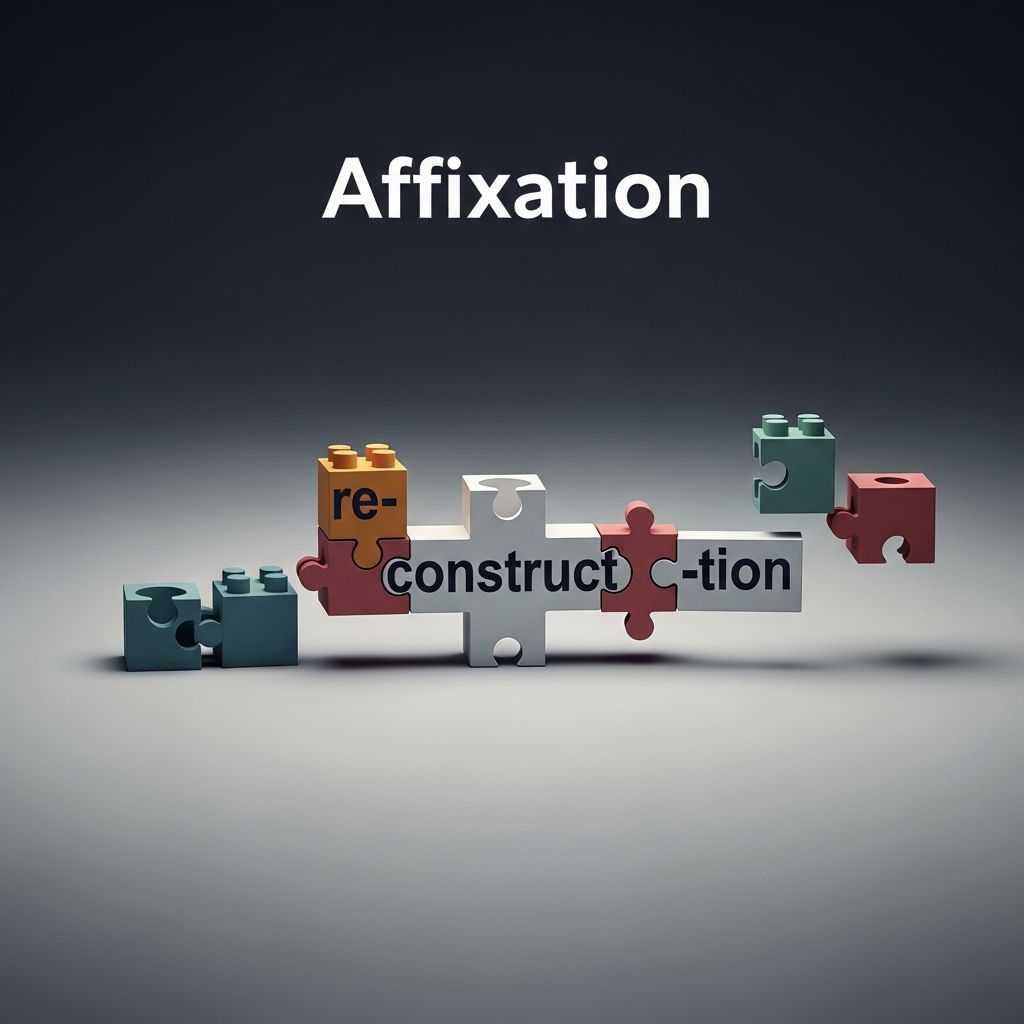
Affixation stands as one of the primary mechanisms in morphology, the study of word structure, where bound morphemes—known as affixes—are added to a base or root to generate new words or adjust grammatical features. This process enables languages to express complex ideas efficiently by modifying existing lexical items.
Understanding the Basics of Morphological Affixation
At its core, an affix is a dependent linguistic unit that cannot stand alone and must attach to a free morpheme, such as a root word, to convey additional meaning or grammatical information. Unlike roots, which carry the primary semantic load, affixes refine or expand upon this core meaning. Linguists define affixation as the attachment of these bound forms to a morphological base, a practice nearly universal across human languages.
This morphological strategy contrasts with other word-formation methods like compounding or conversion, focusing instead on linear or internal modifications. Affixation’s versatility allows it to serve both creative (derivational) and structural (inflectional) roles, making it indispensable for vocabulary growth and sentence construction.
Core Types of Affixes and Their Positions
Affixes are classified primarily by their position relative to the base word. The most prevalent types are prefixes and suffixes, with rarer forms including infixes, circumfixes, and suprafixes.
- Prefixes: These attach to the front of the base, altering meaning without changing part of speech in many cases. For instance, adding ‘re-‘ to ‘do’ yields ‘redo,’ implying repetition.
- Suffixes: Positioned at the end, they often shift grammatical categories or indicate plurality, tense, or degree. ‘Happy’ becomes ‘happiness’ with ‘-ness,’ turning an adjective into a noun.
- Infixes: Inserted within the base, these are uncommon in English but appear in languages like Tagalog. Colloquial English may mimic this with expletives, as in ‘abso-bloody-lutely’.
- Circumfixes: Bracket the base with parts before and after, seen in languages like German (e.g., ‘ge-komm-en’ for past participle).
- Suprafixes: Change word form via stress or tone shifts, rare and prosodically driven.
Prefixes and suffixes dominate, with suffixation more common globally due to languages’ tendency toward rightward affix growth. Multiple affixes can stack, as in ‘un-re-lockable,’ where ‘un-‘, ‘re-‘, and ‘-able’ layer meanings.
Derivational vs. Inflectional Affixes: Key Distinctions
Affixes split into two functional categories: derivational and inflectional. Derivational affixes create entirely new words by changing meaning or category, such as ‘dis-‘ in ‘disagree’ (verb to verb with negation) or ‘-ly’ in ‘quickly’ (adjective to adverb). These are productive, fueling lexicon expansion.
Inflectional affixes, conversely, adapt words to syntactic contexts without lexical innovation—think plural ‘-s’ in ‘cats’ or past tense ‘-ed’ in ‘walked.’ English limits inflection to suffixes, with eight main ones: plurals, possessives, third-person singular, past tense, past participle, present participle, comparatives, and superlatives.
| Type | Function | English Examples | Effect |
|---|---|---|---|
| Derivational | New word creation | un-happy, teach-er | Changes meaning/category |
| Inflectional | Grammatical agreement | cat-s, walk-ed | Fits syntax, no new lexicon |
This table highlights how derivational affixes innovate while inflectional ones conform.
Affixation in the English Language: Patterns and Productivity
English relies heavily on affixation, blending Germanic and Latinate influences. Germanic prefixes like ‘for-‘ (forbid) coexist with Latinate ones like ‘pre-‘ (predict). Suffixes abound: nominalizers (‘-ment,’ ‘-tion’), adjectivizers (‘-able,’ ‘-ic’), and adverbial ‘-ly’.
Productivity varies; ‘-ness’ readily forms nouns from adjectives (e.g., ‘kindness’), while others like ‘-th’ (truth) are fossilized. Prefixes like ‘un-‘ generate antonyms prolifically (e.g., ‘unhappy,’ ‘unlock’). Order matters: in ‘unhappiness,’ ‘un-‘ precedes ‘-ness,’ following English’s prefix-suffix hierarchy.
Challenges arise with homophones or spelling shifts, like ‘decide/decision’ where the root adapts. Yet, affixation enriches English’s 170,000+ words, adapting to modern needs (e.g., ’email’ spawning ‘e-commerce’).
Cross-Linguistic Perspectives on Affixation
While English favors prefixes and suffixes, other languages showcase affixation’s diversity. Agglutinative tongues like Turkish string multiple suffixes: ‘ev-ler-im-de’ (in my houses). Polysynthetic languages like Inuktitut embed dozens of affixes in single words.
Prefix-heavy Bantu languages contrast suffix-dominant Indo-European ones. Infixation thrives in Austronesian languages, and circumfixes mark German perfectives. Non-promiscuity defines true affixes: they target specific root classes (nouns, verbs, adjectives), distinguishing them from clitics.
Even tone languages use suprafixes, altering pitch for grammar. This variation underscores affixation’s adaptability, processing sequences vital for language acquisition.
Cognitive and Neurolinguistic Dimensions
Research reveals affixation engages sequence processing in the brain, mirroring grammatical morpheme handling. Native speakers decompose complex words online, recognizing ‘walked’ as ‘walk + -ed’.
Children acquire affixes early, overgeneralizing (e.g., ‘tooths’). Bilinguals navigate varied systems, enhancing metalinguistic awareness. Affixation thus bridges cognition and communication.
Practical Applications in Language Learning and Analysis
For learners, mastering affixes unlocks vocabulary: knowing ‘bio’ (life) yields ‘biology,’ ‘biography.’ Teachers use affix trees to dissect words, boosting spelling and comprehension.
In computational linguistics, affix rules power stemmers for search engines. Forensic linguists analyze affix patterns for authorship. Affixation remains a cornerstone of linguistic analysis.
Frequently Asked Questions (FAQs)
What is the main difference between prefixes and suffixes?
Prefixes attach before the root (e.g., ‘rewrite’), while suffixes follow it (e.g., ‘writer’), each modifying meaning or grammar differently.
Can English have infixes?
Rarely in standard use, but colloquial insertions like ‘fan-fucking-tastic’ mimic infixation for emphasis.
How does affixation differ from compounding?
Affixation adds bound morphemes to one root; compounding joins free morphemes (e.g., ‘blackboard’).
Why are suffixes more common than prefixes globally?
Many languages append material rightward, favoring suffixation for phonological and syntactic reasons.
Are all affixes productive in modern English?
No; some like ‘-dom’ (freedom) are less active than ‘-able’ (readable).
References
- Affixation patterns in native language and sequence processing — PMC/NCBI. 2020-11-01. https://pmc.ncbi.nlm.nih.gov/articles/PMC7617444/
- What is an affix? A fresh attempt — Diversity Linguistics Comment. 2017-04-12. https://dlc.hypotheses.org/1664
- Affixation in English — Linguistics Network. 2023-01-15. https://www.linguisticsnetwork.org/affixation-in-english/
- Affixation in Morphology — Oxford Research Encyclopedia of Linguistics. 2024-05-20. https://academic.oup.com/edited-volume/61882/chapter/547670787
- Affixes – The Linguistic Analysis of Word and Sentence Structures — Open Educational Resource (Pressbooks). 2022-08-10. https://pressbooks.openedmb.ca/wordandsentencestructures/chapter/affixes/

Medha Deb is an editor with a master's degree in Applied Linguistics from the University of Hyderabad. She believes that her qualification has helped her develop a deep understanding of language and its application in various contexts. Medha specializes in the areas of beauty, health, sports, and wellness and is committed to ensuring that the content on the website is…