
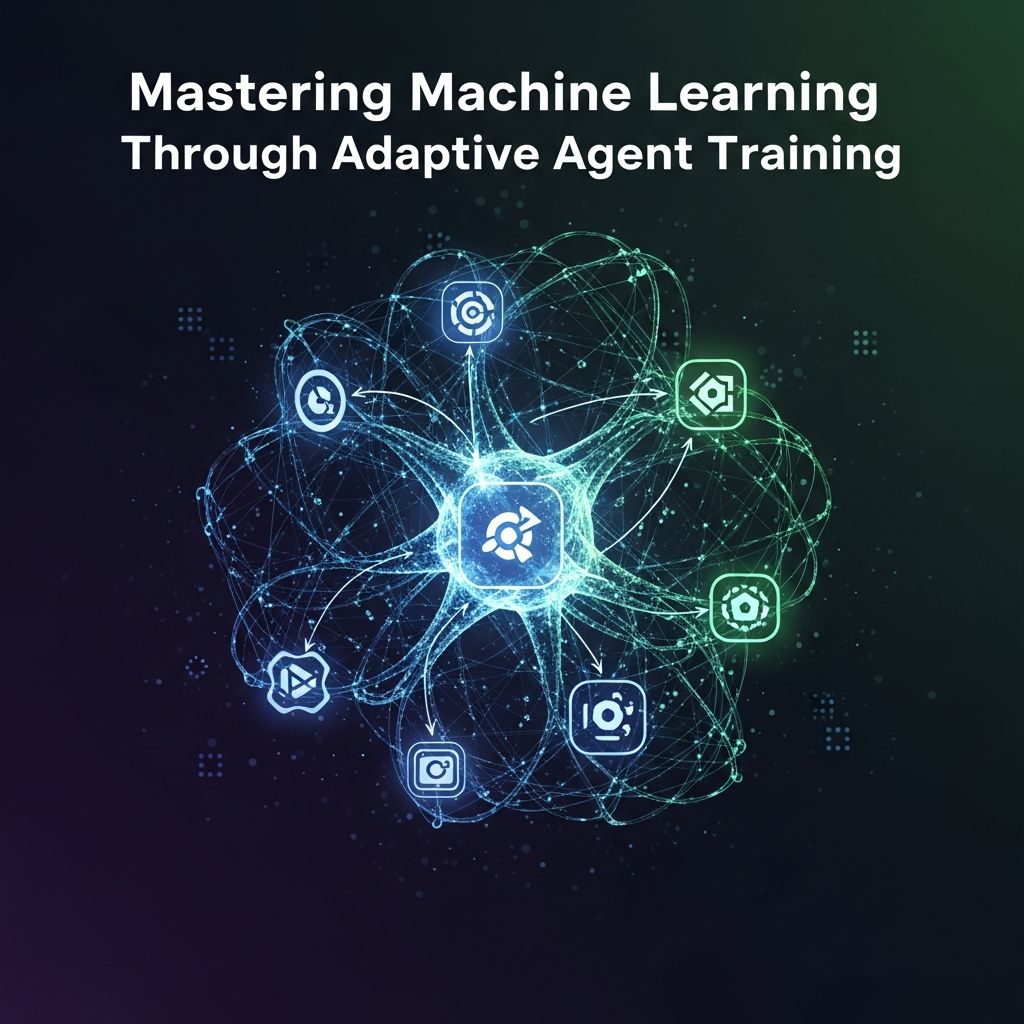
Understanding Agent-Based Machine Learning Systems
Machine learning has evolved significantly over the past decade, introducing multiple paradigms for teaching computers to solve complex problems. Among these approaches, agent-based learning stands out as a particularly powerful methodology for scenarios where predefined solutions cannot be easily specified. Unlike supervised learning, which relies on labeled datasets with explicit correct answers, agent-based systems discover optimal behaviors through direct interaction with their environments. This fundamental shift in learning methodology enables machines to operate effectively in dynamic, unpredictable settings where human intervention would be impractical or impossible.
The core principle behind agent-based learning involves an entity—the agent—making sequential decisions within a defined environment, receiving feedback that evaluates the quality of those decisions. This feedback mechanism, typically expressed through numerical rewards or penalties, guides the agent toward increasingly better decision-making strategies. Over time, through repeated interactions and systematic refinement, agents develop sophisticated behaviors that maximize long-term success, even when individual short-term decisions might appear suboptimal.
The Essential Components of Agent-Driven Learning Systems
Effective agent-based learning systems comprise several interconnected elements that work together to enable autonomous learning:
The Agent: The Decision-Making Entity
An agent represents the active component of the learning system—the entity responsible for perceiving environmental conditions and executing actions. Agents can manifest in various forms, from software algorithms controlling robotic systems to digital entities navigating virtual game worlds. The agent’s fundamental responsibility involves analyzing current environmental conditions, selecting appropriate actions, and adapting its behavior based on received feedback.
Environmental State and Transitions
The environment encompasses all external conditions that influence agent behavior and performance. States represent specific configurations or snapshots of the environment at particular moments. When an agent takes an action, the environment transitions to a new state, which may differ in subtle or dramatic ways from the previous condition. These state transitions form the basis of the learning process, as agents observe how their actions influence environmental evolution.
Action Selection and Execution
Actions represent the discrete choices available to the agent at any given moment. The set of possible actions varies depending on the specific problem domain. In autonomous vehicle scenarios, actions might include acceleration, deceleration, and directional steering. In game-playing contexts, actions could represent different move possibilities. The agent’s challenge involves determining which action to select from available options to achieve long-term success.
Feedback Mechanisms and Reward Signals
The reward signal provides crucial evaluative feedback following each action execution. Rewards can be positive (encouraging future similar behavior), negative (discouraging particular actions), or neutral (indicating neither particularly good nor bad outcomes). This numerical feedback directly influences how the agent updates its understanding and refines its decision-making strategies. Without clear reward signals, agents lack the necessary guidance to learn effectively.
Behavioral Strategies and Policies
A policy represents the complete decision-making strategy that an agent employs—essentially the mapping between environmental states and appropriate actions. Policies can range from simple rule-based systems to complex computational models incorporating neural networks. The ultimate objective in agent-based learning involves discovering or developing an optimal policy that maximizes cumulative rewards while navigating the specific problem domain.
The Iterative Learning Process Through Trial and Refinement
Agent-based learning operates through a cyclical feedback loop that continuously repeats throughout the training process:
- Observation: The agent analyzes the current environmental state and identifies relevant information
- Action Selection: Based on its current policy or strategy, the agent chooses and executes an action
- Environmental Response: The environment transitions to a new state and provides reward feedback
- Strategy Refinement: The agent updates its understanding and policy based on the received reward and new state information
- Iteration: The cycle repeats continuously, with the agent progressively improving its decision-making
This trial-and-error approach enables agents to discover effective strategies without explicit programming of correct behaviors. The agent experiments with different actions, observes consequences, and gradually learns which decisions lead to favorable outcomes.
Foundational Computational Approaches in Agent Learning
Several well-established computational methodologies form the theoretical foundation for modern agent-learning systems. Understanding these approaches provides insight into how different algorithms operate and why particular methods suit specific problem types.
Dynamic Programming Methods
Dynamic programming approaches to agent learning leverage complete knowledge of environmental dynamics. These methods break complex problems into smaller subproblems, solving them sequentially and building upon previous solutions. While theoretically powerful, dynamic programming requires comprehensive understanding of how actions influence state transitions and associated rewards—information often unavailable in real-world scenarios.
Monte Carlo Methodologies
Monte Carlo methods learn from complete sequences of experiences, averaging outcomes across multiple simulation or actual runs. These approaches don’t require a model of environmental dynamics but instead learn from observed trajectories. Monte Carlo methods provide unbiased estimates but may require substantial computational resources and longer training periods.
Temporal Difference Learning
Temporal difference learning combines advantages of both dynamic programming and Monte Carlo approaches. These methods learn continuously from experience without requiring complete trajectories, updating knowledge based on comparisons between successive state predictions. Temporal difference methods offer efficient learning with good convergence properties, making them widely applicable across diverse problem domains.
Classical and Modern Algorithmic Approaches
Contemporary agent-based learning systems employ numerous algorithms, each with distinct characteristics, strengths, and appropriate application contexts:
Q-Learning: Value-Based Decision Making
Q-Learning represents one of the foundational algorithms in agent-based learning, focusing on estimating the value of specific actions within particular states. The algorithm iteratively updates Q-values—numerical estimates of action quality—gradually converging toward optimal strategies. Q-Learning operates without requiring a model of environmental dynamics, making it applicable to diverse real-world scenarios where complete environmental knowledge is unavailable.
Deep Q-Networks: Scaling to Complex Problems
Deep Q-Networks (DQN) extend Q-Learning by incorporating deep neural networks, enabling application to problems with vast state spaces or continuous state variables. By using neural networks to approximate Q-values rather than maintaining explicit tables, DQN handles significantly more complex problem domains than traditional Q-Learning. This architectural innovation has enabled breakthroughs in areas like video game playing and robotic control.
Balancing Exploration and Exploitation Dynamics
A fundamental challenge in agent-based learning involves navigating the exploration-exploitation trade-off. Exploitation refers to leveraging known good actions based on previous learning, while exploration involves testing novel actions to potentially discover superior strategies. Agents must balance these competing objectives: excessive exploitation leads to suboptimal policies if initial learning proves incomplete, while excessive exploration wastes computational resources testing inferior actions.
Various strategies address this challenge, including epsilon-greedy approaches that occasionally select random actions, uncertainty-based methods that prioritize unexplored options, and sophisticated algorithms that adaptively adjust the exploration-exploitation balance as learning progresses.
Practical Implementation Considerations
Successfully developing effective agent-learning systems requires attention to numerous practical considerations beyond theoretical algorithm selection:
Experimental Methodology and Rigor
Agent-based learning systems exhibit inherent variability due to environmental stochasticity and algorithmic randomness. Reliable evaluation requires running experiments multiple times with different random seeds, allowing training to proceed sufficiently long to observe stable performance trends. Relying on single experimental runs or premature training termination produces misleading conclusions about algorithm effectiveness.
Iterative Algorithm Selection and Prototyping
Rather than immediately implementing complex algorithms on full-scale problems, successful practitioners begin by testing multiple approaches on simplified or reduced-scale versions. This preliminary experimentation identifies promising methods without excessive computational expenditure, helping avoid costly dead-ends during development.
Reward Function Design
The reward function critically influences agent behavior and learning efficiency. Poorly designed rewards can lead to unintended behaviors or slow learning convergence. Effective reward design requires careful consideration of long-term objectives while providing sufficient short-term guidance to shape learning trajectories.
Computational Resource Management
Agent training can consume substantial computational resources, particularly for complex problems requiring extensive environmental interaction. Efficient implementation involves careful attention to algorithmic efficiency, parallel processing where applicable, and strategic problem decomposition.
Real-World Applications Across Diverse Domains
Agent-based learning has proven transformative across numerous practical applications:
Autonomous Systems: Self-driving vehicles learn to navigate safely through complex urban environments, learning appropriate responses to diverse situations including pedestrian detection, traffic rule compliance, and collision avoidance.
Game Playing: Agents achieve superhuman performance in increasingly complex games, from classic board games to modern video games requiring real-time decision-making and strategic planning.
Robotics: Robotic systems learn manipulation tasks, locomotion strategies, and environmental navigation without explicit programming of motor control sequences.
Resource Optimization: Systems learn to optimize resource allocation, energy consumption, and operational efficiency across manufacturing, logistics, and utility management domains.
Advantages and Limitations of Agent-Based Learning
Agent-based learning paradigms offer significant advantages for specific problem classes while presenting particular challenges:
| Characteristic | Advantages | Limitations |
|---|---|---|
| Dynamic Environments | Excels in changing, unpredictable conditions where predefined solutions fail | Requires continuous learning and potential instability |
| Data Requirements | Learns from interaction rather than requiring large labeled datasets | May require extensive interaction for complex problems |
| Problem Specification | Discovers solutions without explicit algorithmic design | Requires careful reward function design |
| Scalability | Can handle large state spaces with neural network approximation | Computational requirements increase substantially with problem complexity |
Frequently Asked Questions
Q: How does agent-based learning differ from supervised learning?
A: Supervised learning learns from labeled examples with explicit correct answers, while agent-based learning discovers optimal behaviors through environmental interaction and reward feedback without labeled training data.
Q: What makes reward function design critical in agent systems?
A: Reward functions guide agent learning by providing numerical feedback for each action. Poorly designed rewards lead to unintended behaviors or inefficient learning, while well-designed rewards efficiently shape agent behavior toward desired objectives.
Q: Can agent-based systems learn in real-time environments?
A: Yes, certain algorithms particularly excel in real-time learning scenarios. Temporal difference methods and modern deep reinforcement learning approaches can learn continuously from ongoing environmental interaction without requiring complete trajectory information.
Q: How long does agent training typically require?
A: Training duration varies substantially depending on problem complexity, reward structure clarity, and available computational resources. Simple problems may require hours, while complex scenarios may need days or weeks of continuous training.
Q: What role does the exploration-exploitation trade-off play?
A: This fundamental tension determines how agents balance testing new actions against using known effective strategies. Proper balance ensures agents discover superior policies while efficiently utilizing computational resources.
References
- Reinforcement Learning: A Guide to AI’s Interactive Learning Paradigm — Weights & Biases. 2024. https://wandb.ai/site/articles/reinforcement-learning-rl/
- Guide to Reinforcement Learning — Serokell. 2024. https://serokell.io/blog/reinforcement-learning-guide
- What is Reinforcement Learning? — GeeksforGeeks. 2024. https://www.geeksforgeeks.org/machine-learning/what-is-reinforcement-learning/
- Part 1: Key Concepts in RL — OpenAI Spinning Up. https://spinningup.openai.com/en/latest/spinningup/rl_intro.html

- Integrated M.A. in Applied Linguistics, University of Hyderabad
- 5+ years in editorial, instructional, SEO, and research-based writing
Sneha is a relationships and lifestyle writer with a strong foundation in applied linguistics and certified training in relationship coaching. She brings over five years of writing experience to theskillvault, crafting thoughtful, research-driven content that empowers readers to build healthier relationships, boost emotional well-being, and embrace holistic living. Her writing and insights reflect the belief that beauty, happiness, and wellness…