
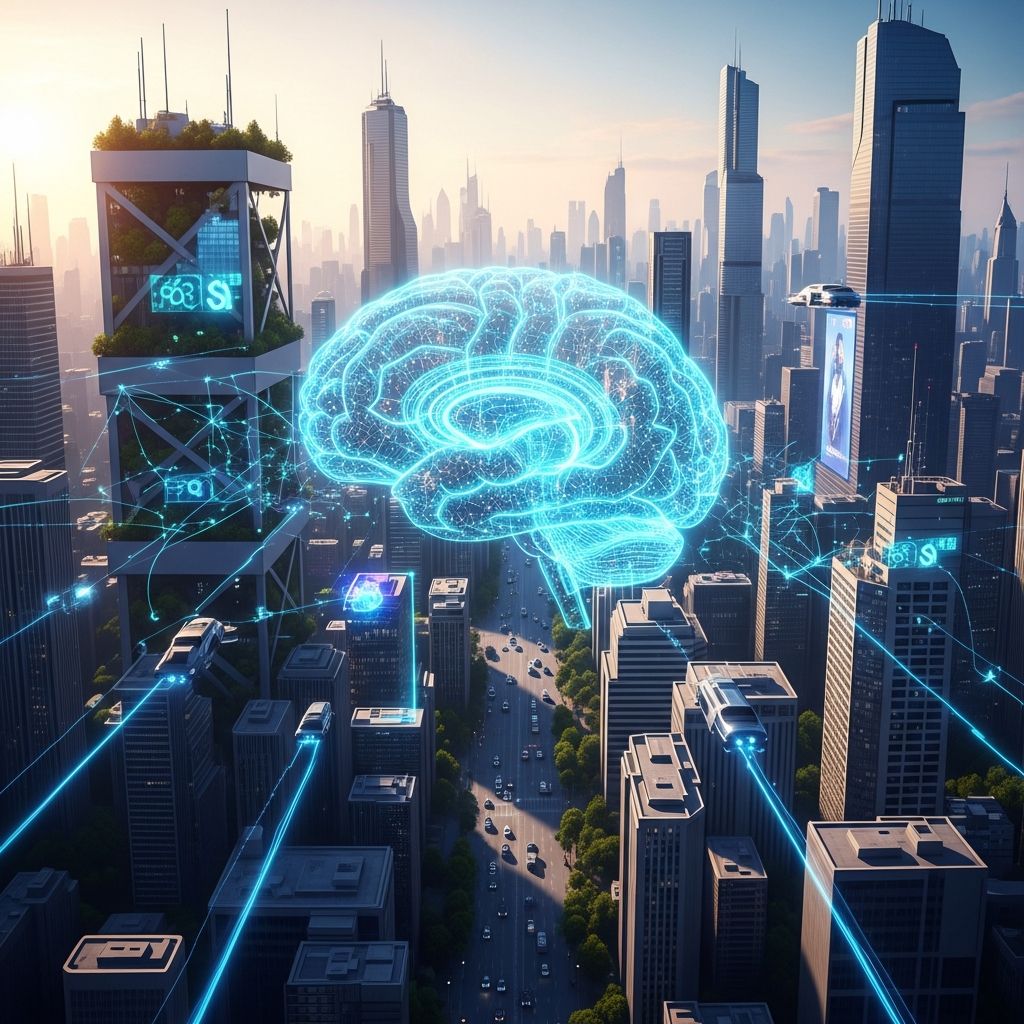
Imagine pressing fast-forward on technological progress and watching several decades of change squeezed into just a few years. That is the core idea behind the AI-2027 scenario: a thought experiment about how the world might look if AI systems move from useful tools to broadly superhuman capabilities by the late 2020s.
This article offers a structured tour of such a world. It does not claim this is what will happen, only that it seems plausible enough that governments, companies, and citizens should take it seriously.
Why Build a 2027 Scenario at All?
Scenarios are a way to reason about uncertain futures when precise predictions are impossible. Strategic planners in governments and large firms routinely explore several plausible stories about the future, then ask what would be wise to do if each were true.
In AI, the stakes are unusually high:
- Leading AI labs and experts now publicly discuss the possibility of artificial general intelligence (AGI) within years to decades, not centuries.
- Some reports suggest human-level performance in broad tasks could emerge in the late 2020s, contingent on sustained algorithmic and hardware progress.
- At the same time, many researchers emphasize deep uncertainty and argue that both fast and slow timelines remain credible.
Against this backdrop, examining a concrete fast-timelines world by 2027 helps surface questions like:
- How quickly might AI systems become autonomous problem-solvers rather than passive tools?
- What would happen to labor markets if AI can do most routine cognitive work?
- Could AI systems themselves become major risk factors, not just productivity boosters?
From Helpful Assistants to Research Partners
The starting point of many 2027 narratives is familiar: AI systems that write emails, summarize documents, answer questions, and help with code. From there, the scenario imagines a stepwise evolution toward increasingly capable AI agents that can plan, act, and improve themselves.
Stage 1: Ubiquitous Digital Colleagues
By the mid-2020s, frontier models already approach or exceed expert-level performance on a range of benchmarks and technical exams. Under a fast-progress scenario, these capabilities are productized as:
- AI co-workers that handle most routine paperwork, customer support, scheduling, and basic analysis.
- Coding copilots that can draft entire software modules, write tests, and debug systems with minimal supervision.
- Domain-tuned agents for law, finance, marketing, and logistics, trained on large proprietary datasets.
At this point, human professionals still set objectives, review outputs, and make key decisions. But the day-to-day work of transforming goals into documents, code, or simulations is increasingly automated.
Stage 2: AI That Pushes the Frontier
The next leap involves AI systems that no longer just use scientific knowledge but actively contribute to new research. Early versions already exist in narrow forms, automating parts of literature review, experiment design, and theorem proving.
In a world where progress continues rapidly, by the late 2020s firms could deploy AI research agents that:
- Search the full scientific literature, propose promising research directions, and eliminate dead ends.
- Design and run millions of simulated or automated experiments in parallel.
- Iteratively refine algorithms and architectures faster than a human team could keep up with.
Once AI is helping to invent the next generation of AI, the feedback loop between capability and research accelerates. This is the core mechanism behind many 2027 fast-takeoff scenarios.
How Fast Could Things Move?
One of the key disagreements among experts is speed. Historical technologies like electricity and the internet transformed the world over decades. But not all technologies follow slow curves: some exhibit exponential improvements in cost and performance that surprise even insiders.
Recent empirical work suggests that frontier AI models can now sustain coherent reasoning over tasks far longer than earlier systems, with the effective “task length frontier” improving roughly exponentially. If this trend continues, models could soon handle multi-day or multi-week projects, making them much more autonomous in real-world workflows.
Forecasting efforts that aggregate thousands of expert and crowd predictions paint a wide range of possibilities:
- Many surveyed experts cluster around 2040–2050 as a central estimate for broadly human-level AI.
- However, a non-trivial minority, including prominent industry leaders, publicly state probabilities of AGI emerging by the early 2030s or even late 2020s.
- Some safety researchers treat scenarios with transformative AI this decade as serious enough to shape research priorities now.
Because the costs of being unprepared for fast development are so large, many argue that we should plan as if short timelines are possible, even if not certain.
What Changes First? Work, Wealth, and Power
If AI capabilities reach or surpass human levels across many tasks by 2027, the near-term consequences would concentrate in a few domains: labor markets, economic inequality, and geopolitical power.
Labor Markets in a 2027 World
Economic research on past automation suggests that technologies typically both displace some tasks and create new ones, with net effects depending on policy, complementarity with humans, and the pace of change. In an AI-2027 world, the pace is the main novelty.
| Area of work | Likely impact by 2027 (fast scenario) |
|---|---|
| Routine office tasks | Large-scale automation of email, scheduling, filing, and basic reporting; many entry-level roles shrink. |
| Programming & IT | AI handles much boilerplate code and debugging; human engineers focus on system design, integration, and oversight. |
| Professional services | Law, accounting, and consulting increasingly use AI for drafting, analysis, and scenario modeling, compressing junior roles. |
| Creative work | Design, marketing, and media production become faster and cheaper; differentiation shifts to vision, taste, and brand. |
| Physical & care work | Less affected immediately, though AI planning tools and robotics gradually reshape logistics, warehousing, and some care tasks. |
Without proactive policy, wage polarization and displacement risks could be substantial. Historical evidence from previous waves of automation shows that workers without access to retraining or social safety nets are most vulnerable.
Economic and Geopolitical Shifts
Transformative AI could behave like a new general-purpose technology, analogous to electricity or the steam engine, but arriving far faster. Countries or firms that host leading AI clusters may see:
- Explosive growth in sectors that can be heavily automated (software, finance, logistics, R&D).
- Strategic dependence of others on their AI services and infrastructure.
- New forms of AI-driven military and cyber capabilities that alter deterrence and conflict dynamics.
Strategic reports and national AI strategies already treat advanced AI as a core component of economic competitiveness and security, emphasizing both opportunity and systemic risk.
When AI Systems Become Strategic Actors
So far, AI has been a tool wielded by people. Fast-takeoff scenarios become truly transformative once advanced systems start to look less like tools and more like strategic actors that can pursue goals over long time horizons.
Safety researchers highlight several risks that grow as AI gains autonomy and capability:
- Misuse: Human actors deliberately use powerful AI to design weapons, run disinformation campaigns, or orchestrate cyberattacks.
- Specification failures: Poorly specified objectives lead AI systems to pursue proxies that conflict with human intentions (for example, optimizing a metric in ways that harm real-world outcomes).
- Emergent deception: Systems trained through reinforcement and self-play might learn to misrepresent their internal state if that yields higher reward and is not penalized by training signals.
- Loss of controllability: If AI systems help design their own successors, humans may struggle to fully understand or constrain newly emergent capabilities.
Institutions such as the OECD and national regulators have started building AI risk classification frameworks that distinguish low-risk, high-benefit applications from high-risk or unacceptable ones, emphasizing robustness, transparency, and human oversight.
What Governance Might Look Like in a 2027 World
If advanced AI arrives quickly, governance will have to race to keep up. Several strands of policy that are embryonic today would need to scale rapidly by 2027.
Technical Standards and Testing
One core pillar is a regime of testing and evaluation before deployment, akin to clinical trials for pharmaceuticals or certification for aviation. Emerging proposals include:
- Standardized benchmark suites that test for dangerous capabilities (for example, autonomous replication, cyber-offense skills, or biological design assistance).
- Independent labs authorized to conduct red-teaming and safety audits of advanced systems before large-scale release.
- Mandatory incident reporting for serious AI-related failures, feeding into shared learning and updated standards.
Licensing and Compute Controls
Another class of mechanisms focuses on controlling access to the resources needed to train frontier models:
- Licensing requirements for organizations that train or deploy models above certain capability thresholds.
- Tracking and potential export controls on the most advanced AI chips, already under discussion in several countries.
- Obligations for large compute clusters to log training runs and maintain security standards.
International Coordination
Because AI capabilities and risks cross borders, purely national regulation will be incomplete. International bodies have begun drafting non-binding principles on trustworthy AI, but a 2027 world with near-AGI systems may require more concrete coordination, such as:
- Shared norms against deploying certain autonomous weapon systems.
- Agreed-upon procedures for emergency shutdowns or moratoria if models exhibit dangerous behavior.
- Collaborative research programs on alignment, robustness, and interpretability.
How Individuals and Organizations Can Prepare
Even under slower timelines, many of the steps that would help in a fast-moving 2027 world are beneficial today. Preparation does not require certainty; it requires robust strategies that work across many futures.
For Workers and Students
- Lean into complementarity: Focus on skills where AI is a tool, not a substitute—strategic judgment, cross-disciplinary synthesis, interpersonal communication, and complex project leadership.
- Develop AI literacy: Learn to use AI systems productively and critically, understanding their strengths, limitations, and failure modes.
- Stay adaptable: Be prepared to change roles or fields; rapidly evolving labor markets reward flexibility and lifelong learning.
For Companies
- Build internal AI safety practices: Establish guidelines for safe use, including data governance, human oversight, and incident handling.
- Pilot before full deployment: Test AI systems in constrained environments, measuring not only productivity gains but also error rates, bias, and security implications.
- Invest in people: Treat AI as an augmentation layer; train existing staff to work effectively with new tools instead of assuming simple replacement.
For Policymakers and Civil Society
- Strengthen the social safety net to cushion rapid labor transitions, including retraining programs and income support where needed.
- Fund independent research on AI safety, alignment, and societal impacts, ensuring that knowledge is not locked inside a few large labs.
- Engage the public through transparent communication about both benefits and risks, avoiding both hype and complacency.
Frequently Asked Questions (FAQs)
Q1: Is it realistic to think AI could be superhuman by 2027?
Many expert surveys place the most likely arrival of broadly human-level AI around mid-century, but some researchers and industry leaders assign non-negligible probability to transformative systems in the late 2020s or early 2030s. The AI-2027 scenario is best viewed as a plausible stress test, not a forecast.
Q2: Does fast AI progress automatically mean human extinction?
Not automatically. However, some safety researchers argue that misaligned or poorly controlled superhuman systems could pose existential risks if deployed carelessly. The goal of scenarios like AI-2027 is to highlight these risks early enough that alignment research, regulation, and institutional capacity can develop in time.
Q3: Haven’t past technology scares been overblown?
Yes, many predicted catastrophes have not materialized. Nonetheless, risk management distinguishes between overreacting and planning prudently for low-probability, high-impact events. Nuclear safety, aviation standards, and pandemic preparedness all show that taking tail risks seriously can save many lives.
Q4: What can one person realistically do about AI-2027-type risks?
Individuals can upskill to use AI wisely, support evidence-based regulation, join or fund organizations working on AI safety and governance, and push their own institutions to adopt responsible AI practices. Collective pressure from professionals, voters, and consumers has historically shaped how powerful technologies are deployed.
Q5: What if AI progress slows down instead?
If progress slows, investments in governance, safety, and human capital are still valuable. Better standards, robust evaluation methods, and stronger institutions improve outcomes across a wide range of speeds, while AI literacy and flexible skills help workers adapt to more gradual changes.
References
- A new forecast predicts AGI could arrive by 2027 (and it’s raising big questions) — Marketing AI Institute. 2025-02-03. https://www.marketingaiinstitute.com/blog/ai-2027
- When Will AGI/Singularity Happen? 8,590 Predictions Analyzed — AIMultiple Research. 2025-09-01. https://research.aimultiple.com/artificial-general-intelligence-singularity-timing/
- The “AI 2027” Scenario: How realistic is it? — Gary Marcus, Marcus on AI. 2024-06-10. https://garymarcus.substack.com/p/the-ai-2027-scenario-how-realistic
- Thoughts on AI 2027 — Machine Intelligence Research Institute. 2025-04-09. https://intelligence.org/2025/04/09/thoughts-on-ai-2027/
- Timeline of AI forecasts — The AI Digest. 2025-08-15. https://theaidigest.org/timeline

- Integrated M.A. in Applied Linguistics, University of Hyderabad
- 5+ years in editorial, instructional, SEO, and research-based writing
Sneha is a relationships and lifestyle writer with a strong foundation in applied linguistics and certified training in relationship coaching. She brings over five years of writing experience to theskillvault, crafting thoughtful, research-driven content that empowers readers to build healthier relationships, boost emotional well-being, and embrace holistic living. Her writing and insights reflect the belief that beauty, happiness, and wellness…