
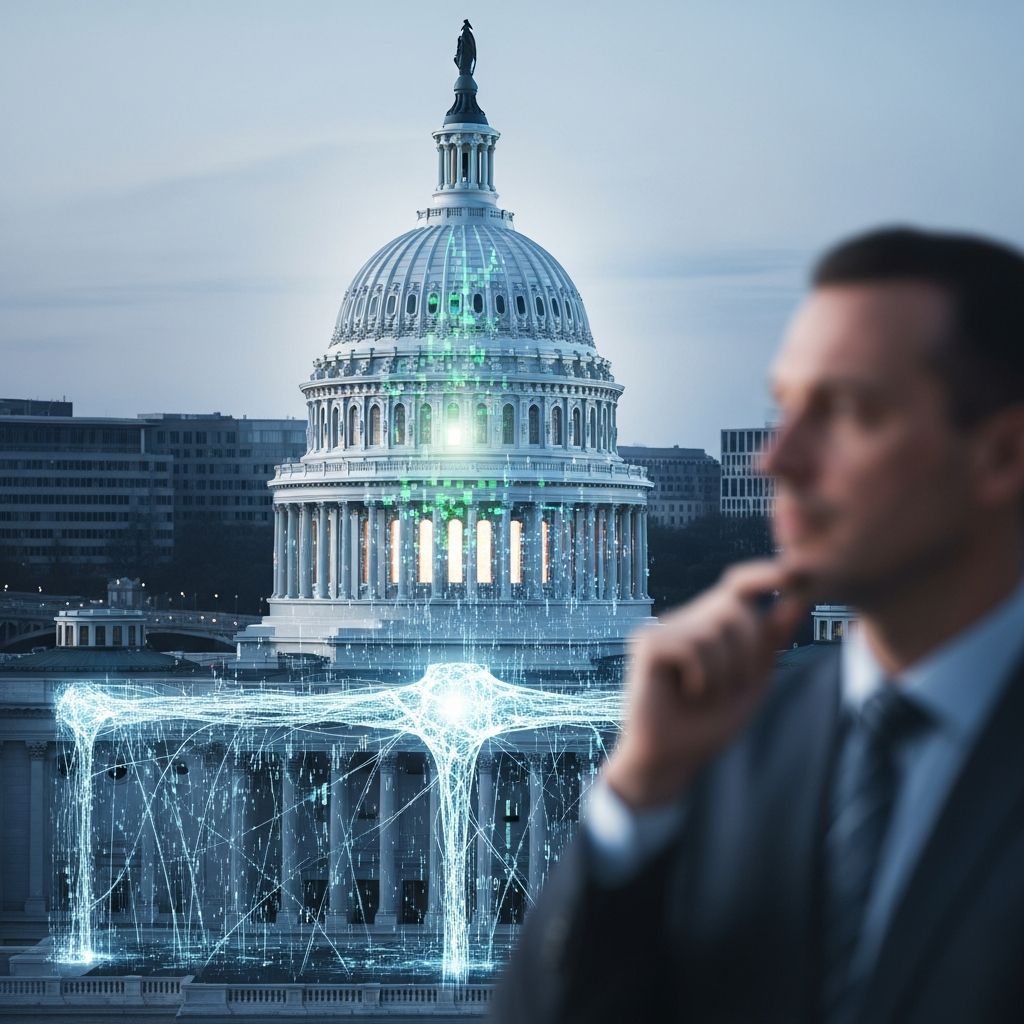
Over the last decade, artificial intelligence has moved from research labs and tech blogs into the center of global politics. Washington DC, long used to dealing with tanks, treaties, and trade, now has to understand algorithms, data centers, and model evaluations. This article explores how AI governance is emerging in DC, what worries national security experts, and how people with the right skills can have an outsized impact.
Why AI Policy Suddenly Matters So Much
AI has existed as a field since the 1950s, but several factors have turned it from a niche specialty into a first-order policy issue:
- Rapid capability jumps in large language models and generative AI, driven by massive compute and data.
- Strategic competition between the United States and China, where AI is seen as a general-purpose technology shaping economic and military power.
- Real-world deployment in finance, health, defense, critical infrastructure, and public administration.
- Concentration of decision-making in a small set of companies and national governments with access to the most advanced systems.
For DC policymakers used to incremental change, AI feels unusual: systems get substantially more capable on the timescale of a single congressional term, while the legal and regulatory environment still moves at the pace of traditional legislation.
Washington’s New AI Institutions
To reduce this gap between technical progress and political understanding, a new ecosystem of organizations has grown up around AI in Washington DC.
Think tanks and research centers
High-capacity think tanks translate technical developments into the language of policy memos, hearings, and white papers. One prominent example is Georgetown University’s Center for Security and Emerging Technology (CSET), founded in 2019 with a major philanthropic grant to provide nonpartisan research on AI and national security.
Organizations like CSET typically:
- Produce empirically grounded reports on AI capabilities, global talent, and compute infrastructure.
- Brief congressional staff, executive-branch officials, and journalists.
- Support hearings with expert testimony and technical clarifications.
- Train early-career analysts who later move into government roles.
Congress, agencies, and oversight bodies
On the government side, AI now touches a wide range of institutions:
- Congressional committees on judiciary, commerce, armed services, and intelligence increasingly hold AI-related hearings and request expert testimony on risk, transparency, and export controls.
- Executive agencies like the Department of Commerce, Department of Defense, and White House science offices develop rules on export controls, government procurement, and safety standards.
- Regulators such as the Federal Trade Commission (FTC) focus on consumer protection, fraud, deceptive marketing, and data misuse involving AI.
Rather than a single AI regulator, the US is evolving a patchwork of domain-specific oversight, with AI expertise gradually embedded across institutions.
AI and National Security: Core Concerns
National security planners in DC tend to see AI less as a single technology and more as an enabling capability that changes other systems. Several recurring themes shape their priorities.
Strategic competition and military applications
AI affects military and geopolitical dynamics in multiple ways:
- Intelligence and analysis: Tools that rapidly process satellite imagery, communications, and open-source data can change how quickly governments detect and respond to threats.
- Autonomous and semi-autonomous systems: Uninhabited vehicles, targeting systems, and decision support tools raise questions about reliability, escalation risk, and compliance with international humanitarian law.
- Cyber operations: AI-supported tools might increase the speed and scale of cyberattacks or help defenders find vulnerabilities more quickly.
US–China competition in AI is often described rhetorically as a “race”, but many policy experts argue that this framing is misleading. It can create incentives to move fast and break things in a domain where error margins are small and externalities global. Instead, they emphasize:
- Maintaining technological leadership while avoiding destabilizing brinkmanship.
- Limiting dangerous proliferation of highly capable models and specialized chips.
- Cooperating where possible on shared risks, such as misuse of advanced systems for bioweapons or cyberattacks.
Frontier AI and systemic risks
Beyond near-term issues, DC’s AI community is increasingly aware of “frontier” systems: the most advanced and compute-intensive models, trained by a handful of leading labs. Policy questions around these models include:
- Capability forecasting: How quickly are models improving, and where are the biggest discontinuities likely to appear?
- Evaluation and red-teaming: Which standardized tests can meaningfully reveal risks like autonomous replication, model-assisted hacking, or persuasive manipulation?
- Containment and access controls: Who should have the ability to run, modify, or fine-tune extremely capable systems, and under what conditions?
Because the underlying technology is not fully understood even by its creators, policymakers in DC often need to legislate under uncertainty—designing rules that can adapt as evidence accumulates.
How AI Policy Gets Made in DC
From the outside, AI regulation can appear as a sequence of big speeches and high-profile hearings. In practice, most of the real work happens in small offices, long email threads, and quiet briefings.
The policy pipeline
A simplified path from idea to implemented policy often looks like this:
| Stage | Key actors | Typical outputs |
|---|---|---|
| Agenda setting | Researchers, journalists, advocacy groups, industry | Reports, op-eds, briefings, public concern |
| Issue framing | Think tanks, congressional staff, agency analysts | Concept notes, talking points, draft memos |
| Policy design | Legislative counsels, regulators, technical experts | Draft bills, regulatory proposals, model standards |
| Negotiation | Members of Congress, agencies, industry, civil society | Compromises, revised drafts, oversight plans |
| Implementation | Agencies, courts, auditors, implementers | Rules, guidance, enforcement actions, audits |
For AI, technically literate researchers can influence multiple stages: clarifying which risks are real, how they scale with capability, which evaluations are feasible, and what kinds of requirements are technically implementable.
Constraints that matter
Even when lawmakers care deeply about AI, they face structural constraints:
- Time: Members of Congress juggle many issues; deep engagement with AI may happen in brief windows before key votes or hearings.
- Information asymmetry: A small number of frontier AI firms control much of the technical knowledge and data.
- Lobbying pressure: Industry actors often have the most resources to shape narratives around innovation, competition, and compliance costs.
- International considerations: Rules cannot be designed in isolation; export controls, standards, and surveillance concerns have global consequences.
These constraints push policy toward measures that are legible, enforceable, and politically durable, even if they are technically imperfect.
What Sensible AI Governance Could Look Like
Because no country has an established playbook for AI regulation, many experts advocate an experimental, iterative approach. Several themes recur in discussions of promising directions.
Focusing on high-leverage chokepoints
Not all AI activity is equally consequential from a policy perspective. Some high-leverage targets include:
- Compute and specialized chips: Export controls on advanced AI chips have already become a key tool in US–China technology policy, aiming to slow military-relevant capabilities without banning ordinary commercial use.
- Frontier model developers: A small number of companies build the largest general-purpose systems. Requirements on model evaluations, safety processes, and incident reporting at this layer can influence downstream ecosystems.
- Critical infrastructure and sensitive sectors: Rules for deploying AI in elections, health, finance, and defense can be stricter than for consumer applications that pose lower systemic risk.
Balancing innovation and safety
In DC debates, there is persistent tension between encouraging innovation and reducing risk. Most serious proposals try to:
- Support open research and competitive markets in low-risk domains.
- Impose graduated obligations as systems become more capable or more widely deployed.
- Encourage independent evaluation and third-party auditing, particularly for high-impact systems.
- Preserve room for international cooperation on shared safety issues, even amid strategic rivalry.
The limits of self-regulation
Frontier AI companies have initiated voluntary commitments, internal safety teams, model cards, and responsible AI frameworks. These steps matter, but many governance experts argue they are not sufficient on their own. Experience from prior industries—finance, aviation, pharmaceuticals—suggests that binding external oversight eventually becomes necessary when risks are systemic and mistakes are hard to reverse.
In this view, government’s role is not to direct research agendas line by line, but to:
- Set minimum safety baselines and transparency requirements.
- Clarify liability and enforcement mechanisms.
- Ensure that a diversity of interests—not only shareholders—shape how powerful systems are deployed.
Career Pathways Into AI Policy
Building effective AI policy requires people who can move between technical and political worlds. Several broad pathways have proven especially useful.
Technical foundations with policy translation
Individuals with backgrounds in computer science, statistics, or engineering who later branch into security studies, public policy, or law are particularly valuable. They can:
- Read research papers and convert them into practical policy options.
- Spot unrealistic mandates that do not reflect how models are actually trained or deployed.
- Design evaluations or reporting schemes that use meaningful technical metrics.
Direct government service
Working inside government—on the Hill, in executive agencies, or in oversight bodies—provides:
- First-hand exposure to how decisions are made and what constraints matter.
- Opportunities to quietly insert AI expertise into procurement rules, oversight plans, or grant programs.
- Networks that later support cross-institutional cooperation.
Many people move between government and think tanks, or between government and academia, carrying expertise in both directions.
Research, analysis, and public communication
Outside government, impactful roles include:
- Policy research at think tanks focused on AI, national security, or technology competition.
- Specialized journalism explaining complex technical and policy developments to broader audiences.
- Academic work in security studies, economics, or law analyzing AI’s long-term geopolitical and institutional effects.
Successful contributors often combine depth in one domain with enough breadth to collaborate across disciplines.
Practical Advice for Aspiring AI Policymakers
People curious about working on AI governance from or around DC can take several practical steps.
- Invest in foundational skills: Quantitative reasoning, clear writing, and basic familiarity with machine learning concepts are durable assets.
- Study institutional detail: Understanding how the US government budget process works, how committees are organized, or how regulations are drafted can multiply impact.
- Be opportunistic about timing: Windows for shaping specific rules or bills may open briefly; being prepared and already trusted when they do matters more than perfect long-term planning.
- Seek proximity to decision-making: Internships, fellowships, and junior roles that place you near key offices can teach more than many courses.
- Stay humble about prediction: AI trajectories are uncertain; robust governance plans need to work across several plausible futures, not just a single forecast.
Frequently Asked Questions (FAQs)
Q1: Does AI governance require a PhD in machine learning?
No. Deep technical expertise is valuable for some roles, but many impactful positions rely more on policy analysis, law, or security studies, combined with enough technical literacy to talk effectively with engineers.
Q2: Is the US treating AI like a traditional arms race?
Public rhetoric sometimes uses arms-race language, but many experts in Washington argue this framing is harmful and instead advocate for maintaining leadership while emphasizing stability, safety, and selective cooperation with other powers.
Q3: What is the role of China in US AI policy debates?
China is central to discussions of AI competition, export controls, and military applications. US policymakers focus both on preventing the most dangerous forms of technology transfer and on understanding China’s own AI ecosystem, investments, and military-civil fusion policies.
Q4: How can small organizations influence AI policy?
Smaller think tanks, academic research groups, and civil-society organizations often influence policy by producing high-quality, clearly written research at the right time and building trusted relationships with staffers and officials who need impartial analysis.
Q5: Will there ever be a single global AI regulator?
Most current proposals favor a mix of national regulations and international coordination mechanisms, such as shared standards, information-sharing arrangements, and joint evaluations, rather than a single centralized global authority.
References
- Helen Toner — Wikipedia. 2025-10-27. https://en.wikipedia.org/wiki/Helen_Toner
- Helen Toner: The 100 Most Influential People in AI 2024 — TIME. 2024-05-16. https://time.com/7012863/helen-toner/
- Helen Toner | Center for Security and Emerging Technology — Georgetown University. 2025-05-20. https://cset.georgetown.edu/staff/helen-toner/
- Helen Toner, former OpenAI director: “If all AI development stopped now, its impact is already as big as the internet” — EL PAÍS English. 2025-06-02. https://english.elpais.com/technology/2025-06-02/helen-toner-former-openai-director-if-all-ai-development-stopped-now-its-impact-is-already-as-big-as-the-internet.html

Medha Deb is an editor with a master's degree in Applied Linguistics from the University of Hyderabad. She believes that her qualification has helped her develop a deep understanding of language and its application in various contexts. Medha specializes in the areas of beauty, health, sports, and wellness and is committed to ensuring that the content on the website is…