
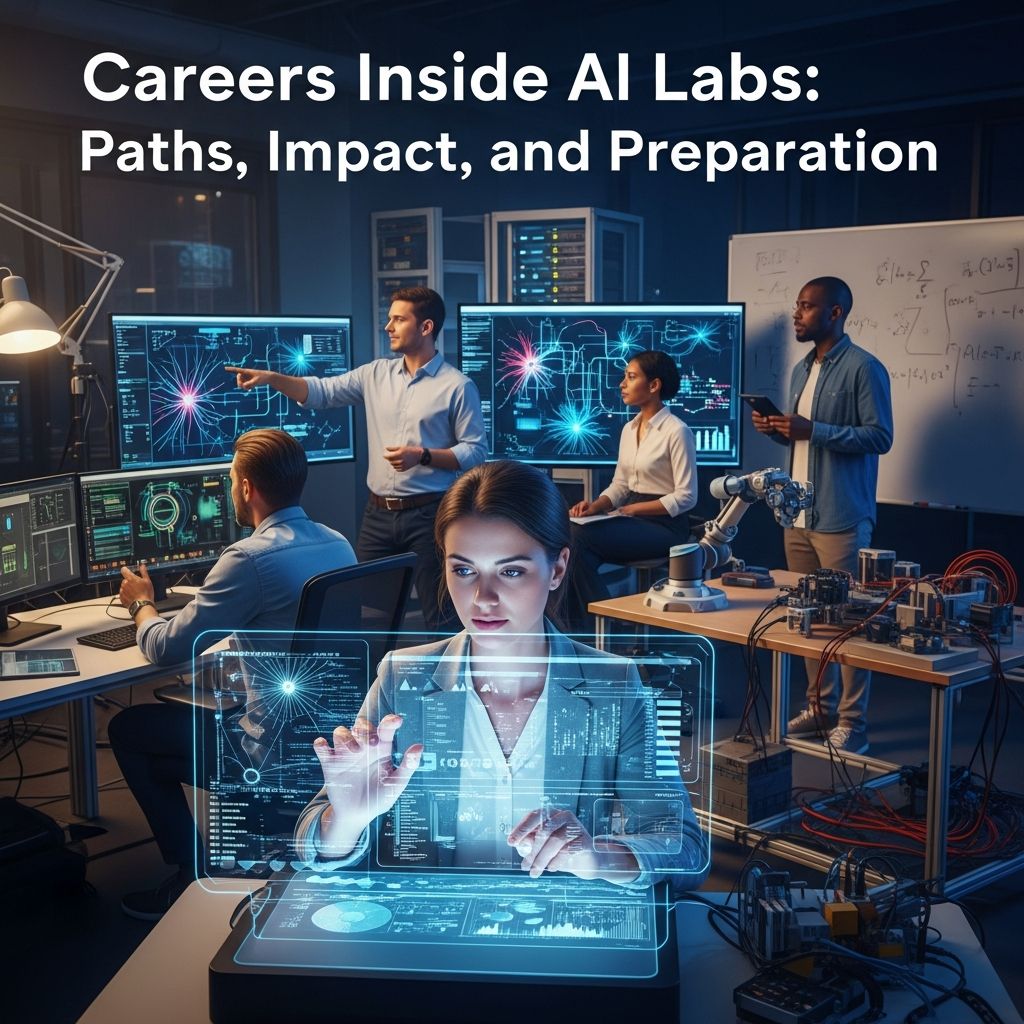
Artificial intelligence (AI) labs sit at the center of today’s most important technological advances. They design and train large models, build tools used by millions, and increasingly shape how societies use and govern AI. For many people who want their careers to matter, roles in AI research labs are compelling options — but they are also competitive and demanding.
This guide gives an overview of what AI labs do, the main career paths inside them, the skills you need, and how to think about impact, risk, and personal fit before pursuing this path.
What AI Labs Do and Why They Matter
Modern AI labs range from academic groups to industry research organizations at large technology companies and independent research institutes. Across these settings, AI labs usually focus on some combination of the following:
- Fundamental research – inventing new algorithms, model architectures, or training methods that expand what AI systems can do.
- Applied AI development – turning research results into products and tools, such as recommendation engines, large language models, or computer vision systems.
- Infrastructure and platforms – building data pipelines, training platforms, and deployment tools that enable large-scale AI experiments and production systems.
- Safety, reliability, and evaluation – testing models for robustness, bias, misuse, and other risks, and developing methods to reduce those harms.
- Policy and governance research – advising organizations and governments on responsible AI deployment and regulation.
Because AI is now applied in domains like health, finance, logistics, and public services, progress made in labs can quickly translate into large economic and social effects — both positive and negative.
Core Career Paths Inside AI Labs
AI labs hire for many specialties, but several broad tracks appear across organizations. Titles vary, but the underlying work often fits into the paths below.
| Path | Main Focus | Typical Background |
|---|---|---|
| AI Research Scientist | Develop new algorithms and models | PhD or equivalent research track record in ML, CS, or related field |
| Applied / ML Engineer | Build and deploy models into products | Software engineering plus strong ML skills |
| Data / Evaluation Specialist | Data pipelines, metrics, experiments, monitoring | Statistics, data science, or analytics background |
| AI Product & Program Roles | Define problems, coordinate teams, ship features | Product management, technical leadership, or strategy |
| AI Safety & Governance | Risk analysis, red-teaming, policy, and compliance | Security, policy, law, or technical safety research |
AI Research Scientist Roles
Research scientists focus on advancing the state of the art. Their work often looks like academic research but embedded inside an engineering organization.
- Design experiments to test new algorithms, training objectives, or architectures.
- Prototype and benchmark models on standard datasets and internal metrics.
- Collaborate with engineers to scale up promising ideas on large compute clusters.
- Publish papers, open-source code, or share results internally to guide future projects.
These roles typically expect a strong research record, such as a PhD or equivalent industry experience showing original contributions to machine learning or related fields.
Machine Learning and AI Engineering Roles
Machine learning engineers and AI engineers build reliable systems from research advances.
- Implement training pipelines using frameworks like PyTorch or TensorFlow.
- Integrate models into products, APIs, or internal tools with attention to performance and cost.
- Monitor models in production, addressing issues like data drift, latency, or failures.
- Collaborate closely with research, product, and data teams.
These roles typically require strong software engineering skills and a solid grasp of machine learning fundamentals — including evaluation, overfitting, regularization, and data quality concerns.
Data, Evaluation, and Analytics Roles
Data scientists, evaluation engineers, and related roles ensure that models are trained on high-quality data and that their behavior is measured rigorously.
- Design datasets, labeling schemes, and data collection processes.
- Run experiments such as A/B tests, offline evaluations, and user studies.
- Develop metrics that reflect real-world performance and user value.
- Investigate bias, robustness, and failure modes with statistical tools.
Strong skills in statistics, experimental design, and tools like SQL and Python are common requirements.
AI Product, Strategy, and Operations Roles
AI product managers and related strategy roles bridge technical teams and users.
- Identify where AI can meaningfully improve a product or workflow.
- Prioritize features based on user research, risks, and organizational goals.
- Coordinate cross-functional teams, including research, engineering, legal, and policy.
- Track success using both technical and business metrics.
These roles benefit from a mix of communication, product sense, and enough technical understanding to evaluate feasibility and trade-offs.
AI Safety, Red-Teaming, and Governance Roles
As AI capabilities grow, more labs are building dedicated safety and governance teams.
- Safety engineering – design evaluations for misuse, robustness, and harmful outputs; develop mitigations.
- Red-teaming – actively probe systems for vulnerabilities, such as prompt-injection attacks or ways to bypass safeguards.
- Policy and compliance – interpret regulations, design governance processes, and coordinate with regulators and external stakeholders.
These paths can be a good fit if you care about the risks from advanced AI, enjoy systematic thinking about failure modes, and like working across disciplines.
Skills and Qualifications AI Labs Look For
AI labs are often selective, but the core skill requirements are relatively consistent across organizations.
Technical Foundations
- Programming – strong skills in languages such as Python, plus software engineering practices like testing, version control, and code review.
- Machine learning and statistics – understanding of supervised and unsupervised learning, deep learning, evaluation metrics, and sources of bias.
- Mathematics – comfort with linear algebra, probability, and optimization, especially for research roles.
- Specialized domains such as natural language processing, computer vision, or reinforcement learning for certain teams.
Non-Technical and Cross-Functional Skills
- Communication – explaining complex ideas to people with different backgrounds, from executives to policymakers.
- Collaboration – working effectively in cross-functional teams that combine research, engineering, and operations.
- Critical thinking – questioning assumptions, identifying edge cases, and weighing evidence carefully.
- Ethical awareness – understanding issues like fairness, privacy, and accountability in AI systems.
Typical Educational Backgrounds
There is no single required degree, but some patterns are common:
- Research roles often expect a PhD in computer science, machine learning, statistics, or a related field — or equivalent research output.
- Engineering roles frequently hire candidates with bachelor’s or master’s degrees in computer science or similar disciplines, plus project experience in ML.
- Data and evaluation roles may come from statistics, applied mathematics, or data science programs.
- Policy and governance staff may hold degrees in law, public policy, economics, or international relations, ideally combined with some technical familiarity.
Why People Choose to Work in AI Labs
Working in an AI lab can be highly rewarding, but the reasons differ from person to person. Some commonly cited advantages include:
- High potential for impact – tools developed in large labs can reach hundreds of millions of users, shaping whole industries and research agendas.
- Exposure to frontier technology – you may work with large-scale models, cutting-edge architectures, and substantial compute resources that are difficult to access elsewhere.
- Strong learning environment – AI labs often attract highly skilled colleagues, providing opportunities for mentorship and rapid skill development.
- Competitive compensation – many industry labs offer salaries and benefits that are above typical academic or nonprofit roles.
Key Downsides, Risks, and Trade-offs
Despite the benefits, careers in AI labs involve real costs and uncertainties. It is important to think through these trade-offs carefully.
- Intense competition – hiring can be highly selective, especially for research roles at prominent labs.
- Fast-moving environment – tools, methods, and priorities can shift quickly, requiring constant learning and adaptation.
- Ethical ambiguity – some projects may raise concerns about misuse, disruption of labor markets, or concentration of power.
- Burnout risk – long hours, tight deadlines, or high expectations can make it challenging to maintain work–life balance, depending on the organization and team culture.
People who care about long-term societal outcomes sometimes worry that contributing to faster AI progress could increase risks, such as accidents, misuse, or a race dynamic between organizations. Working in a lab can, however, also give you leverage to advocate for stronger safety practices and responsible deployment.
Comparing AI Lab Work to Other AI Careers
If you are interested in AI but unsure about joining a lab, it helps to compare this path to other options.
| Career Setting | Typical Focus | Pros | Cons |
|---|---|---|---|
| Industry AI Lab | Frontier research and large-scale products | Resources, reach, compensation | Ethical tensions, competition, potential for long hours |
| Academic Research Group | Open-ended research, teaching | Intellectual freedom, mentoring students | Funding constraints, slower product impact |
| AI in Non-Tech Sectors | Applying AI in health, finance, public sector, etc. | Direct domain impact, closer to end users | Less access to cutting-edge models or infrastructure |
| Policy and Governance Roles | Regulation, standards, public interest | Influence on systemic risks and norms | Slower processes, less hands-on technical work |
How to Prepare for a Career in an AI Lab
If you decide this path fits your interests and values, preparation usually involves three components: skills, experience, and signaling.
Build Relevant Skills
- Study core machine learning and statistics through university courses, online programs, or self-study, making sure you can implement standard algorithms yourself.
- Develop strong programming habits, including clean code, testing, and documentation, ideally in at least one language widely used in AI (such as Python).
- Learn a specialized area, such as natural language processing, computer vision, or reinforcement learning, if you want to target specific teams.
Gain Practical Experience
- Work on open-source projects or personal research that demonstrates your ability to design and run experiments.
- Seek internships or research assistant positions in AI-related groups, either in academia or industry.
- Contribute to benchmarks, datasets, or evaluation tools that others use, which can show practical impact.
Strengthen Your Signal
- Publish papers or technical reports if you are on a research-heavy track.
- Showcase projects on a portfolio site or code hosting platform so hiring managers can see concrete evidence of your skills.
- Cultivate references from supervisors who can speak to your research ability, reliability, and teamwork.
Deciding Whether This Path Is Right for You
Before committing to a long training path, it can be helpful to step back and ask:
- Do you enjoy long, open-ended technical projects and frequent context-switching as research directions evolve?
- Are you willing to invest heavily in up-front skill building, even if entry-level roles are competitive?
- How do you weigh the benefits of faster AI progress against the risks, and what kinds of roles would align best with your values?
- Would you prefer to work directly on capabilities, or on safety, governance, and risk reduction?
Speaking with people currently working in AI labs, or trying short-term internships, can give you more realistic information than reading job descriptions alone.
Frequently Asked Questions (FAQs)
Q: Do I need a PhD to work in an AI lab?
A: A PhD is often expected for research scientist roles, but many labs hire machine learning engineers, data scientists, and product specialists without doctorates. Strong evidence of ability — such as impactful projects, publications, or open-source contributions — can substitute for formal degrees in some cases.
Q: How competitive are entry-level AI lab positions?
A: Entry-level roles such as ML engineer, research engineer, or AI intern can be highly competitive, especially at well-known labs. Candidates who stand out typically combine solid fundamentals with concrete projects and clear communication skills.
Q: Can I contribute to AI safety without being a top-tier researcher?
A: Yes. AI safety and governance rely on many skill sets beyond frontier research, including evaluation engineering, policy analysis, security, and program management. Bringing rigorous thinking and a focus on real-world risks can be valuable even without a highly specialized technical background.
Q: What if I care about AI but prefer not to work in a big tech company?
A: Alternatives include academic labs, nonprofit research institutes, startups, government agencies, and standards bodies. These settings can allow you to work on AI-related questions, from safety and auditing to public-interest applications, with different trade-offs in terms of freedom, resources, and impact pathways.
Q: How fast will AI-related careers change?
A: The AI labor market is evolving quickly, but foundational skills such as programming, statistics, and critical thinking remain valuable. Focusing on durable capabilities, while staying open to new tools and specialties (like large language models or new evaluation methods), can help you adapt as roles shift.
References
- Top AI Careers: Paths, Skills, and Salaries — Northeastern University Graduate Programs. 2023-10-09. https://graduate.northeastern.edu/knowledge-hub/career-in-artificial-intelligence/
- AI Careers: A Guide to Jobs in Artificial Intelligence — Western Governors University. 2023-03-15. https://www.wgu.edu/blog/ai-careers-guide-jobs-artificial-intelligence2503.html
- 14 Artificial Intelligence Careers & Job Outlook — University of San Diego, School of Professional & Continuing Education. 2024-01-05. https://onlinedegrees.sandiego.edu/artificial-intelligence-jobs/
- Artificial Intelligence Degree Overview — CareerExplorer. 2023-06-20. https://www.careerexplorer.com/degrees/artificial-intelligence-degree/
- Artificial Intelligence in Laboratory Medicine — American Society for Clinical Laboratory Science (ASCLS). 2023-02-01. https://ascls.org/artificial-intelligence-in-laboratory-medicine/

- Integrated M.A. in Applied Linguistics, University of Hyderabad
- 5+ years in editorial, instructional, SEO, and research-based writing
Sneha is a relationships and lifestyle writer with a strong foundation in applied linguistics and certified training in relationship coaching. She brings over five years of writing experience to theskillvault, crafting thoughtful, research-driven content that empowers readers to build healthier relationships, boost emotional well-being, and embrace holistic living. Her writing and insights reflect the belief that beauty, happiness, and wellness…