
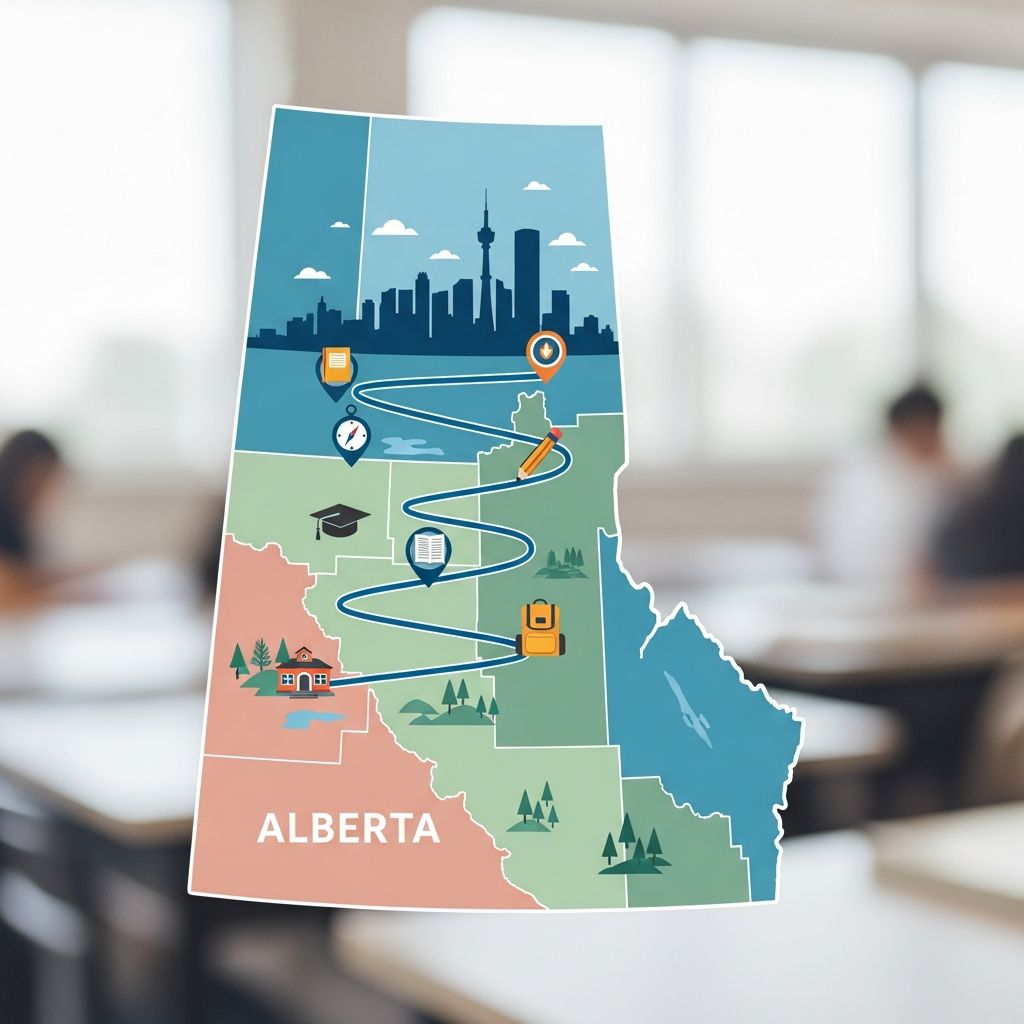
Alberta’s high school system offers a structured yet flexible framework designed to equip students with essential knowledge and skills for diverse futures. From grades 10 to 12, students engage in a curriculum that balances core academics with elective opportunities, preparing them for university, college, trades, or direct workforce entry.
Understanding Alberta’s K-12 Framework
The foundation of education in Alberta spans from Early Childhood Services (ECS) through Grade 12, managed by Alberta Education. This system ensures a standardized curriculum across public, separate, charter, and private schools, emphasizing competencies like critical thinking, literacy, and digital fluency.
Elementary years (Grades 1-6) focus on foundational subjects including Language Arts, Mathematics, Science, Social Studies, Arts, and Physical Education. Junior high (Grades 7-9) builds on these with added emphasis on health, personal life skills, and technology integration.
Senior high (Grades 10-12) introduces greater choice, with courses sequenced by difficulty levels: -1 for advanced university prep, -2 for general college/trades, and -3 for knowledge and employability streams.
Core Components of High School Curriculum
At the heart of Alberta’s high school experience are mandatory subjects that develop well-rounded individuals. Students must complete 100 credits over three years, including English Language Arts (30 credits), Social Studies (10 credits), Mathematics (30 credits), Science (10 credits), Physical Education (10 credits), and Career and Life Management (3 credits).
Electives allow personalization, covering Fine Arts, Second Languages, Career and Technology Studies (CTS), and specialized programs like Dual Credit for earning post-secondary credits early.
| Subject Category | Required Credits | Examples |
|---|---|---|
| English Language Arts | 30 Level | ELA 10-1, 20-1, 30-1 |
| Mathematics | 30 Level | Math 10C, 20-1, 30-1 |
| Social Studies | 10, 20, 30 Level | Social 10-1, 20-1, 30-1 |
| Science | 10 Level (Biology, Chemistry, Physics, Science options) | Science 10, Biology 20/30 |
| Physical Education | 10, 20-30 Level | Physical Education 10, 20-30 |
| Electives/Options | 50+ Credits | CTS, Arts, Languages |
This table summarizes key requirements for the Alberta High School Diploma, highlighting the need for strategic selection to meet specific goals.
Graduation Pathways and Achievements
Alberta recognizes two main high school completions: the High School Diploma and the Certificate of High School Achievement. The Diploma requires 100 credits, including 50 at the 20- and 30-level, three 30-level diploma exams (minimum 50% blended score), and literacy/numeracy assessments.
- Diploma Exam Subjects: English 30-1/30-2, Social Studies 30-1/30-2, Math 30-1/30-2, Biology 30, Chemistry 30, Physics 30, Science 30.
- Certificate of High School Achievement: For students in Knowledge and Employability streams, focusing on practical skills without diploma exams.
- Dual Credit: Earn credits toward apprenticeships or post-secondary while in high school.
Provincial Achievement Tests in Grades 6 and 9 ensure foundational proficiency, using ‘exceeding,’ ‘meeting,’ or ‘approaching’ standards.
Choosing the Right Courses for Your Goals
Course selection in Grade 10 sets the trajectory. University-bound students prioritize -1 sequences; college or polytechnic aspirants opt for -2; trades or employment focus on -3 and CTS.
Consider prerequisites: ELA 10-1 leads to 20-1/30-1; Math 10C branches to 20-1 (calculus-ready) or 20-2/20-3.
- Assess interests via career quizzes and counselor meetings.
- Balance workload: Avoid overloading on advanced courses without support.
- Explore CTS clusters like Business, Health, Natural Resources for hands-on experience.
High schools offer varied programs by authority, from academic streams to RAP (Registered Apprenticeship Program).
Personalized Learning and Support Options
Alberta emphasizes inclusivity with Individual Program Plans (IPPs) for diverse needs, including English learners and gifted students. Options include blended learning, online credits via Alberta Distance Learning Centre, and home education.
Teachers, certified with four-year degrees, provide mentorship. School authorities, governed by elected trustees, ensure accountability through performance data and surveys.
Building a Four-Year Success Plan
Start planning in Grade 9 by reviewing transcripts and post-secondary requirements. Use tools like MyBlueprint or Alberta’s career planner.
- Year 1 (Grade 10): Core 10-level courses, introduce electives.
- Year 2 (Grade 11): 20-level sequences, first diploma exams possible.
- Year 3 (Grade 12): 30-level completion, apply to post-secondary.
Track progress with credit checklists. Adjust for life changes, like switching streams with bridging courses.
Post-High School Transitions
Graduates access universities (e.g., University of Alberta), colleges (NAIT, SAIT), apprenticeships, or jobs. Competitive programs require 70%+ in -1 courses and strong diploma exam results.
Explore scholarships via Alberta Student Aid and work-integrated learning.
Frequently Asked Questions (FAQs)
What is the minimum passing grade for high school courses?
A minimum of 50% overall is required for Grades 10-12 courses, with diploma exams weighted 30% or 50% in select subjects.
Can I switch course sequences mid-way?
Yes, bridging programs like Math 10C to 20-3 allow transitions, though it may extend timelines.
What if I fail a diploma exam?
Retake it or write a diploma exam rewrite; final course grade uses the higher blended score.
Are there alternatives to in-person high school?
Yes, online learning, blended programs, and home education are approved options.
How do I earn extra credits?
Through CTS (up to 55 credits), Dual Credit, or prior learning assessment.
Thriving in Alberta’s High School Environment
Success hinges on engagement, seeking help early, and aligning choices with aspirations. Alberta’s system, lauded internationally, fosters competencies for a dynamic world.
Parents and students should attend info nights, consult advisors, and monitor Provincial Satisfaction Surveys for school quality.
With rigorous standards and support, Alberta high school launches students toward fulfilling paths.
References
- Alberta’s school system — Government of Alberta. 2023. https://www.alberta.ca/albertas-school-system
- Alberta Curriculum — TheTuitionE. 2024. https://thetuitione.com/alberta
- Alberta’s K to 12 education system — Government of Alberta. 2023. https://www.alberta.ca/albertas-k-12-education-system
- Education in Alberta — Wikipedia (informed by primary sources). 2024. https://en.wikipedia.org/wiki/Education_in_Alberta
- Detailed High School Course Guide — Calgary Board of Education. 2025. https://www.cbe.ab.ca/programs/high-school/Documents/Detailed-High-School-COurse-Guide.pdf

- Integrated M.A. in Applied Linguistics, University of Hyderabad
- 5+ years in editorial, instructional, SEO, and research-based writing
Sneha is a relationships and lifestyle writer with a strong foundation in applied linguistics and certified training in relationship coaching. She brings over five years of writing experience to theskillvault, crafting thoughtful, research-driven content that empowers readers to build healthier relationships, boost emotional well-being, and embrace holistic living. Her writing and insights reflect the belief that beauty, happiness, and wellness…