
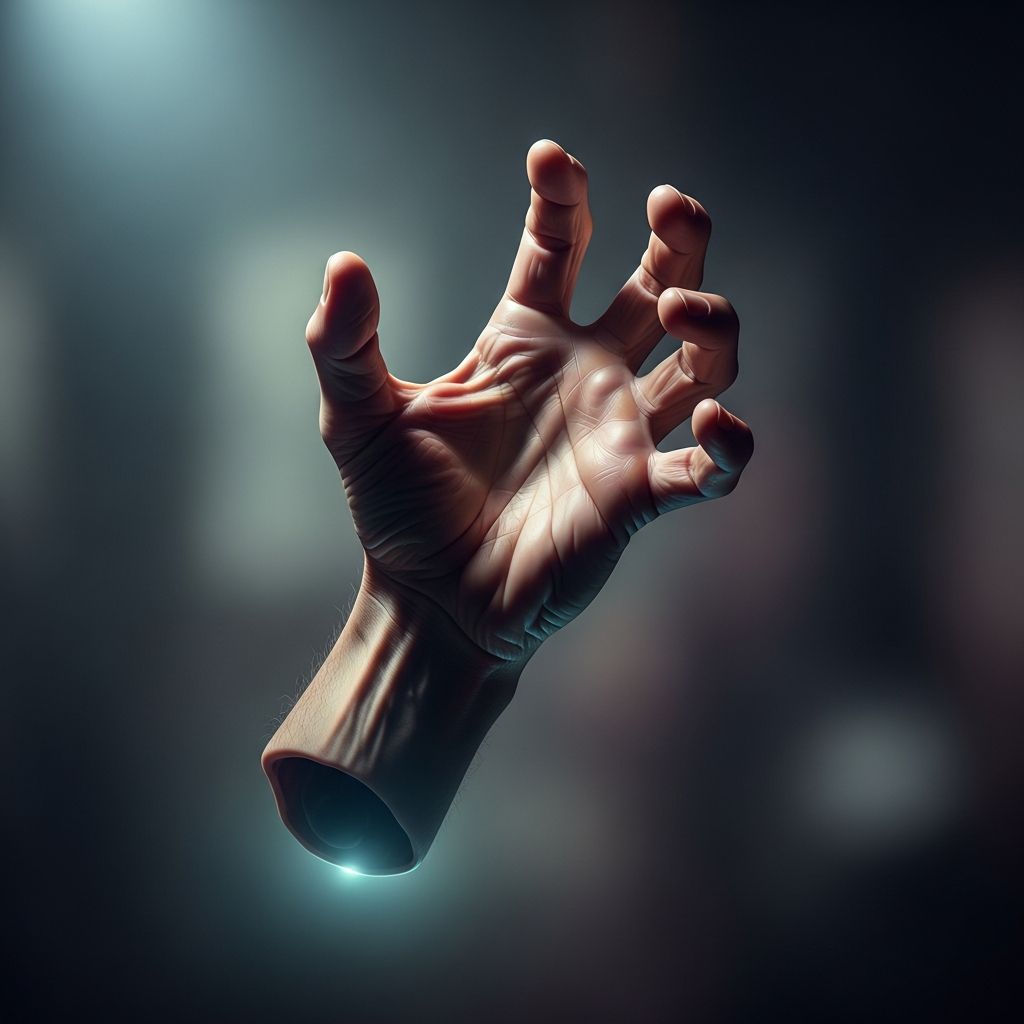
The human brain orchestrates a symphony of movements, but what happens when one hand breaks free from the conductor’s baton? Alien hand syndrome (AHS), also called anarchic hand syndrome, is a rare neurological disorder where a person’s limb—typically a hand—performs actions without conscious intent. Patients describe their hand as having a mind of its own, leading to conflicts, embarrassment, and profound philosophical questions about free will and self-control.
Recognizing the Signs: Symptoms and Daily Struggles
Individuals with AHS experience their affected limb engaging in purposeful, complex movements they did not initiate. The hand might grasp objects unbidden, button unwanted clothing, or even interfere with the other hand’s tasks. Unlike simple tremors, these actions are goal-directed: a hand could turn off a TV channel the patient just selected or reach for a doorknob against their wishes.
Emotional distress accompanies these episodes. Patients often express frustration or dismay, sometimes using their healthy hand to restrain the rogue limb. Socially inappropriate behaviors, like undoing a shirt in public, amplify embarrassment. Crucially, patients recognize the limb as their own—no delusions of prosthetics or foreign attachments—but disown its actions, a phenomenon known as ‘auto-criticism’.
- Common symptoms: Unintended grasping, interference with contralateral hand, compulsive tool use.
- Emotional impact: Bewilderment, anxiety, and a fractured sense of agency.
- Duration: Episodes can last seconds to minutes, recurring unpredictably.
Brain Malfunctions: Neurological Origins
AHS arises from disruptions in brain networks governing movement and intention. Damage to the corpus callosum—the bridge between hemispheres—often plays a role, especially post-surgery for epilepsy. This ‘disconnection syndrome’ allows one hemisphere to command the limb without the other’s oversight, creating opposition between hands.
Lesions in the supplementary motor area (SMA), parietal lobe, or frontal regions are implicated. The SMA handles internally driven actions, while premotor cortex (PMC) responds to external cues. An SMA imbalance lets environmental stimuli hijack the hand, provoking ‘anarchic’ responses.
| Brain Region | Role in AHS | Typical Damage Source |
|---|---|---|
| Corpus Callosum | Inter-hemispheric disconnect | Split-brain surgery |
| Supplementary Motor Area (SMA) | Loss of internal control | Stroke, tumor |
| Parietal/Occipital Lobes | Sensory-motor mismatch | Trauma, aneurysm |
Two main theories explain this: disconnection, where motor execution splits from conscious agency, and loss of inhibitions, where frontal ‘premotor’ systems fail to suppress competing impulses.
Historical Cases: Patients Who Lived the Nightmare
Real stories illuminate AHS’s grip. One patient, post-corpus callosum section, struggled with TV remotes: her left hand vetoed every right-hand choice. Another described her hand ‘doing whatever pleased it,’ echoing Dr. Strangelove’s infamous salute—inspiration for the syndrome’s nickname.
François Lhermitte documented ‘utilization behavior,’ where patients compulsively use nearby objects, akin to AHS but without full alienation. Cases post-stroke or tumor resection highlight vulnerability in older adults.
Diagnostic Challenges and Medical Pathways
Diagnosing AHS requires excluding seizures, tremors, or psychiatric issues. Neurologists use video-EEG, MRI, and behavioral tests: patients might be asked to perform bilateral tasks while describing intentions.
Treatment focuses on symptom management—no cure exists. Strategies include:
- Behavioral therapy: Distracting or restraining the hand.
- Medications: Anticonvulsants or botox for overactivity.
- Rehabilitation: Retraining motor control via therapy.
Prognosis varies; some improve spontaneously, others adapt lifelong.
Scientific Insights: Dissecting Agency and Ownership
AHS challenges unified consciousness. Normally, agency emerges from sequential activation: SMA first, then primary motor cortex. Disruption creates ‘disentangled’ thought-action links, proving the mind’s modularity.
Related to rubber hand illusion experiments, where multisensory sync induces false ownership. AHS reverses this: mismatch erodes embodiment, hinting at shared mechanisms.
“The sense of agency… is associated with an orderly sequence of activation.”
Psychological Ripples: Impact on Identity
Beyond motor issues, AHS fractures self-perception. Patients grapple with ‘disunity of mind,’ questioning volition. Philosophers debate: Does this reveal subconscious agents or just neural glitches?
Therapy addresses existential distress, fostering acceptance of this ‘rebel limb’ as part of a complex brain.
Experimental Frontiers: Research and Future Therapies
Recent studies probe AHS via fMRI, revealing premotor-parietal roles in ownership. Optogenetics and neuromodulation hold promise for restoring balance. Multisensory training, inspired by illusions, may recalibrate agency.
Understanding AHS illuminates broader conditions like schizophrenia or OCD, where agency falters.
Frequently Asked Questions (FAQs)
Is alien hand syndrome permanent?
Not always; many cases resolve or improve with time and therapy, especially if caused by transient events like stroke.
Can AHS affect both hands?
Rarely; it typically impacts one, often the left, due to right-hemisphere dominance in spatial tasks.
Does AHS mean the brain is ‘split’?
Often linked to corpus callosum damage, mimicking split-brain effects, but other lesions suffice.
How common is alien hand syndrome?
Extremely rare, mostly in neurosurgery patients or stroke survivors; exact prevalence unknown.
Can therapy cure AHS?
No full cure, but occupational therapy and meds manage symptoms effectively.
Broader Implications for Neuroscience
AHS exemplifies how fragile body ownership is. Rubber hand studies show embodiment fades with sensory conflict, mirroring AHS’s disownership. This malleability underscores multisensory integration’s role in self-modeling.
Clinically, AHS informs stroke rehab and epilepsy surgery risks. Theoretically, it dismantles the ‘homunculus’ myth, revealing consciousness as emergent from competing modules.
Patient narratives enrich this: one wrestled her hand from chokes, another battled buttoning battles. These tales humanize the science, blending neurology with existential awe.
Expand on variants: ‘post-unilateral’ AHS from frontal lesions causes grasping; ‘callosal’ sparks hand rivalries; ‘posterior’ yields sensory alien limbs.
References
- The anarchic hand — British Psychological Society. 2023-05-15. https://www.bps.org.uk/psychologist/anarchic-hand
- Alien hand syndrome — WikiDoc. 2024-01-10. https://www.wikidoc.org/index.php/Alien_hand_syndrome
- How to lose a hand: Sensory updating drives disembodiment — PMC (National Library of Medicine). 2021-06-15. https://pmc.ncbi.nlm.nih.gov/articles/PMC8219564/
- Alien hand syndrome — Wikipedia (sourced from peer-reviewed refs). 2025-03-20. https://en.wikipedia.org/wiki/Alien_hand_syndrome
- Alien Hand Syndrome: What It Is, Symptoms & Treatment — Cleveland Clinic. 2024-11-05. https://my.clevelandclinic.org/health/diseases/alien-hand-syndrome

Medha Deb is an editor with a master's degree in Applied Linguistics from the University of Hyderabad. She believes that her qualification has helped her develop a deep understanding of language and its application in various contexts. Medha specializes in the areas of beauty, health, sports, and wellness and is committed to ensuring that the content on the website is…