
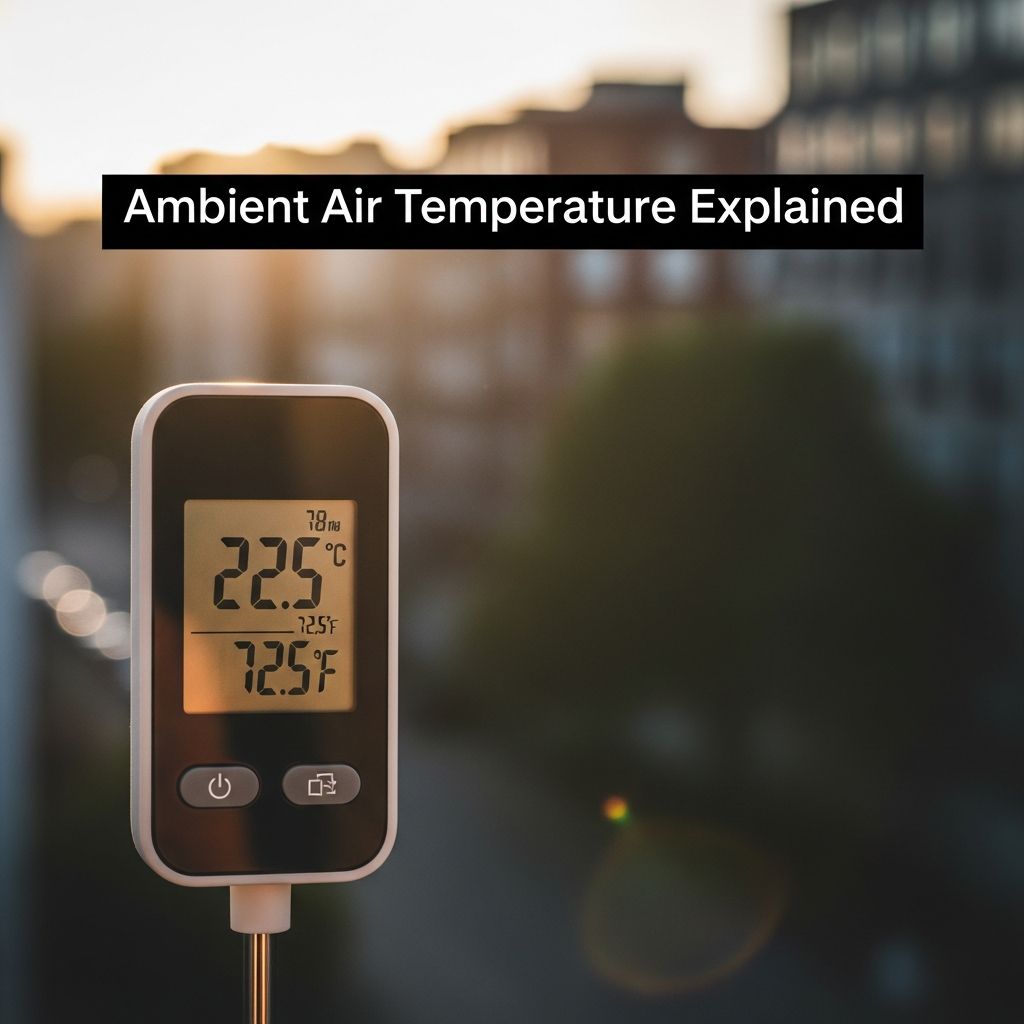
Ambient air temperature represents the actual temperature of the air in a specific environment, measured directly with a thermometer, serving as a fundamental metric in meteorology, engineering, and everyday applications.
Defining Ambient Air Temperature
The core concept of **ambient air temperature** refers to the temperature of the surrounding air at a given location, distinct from the heat generated by objects within that space. It captures the baseline thermal conditions of the atmosphere, whether indoors or outdoors, providing a quantifiable value essential for scientific analysis and practical decision-making.
This measurement is precise and objective, relying on standard instruments rather than subjective feelings of comfort. For instance, in outdoor settings, it equates to the reported air temperature during weather forecasts, reflecting the immediate atmospheric state.
Key Distinctions: Ambient vs. Room Temperature
A common point of confusion arises between ambient air temperature and room temperature. While ambient temperature is the exact air reading from a thermometer in any environment, room temperature describes a comfortable range for human occupancy, typically 20-25°C (68-77°F).
| Aspect | Ambient Temperature | Room Temperature |
|---|---|---|
| Definition | Actual air temperature measured by thermometer | Comfortable indoor range, often 20-25°C |
| Context | Any environment (outdoor/indoor) | Primarily indoor human spaces |
| Measurement | Precise, objective | Subjective, range-based |
| Example Range | Can vary widely (e.g., -10°C to 40°C) | 18-27°C typically |
These differences are critical in fields like laboratory protocols, where “room temperature” (RT) might allow slight flexibility, but ambient readings demand accuracy.
Importance Across Industries and Daily Life
Understanding ambient air temperature influences numerous sectors. In data centers and computing, maintaining 15-24°C (60-75°F) prevents equipment overheating and extends hardware lifespan.
In cold chain logistics, ambient control between 15-25°C ensures product integrity for items like cosmetics and electronics, avoiding damage from extremes.
- Meteorology: Forms the basis for weather reports and forecasts.
- Engineering: Critical for thermal design and safety ratings.
- Health: Affects human comfort and physiological responses.
- Cooking: Influences oven or grill air heat during food preparation.
Accurate Methods for Measuring Ambient Air Temperature
Precise measurement requires proper technique. Place thermometers in shaded, well-ventilated areas at mid-room height to avoid direct sunlight or surface influences.
Monitor over time to capture daily highs and lows, especially indoors. Digital sensors provide real-time data, essential for controlled environments like server rooms (ideally 20-22°C).
- Select a shielded thermometer or sensor.
- Position away from heat sources, walls, or drafts.
- Record multiple readings for averages.
- Calibrate devices regularly for reliability.
In outdoor scenarios, standard weather stations use aspirated shelters to ensure representative readings.
Effects on Technology and Equipment Performance
High ambient temperatures can degrade electronics; for example, servers in 68-71°F rooms optimize efficiency. Conversely, cold ambients risk condensation in unheated spaces.
Manufacturers specify operating ranges, like 0-40°C for many devices, with optimal performance near 20°C.
Role in Weather Forecasting and Climate Studies
Meteorologists rely on ambient readings from global networks to predict patterns. Variations due to time, location, and conditions like humidity inform severe weather alerts.
Climate research tracks long-term ambient shifts, linking them to global warming trends and ecosystem impacts.
Human Health and Comfort Considerations
Prolonged exposure to extreme ambients poses risks: heat stress above 35°C or hypothermia below 0°C. Indoor ambients outside 18-27°C reduce productivity and sleep quality.
Vulnerable groups, such as the elderly, require controlled ambients for safety.
Ambient Temperature in Cooking and Food Safety
In culinary settings, ambient refers to the air inside cooking appliances. Monitoring ensures even cooking; for smokers, stable ambients prevent bacterial growth.
Food safety guidelines recommend ambients below 4°C for perishables post-cooking.
Challenges and Control Strategies
Fluctuations challenge consistency. Solutions include HVAC systems, insulation, and sensors for real-time adjustments.
- Energy-efficient cooling for data centers.
- Insulated shipping for logistics.
- Smart thermostats for homes.
Future Trends in Ambient Monitoring
IoT sensors and AI analytics promise precise, predictive control. In climate tech, satellite data enhances global ambient mapping for disaster preparedness.
Frequently Asked Questions (FAQs)
What is the ideal ambient temperature for a server room?
A range of 18-27°C (64-80°F) is recommended, with cooler ends preferred for optimal performance.
How does ambient temperature differ from surface temperature?
Ambient is air-only; surface temperature measures object heat, often higher due to radiation.
Can ambient temperature be the same as room temperature?
Yes, indoors, if within the 20-25°C comfort range, but ambient is always the precise measurement.
Why measure ambient temperature over time?
To identify peaks and troughs, ensuring equipment or processes handle daily variations.
What tools measure ambient air temperature accurately?
Digital thermometers, hygrometers, or data loggers in shaded, ventilated spots.
References
- What is Ambient Temperature? – Definition from TechTarget.com — TechTarget. 2023-10-15. https://www.techtarget.com/searchdatacenter/definition/ambient-temperature
- What is the difference between room-temperature-(RT) and ambient temperature? — Delta Microscopies. 2022-05-12. https://www.deltamicroscopies.com/what-is-the-difference-between-room-temperature-rt-and-ambient-temperature-2/
- Room temperature — Wikipedia. 2026-04-01. https://en.wikipedia.org/wiki/Room_temperature
- What Is Ambient Temperature: Understanding Its Importance and Effects — RACOMAN. 2024-03-20. https://www.racoman.com/blog/what-is-ambient-temperature-understanding-its-importance-and-effects
- What is Ambient Temperature In Cooking? — MEATER. 2023-08-10. https://meater.com/learn/what-is-ambient-temperature
- What is Ambient Temperature? — Nordic Cold Chain Solutions. 2024-01-05. https://www.nordiccoldchain.com/what-is-ambient-temperature/
- Ambient Temperature | Definition & Importance — Study.com. 2023-11-28. https://study.com/academy/lesson/video/ambient-temperature-definition-range.html

Medha Deb is an editor with a master's degree in Applied Linguistics from the University of Hyderabad. She believes that her qualification has helped her develop a deep understanding of language and its application in various contexts. Medha specializes in the areas of beauty, health, sports, and wellness and is committed to ensuring that the content on the website is…