
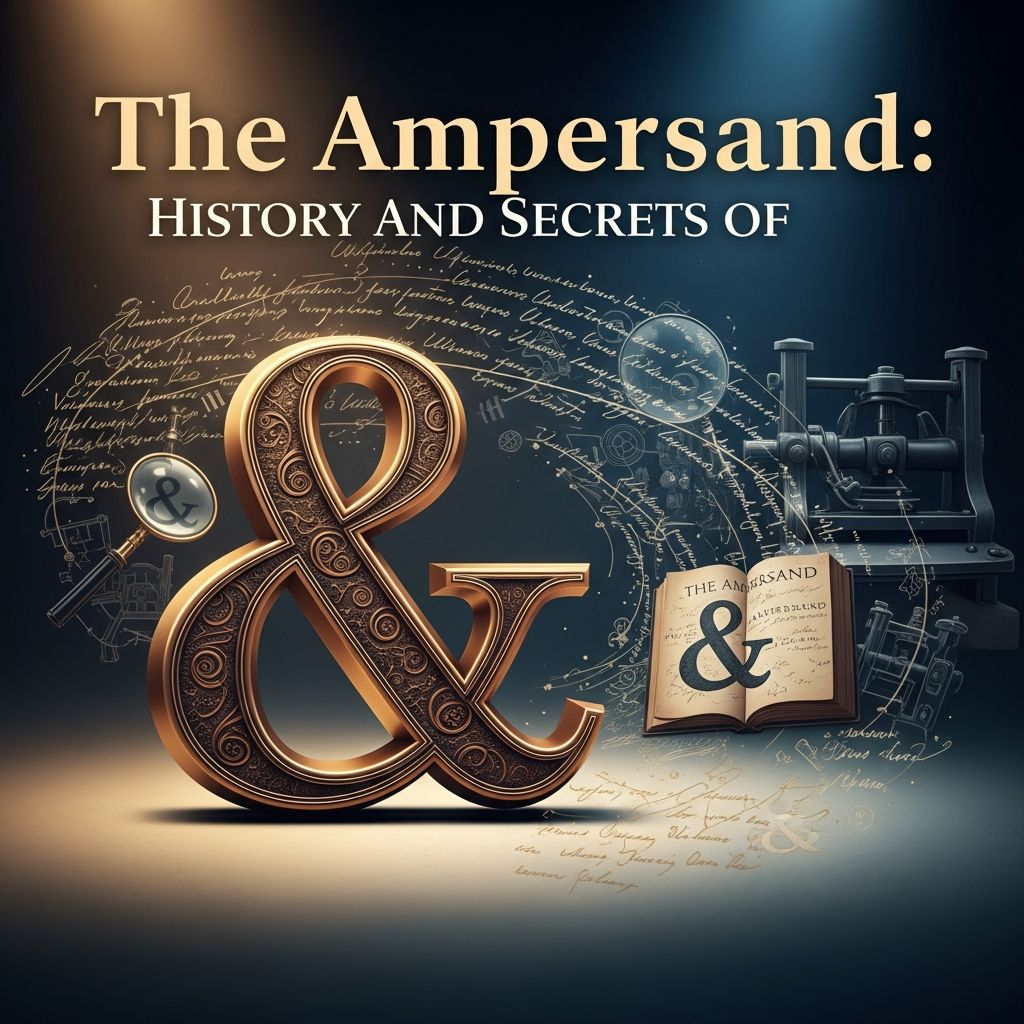
The ampersand (&) stands as one of typography’s most intriguing symbols, a compact representation of ‘and’ that blends artistry, history, and utility. Evolving from ancient Roman scripts to a staple in modern design, this logogram has transcended its origins to symbolize connection and partnership in logos, headlines, and everyday text.
Ancient Roots in Roman Script
The story of the ampersand begins over two millennia ago in the Roman Empire, where scribes sought efficiency in writing. The Latin word et, meaning ‘and,’ was frequently ligatured—two letters joined into one glyph for speed. The ‘e’ and ‘t’ merged fluidly in cursive forms, creating early versions of what we recognize as &.
Evidence from Pompeii graffiti, preserved by the 79 AD eruption of Mount Vesuvius, shows the symbol’s nascent form, marking it as a practical innovation in everyday Roman communication. As New Roman Cursive developed in the 4th century, ligatures proliferated, with the et-symbol varying widely but always prioritizing flow and brevity.
Medieval Revival and Scribal Traditions
During the Middle Ages, the ampersand persisted amid evolving scripts. Around 63 BC, Marcus Tullius Tiro, secretary to Cicero, devised Tironian notes—a shorthand system that included a distinct et-sign, influencing later notations. By 800 AD, in Carolingian minuscule, the ligature reemerged as one of few permitted joins, appearing in manuscripts until about 1200.
A transitional phase around 1230 distinguished forms: the classic & as uppercase and Tironian variants as lowercase, solidifying its role as a logogram—a single character denoting a full word. Monks and scribes alternated between styles, adapting to context in diplomatic and notarial documents.
Entry into English Alphabets
The ampersand reached English shores in the late 1700s, rapidly gaining traction. By the early 1800s, it was enshrined as the 27th letter of the alphabet, recited by schoolchildren after X, Y, Z.
The term ‘ampersand’ arose from recitation traditions. Letters doubling as words—like A, I, O—were clarified with per se (‘by itself’), as in ‘A per se A.’ Thus, the alphabet ended: ‘X, Y, Z, and per se &.’ Hurried speech slurred this to ‘ampersand,’ entering dictionaries by 1837.
Typographic Flourish and Design Evolution
Printers in the 19th century elevated the ampersand to an art form. Typefounders like Giambattista Bodoni and William Caslon crafted ornate variants, turning a functional symbol into decorative elements. These flourishes reflected eras: Victorian exuberance versus modernist minimalism.
Today, fonts offer dozens of ampersand styles—from elegant swashes in script faces to geometric simplicity in sans-serifs. Designers prize its versatility, often customizing it for brand identities like Barnes & Noble or AT&T.
| Era | Key Style | Example Influence |
|---|---|---|
| Renaissance | Intricate ligature | Old-style serifs |
| 19th Century | Flourished | Didone types |
| Modern | Minimalist | Helvetica, Futura |
| Contemporary | Custom script | Logo design |
Modern Rules for Usage
In formal writing, reserve the ampersand for specific contexts. Style guides like Chicago Manual of Style permit it in business names (e.g., Procter & Gamble) or tables for space-saving, but prefer ‘and’ in running prose.
- Use & in company names exactly as stylized.
- Avoid in academic or legal text unless quoting.
- In headlines or ads, embrace for punchy rhythm.
- HTML encoding: & to display correctly.
Grammarly notes its casual tone suits social media or branding, but overuse dilutes impact. Pairings like R&D or P&J evoke seamless unity.
Cultural Impact and Symbolic Power
Beyond text, the ampersand embodies collaboration. Brands leverage it for partnership vibes: think M&S or H&M. In art, it’s a motif in tattoos and jewelry, symbolizing bonds.
Its logogrammatic nature links it to @ or %, representing ideas efficiently. Pop culture nods include ampersand-shaped jewelry popularized online.
Ampersand in Digital Age
Unicode standardizes it as U+0026, ensuring cross-platform consistency. CSS stylers tweak kerning for perfect pairings. Emojis and fonts like Wingdings offer playful variants.
In programming, && denotes logical AND, echoing its connective essence.
Variations Across Languages
- Spanish: & or y with tilde.
- French: Et ligature in historic prints.
- Math: & for ‘and’ in logic.
- Old English: Tironian remnants in manuscripts.
Frequently Asked Questions
What does the ampersand symbolize?
It represents ‘and,’ originating as a ligature of Latin et, now symbolizing unity in design and text.
Why was it the 27th letter?
In early 19th-century English teaching, it followed Z, recited as ‘and per se &’ to distinguish the symbol.
Can I use & instead of ‘and’?
Yes in logos, lists, or informal contexts; no in formal prose per most style guides.
What’s the oldest known ampersand?
Pompeii graffiti from before 79 AD, a cursive et-form.
How do you type special ampersands?
Use font alternates in design software or Unicode variants for flourishes.
Mastering the Ampersand Today
From ancient efficiency to digital darling, the ampersand endures. Experiment in your next project—its charm lies in blending tradition with innovation. Whether crafting a logo or editing text, & connects with timeless elegance.
References
- The History and Meaning of The Ampersand Symbol — AmpersandMKE. Accessed 2026. https://ampersandmke.com/the-history-and-meaning-of-the-ampersand-symbol/
- What is an Ampersand? Definition and Examples — Grammarly. Accessed 2026. https://www.grammarly.com/blog/punctuation-capitalization/ampersand/
- The Story of the Ampersand Symbol — Blaze Type Blog. Accessed 2026. https://blazetype.eu/blog/the-story-of-the-ampersand
- Ampersand — Wikipedia. Accessed 2026. https://en.wikipedia.org/wiki/Ampersand
- The History and Usage of Common Symbols — Scribendi Academy. Accessed 2026. https://www.scribendi.com/academy/articles/common_symbols.en.html
- The History of ‘Ampersand’ — Merriam-Webster Grammar. 2023-10-12. https://www.merriam-webster.com/grammar/the-history-of-ampersand

Medha Deb is an editor with a master's degree in Applied Linguistics from the University of Hyderabad. She believes that her qualification has helped her develop a deep understanding of language and its application in various contexts. Medha specializes in the areas of beauty, health, sports, and wellness and is committed to ensuring that the content on the website is…