
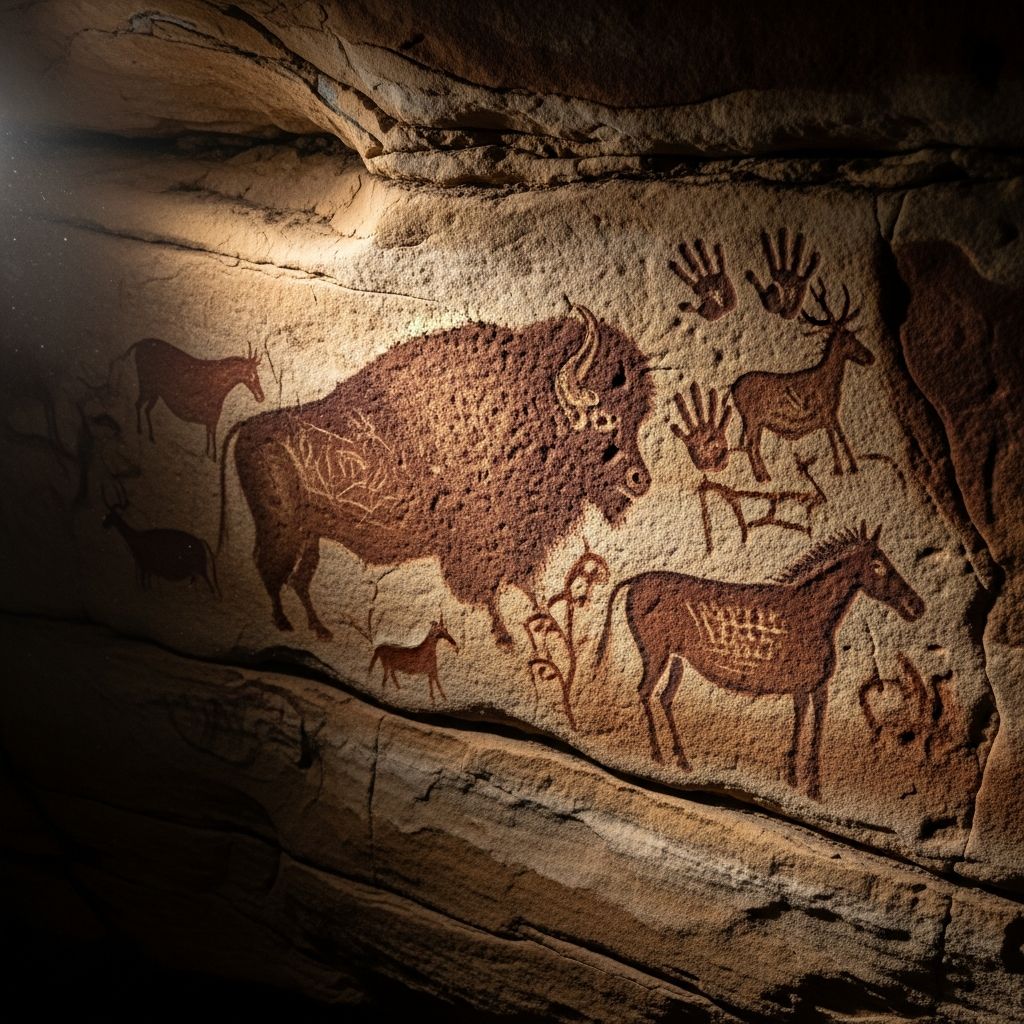
Deep within the earth’s hidden chambers, our ancestors left indelible marks on stone walls, offering glimpses into their world long before written history. These **cave paintings** and engravings, spanning tens of thousands of years, depict animals, humans, symbols, and scenes that puzzle modern minds. From the humid caves of Indonesia to the arid canyons of Texas, recent archaeological finds continue to rewrite our understanding of early human expression, creativity, and possibly spirituality.
The Dawn of Human Artistic Expression
The story of cave art begins in the Upper Paleolithic era, when Homo sapiens ventured into dark caverns armed with torches and pigments. These weren’t mere doodles; they represent deliberate acts of creation, often in hard-to-reach locations suggesting ritual significance. The oldest verified examples push human artistry back over 50,000 years, challenging notions of when symbolic thinking emerged.
In Indonesia’s Sulawesi island, a cave painting discovered in 2021 features three warty pig-like figures and human-handled shapes, dated to at least 51,200 years ago through uranium-series dating of overlying calcite layers. This surpasses previous records, indicating that complex narrative scenes—possibly hunting or spiritual encounters—existed far earlier than thought.
Similarly, South Africa’s Blombos Cave yielded a 73,000-year-old ochre plaque with crosshatched lines, though not a full painting, it hints at even deeper roots for abstract marking. These finds suggest art was integral to cognitive evolution, aiding memory, communication, or social bonding in hunter-gatherer groups.
Iconic European Masterpieces and Their Techniques
Europe boasts the densest concentration of Paleolithic art, with over 350 caves in France and Spain alone. Lascaux in France and Altamira in Spain, famous for their vivid animal portraits, date to 17,000–35,000 years ago. Artists used charcoal, ochre, and manganese dioxide, blown or brushed onto walls, creating shaded, dynamic forms that seem to move in flickering torchlight.
Chauvet Cave in France reveals two creative phases: around 35,000 and 30,000 years ago, with over 80 radiocarbon dates from torches, bones, and pigments confirming repeated visits and modifications over millennia. Panels show lions, rhinos, and horses in panoramic compositions, overlaid to form evolving narratives.
A groundbreaking 2023 discovery in Spain’s Cova Dones cave near Valencia uncovered over 100 motifs, including 19 animals like aurochs, hinds, and horses, dated to at least 24,000 years ago via weathering and bear claw marks. Uniquely, most were fashioned from red cave clay smeared with fingers and palms, preserved by humidity and calcite. This contrasts with typical ochre paints elsewhere in Iberia, highlighting regional innovation.
Global Rock Art Treasures Beyond Europe
Cave art isn’t confined to Eurasia. In Mexico’s Sierra de San Carlos, nearly 5,000 paintings in 14 caves, including the Horse Cave’s 1,550 motifs, depict humans, animals, tipis, vegetation, and atlatls—spear-throwers unseen in nearby art. Created by pre-Columbian hunter-gatherers in red, yellow, black, and white, they prove the region was inhabited long before Spanish arrival.
Across the border in Texas’ Lower Pecos Canyonlands, murals spanning 500 feet feature recurring icons like crenelated arches, rabbit-eared headdresses, and dart tips across 134 sites. A 2024 study radiocarbon-dated 53 figures to four millennia (5,760–1,035 years ago), revealing single-event creations in a dark-to-light pigment sequence (black, red, yellow, white), echoing later Indigenous creation myths.
- Sulawesi, Indonesia: 45,500+ year-old pig art with hand stencils.
- Namibia’s Apollo 11 Cave: 25,500–27,500-year-old animal figures.
- Somaliland’s Laas Geel: 5,000-year-old cows and herders.
- Brazil’s Itatiaia National Park: Recently found panels possibly 2,000–3,000 years old by hunter-gatherers.
These diverse sites illustrate art’s universal role in human societies, adapting to local materials and environments.
Decoding the Purposes: Rituals, Hunting, or Storytelling?
Why did ancient peoples risk treacherous caves to paint? Theories abound, supported by context like animal bones and tools.
| Theory | Evidence | Examples |
|---|---|---|
| Hunting Magic | Animals in dynamic poses, wounded spears; found near kill sites. | Lascaux arrows piercing beasts. |
| Shamanic Rituals | Therianthropes (human-animal hybrids), dots, hand stencils in deep chambers. | Chauvet lion-man figures. |
| Territorial Markers | Hand prints, abstract signs near entrances. | Sulawesi stencils. |
| Social/Teaching | Sequential scenes, consistent motifs over generations. | Lower Pecos iconography. |
Many panels show single-session bursts, per radiocarbon clustering, implying communal events. The clay technique at Cova Dones, using abundant local material, suggests practical innovation tied to humid preservation.
Preservation Challenges and Modern Discoveries
Tourist damage, like Lascaux’s mold from lighting, led to closures. Today, drones, 3D scanning, and non-invasive dating protect sites. Cova Dones’ find emphasizes surveying overlooked eastern Iberia, potentially revealing more clay arts.
In Brazil, accessible Mantiqueira Mountain caves held undetected paintings, signaling undiscovered troves worldwide. Climate change threatens arid sites like Lower Pecos via erosion.
Frequently Asked Questions (FAQs)
What is the oldest known cave art?
The oldest is a 51,200-year-old warty pig scene in Sulawesi, Indonesia, with figures possibly interacting in a narrative.
How were cave paintings made?
Using fingers, blowing pigments via reeds, etching, or smearing clay; colors from ochre, charcoal, manganese, and whites like mondmilch.
What do cave paintings tell us about ancient life?
They reveal diet (dominant animals), beliefs (rituals), technology (weapons), and social organization through motifs and locations.
Are new cave arts still being found?
Yes, like Spain’s 2023 Cova Dones (100+ motifs) and Brazil’s 2025 Itatiaia panels, expanding known distributions.
Why were paintings deep in caves?
Likely for seclusion in ceremonies, away from daily life, as accessible areas have fewer complex arts.
References
- Archaeologists Discover More Than 100 Ancient Drawings in a Spanish Cave — Smithsonian Magazine. 2023-10-11. https://www.smithsonianmag.com/smart-news/archaeologists-discover-more-than-100-ancient-drawings-in-spanish-cave-180982898/
- Archeologists Discover Nearly 5,000 Ancient Cave Paintings in Mexico — Hyperallergic. 2023-05-15. https://hyperallergic.com/archeologists-discover-nearly-5000-ancient-cave-paintings-in-mexico/
- Scientists Finally Unlocked the Age of Mysterious Cave Paintings in West Texas — Artnet News. 2024-07-20. https://news.artnet.com/art-world/lower-pecos-cave-paintings-radiocarbon-date-2723015
- What Newly Discovered Cave Art Tells Us About Human Creativity — Science Friday. 2023-07-14. https://www.sciencefriday.com/segments/oldest-cave-art-human-creativity/
- Cave painting — Wikipedia (informational, primary sources referenced). 2026-04-01. https://en.wikipedia.org/wiki/Cave_painting
- Cave Paintings Dating Back Thousands of Years Identified in Brazilian National Park — Archaeology Magazine. 2025-04-15. https://archaeology.org/news/2025/04/15/cave-paintings-dating-back-thousands-of-years-identified-in-brazilian-national-park/

Medha Deb is an editor with a master's degree in Applied Linguistics from the University of Hyderabad. She believes that her qualification has helped her develop a deep understanding of language and its application in various contexts. Medha specializes in the areas of beauty, health, sports, and wellness and is committed to ensuring that the content on the website is…