
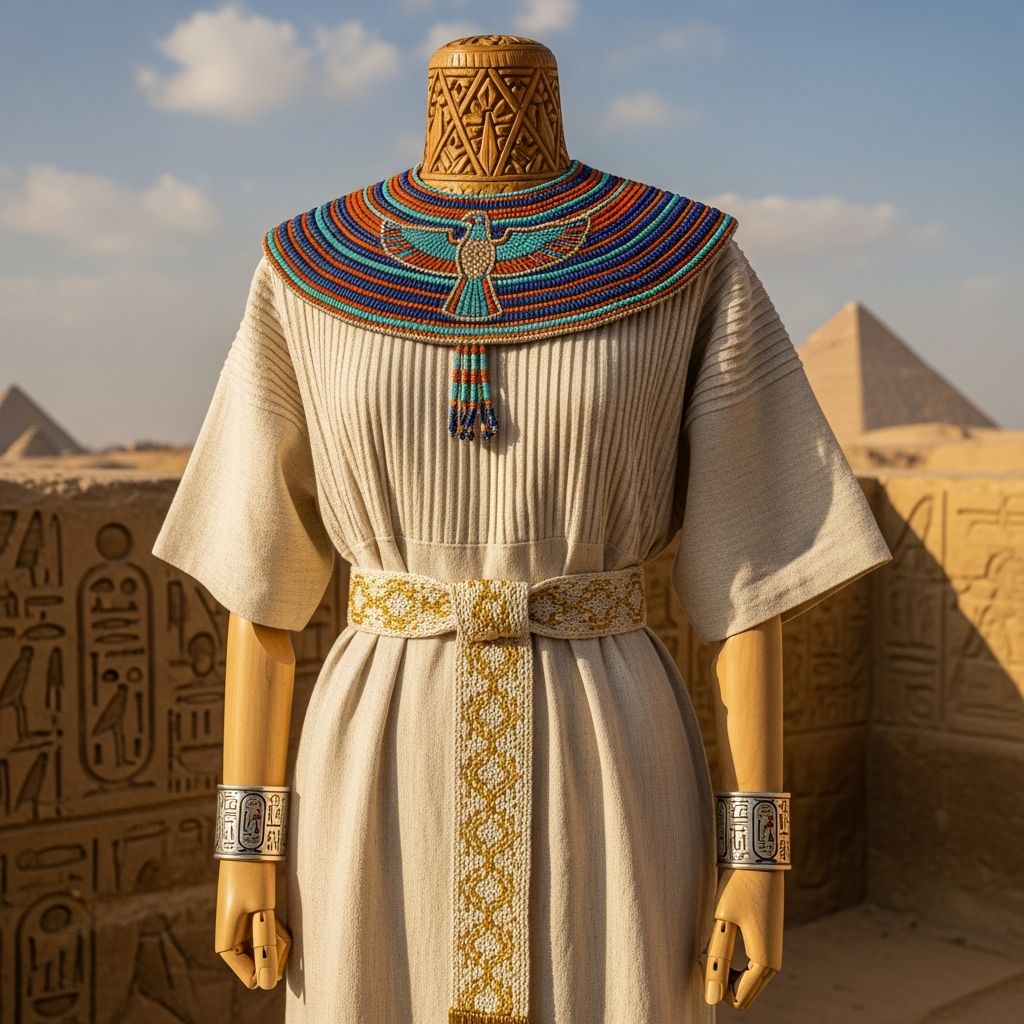
Ancient Egyptian clothing emphasized simplicity, breathability, and subtle hierarchy, primarily using white linen to suit the Nile Valley’s scorching heat. Garments evolved minimally over three millennia, prioritizing ease of movement and cultural symbolism from the Old Kingdom to the Ptolemaic era.
Primary Fabrics and Production Techniques
Linen dominated ancient Egyptian wardrobes, derived from flax plants cultivated along the Nile since around 5000 BCE. This fiber’s lightness prevented heat retention, making it ideal for daily wear, while its natural white hue symbolized purity in religious contexts.
Flax processing involved retting stems in water, beating to separate fibers, spinning into threads on drop spindles, and weaving on horizontal looms—often by women in early periods. By the Old Kingdom (c. 2686–2181 BCE), this became a specialized industry, producing fine sheer linens for elites and coarser weaves for laborers.
- Flax cultivation: Thrived in Nile floodplains, integral to agriculture and economy.
- Weaving innovations: Allowed pleating via starching, enhancing visual appeal without added weight.
- Rarity of dyes: White prevailed; occasional blue or red from minerals for elites.
Cotton appeared later in the New Kingdom via trade, but linen remained supreme due to local abundance and ritual significance.
Men’s Garments Across Eras
Men typically wore the schenti, a rectangular linen sheet wrapped around the waist and secured by a belt, originating in the Old Kingdom (c. 2700–2000 BCE). Initially leather for laborers, it shifted to linen, with pleats added in the Middle Kingdom (c. 2040–1782 BCE) for sophistication.
Upper-class variations included a triangular apron over the schenti, starched and ornate, denoting status. Pharaohs added bull tails or uraeus emblems, blending regality with tradition. Laborers favored plain, short kilts for mobility in fields or construction.
| Era | Key Men’s Style | Distinctions |
|---|---|---|
| Old Kingdom | Basic wrap skirt | Plain for all; finer linen for nobles |
| Middle Kingdom | Pleated schenti + apron | Elites: starched folds, sashes |
| New Kingdom | Longer kilts, occasional shirts | Embroidered edges, jewelry integration |
By the New Kingdom (c. 1570–1069 BCE), some men adopted short shirts or tunics, influenced by foreign contacts, yet the kilt persisted.
Women’s Wardrobes and Form
Women’s attire centered on the kalasiris, a narrow sheath dress draped from shoulders to ankles, tied with straps or sewn minimally. Old Kingdom elite women wore fuller versions covering the chest; lower classes opted for kilts like men for practicality.
Middle Kingdom innovations brought pleated, form-fitting gowns with V-necklines, often translucent to showcase skin as a beauty ideal. New Kingdom styles grew elaborate, with beaded fringes and colored accents for royalty like Nefertiti.
- Sheath dress basics: One-piece linen sheet, adjustable by wrapping skill.
- Class markers: Elites layered mantles; commoners wore single kilts.
- Pregnancy adaptations: Loose wraps for comfort and mobility.
Footwear, Headwear, and Accessories
Sandals crafted from papyrus or palm fibers suited dusty paths, with upscale versions in leather for nobility. Wigs of human hair or wool, often black and shoulder-length, protected scalps from sun and denoted status—daily for women, ceremonial for men.
Usekh collars of faience beads, gold, or lapis lazuli adorned necks, symbolizing protection. Armlets, anklets, and kohl eyeliner (from galena) served cosmetic, practical, and apotropaic roles. Priests donned leopard skins; pharaohs, nemes headcloths with uraeus.
Class, Gender, and Occupational Variations
Clothing reflected rigid social strata: pharaohs in pleated kilts with divine emblems, nobles in pleated finery, while farmers and slaves wore minimal loincloths. Women across classes shared sheath styles, but quality differentiated them.
Occupations influenced dress—soldiers in striped kilts, scribes in plain schenti. Children went nude until puberty, then adopted adult mini-versions. Foreign influences in the Late Period introduced Persian trousers, but core linen persisted.
| Social Class | Typical Garments | Adornments |
|---|---|---|
| Pharaoh/Elite | Pleated kilt, long gown | Gold collars, wigs, jewels |
| Middle Class | Simple schenti, sheath | Beaded collars, sandals |
| Lower Class | Loincloth, short kilt | Minimal; occasional amulets |
Chronological Shifts in Style
Early Dynastic (c. 3150 BCE) saw hide transitions to linen. Old Kingdom standardized kilts and dresses. Middle Kingdom added pleats and aprons amid cultural revival. New Kingdom vibrancy peaked with Tutankhamun’s embroidered loincloth and beaded goods.
Ptolemaic era (305–30 BCE) blended Greek chitons, yet Egyptian essence endured, as tomb evidence shows.
Cultural and Symbolic Dimensions
Garments embodied ma’at—order and purity—with white linen for rituals and mummification. Nudity in art signified youth or fertility; opulence, power. Gender norms allowed women similar exposure, unlike later societies.
Trade introduced wool sparingly, but linen’s sanctity prevailed. British Museum textiles from arid tombs reveal exquisite preservation, underscoring craft mastery.
Frequently Asked Questions
What was the most common fabric in ancient Egypt?
Linen from flax, prized for coolness and purity.
Did ancient Egyptians wear underwear?
No, basic loincloths sufficed under kilts.
How did class affect clothing choices?
Elites enjoyed pleats, jewels; commoners plain linen.
Were colors common in Egyptian attire?
Rarely; white dominated, with elite mineral dyes.
What role did wigs play?
Sun protection, status symbols, styled elaborately.
References
- Clothing in ancient Egypt — Wikipedia. 2023-10-15. https://en.wikipedia.org/wiki/Clothing_in_ancient_Egypt
- Schenti — Fashion History Timeline, FITNYC. 2020-05-12. https://fashionhistory.fitnyc.edu/schenti/
- Ancient Egyptian Clothing and Fashion — Egypt Tours Portal. 2024-02-20. https://www.egypttoursportal.com/en-us/blog/ancient-egyptian-civilization/ancient-egyptian-clothing/
- Fashion & Dress in Ancient Egypt — World History Encyclopedia. 2016-08-10. https://www.worldhistory.org/article/1037/fashion–dress-in-ancient-egypt/
- Dress like an Egyptian — British Museum. 2022-11-05. https://www.britishmuseum.org/collection/egypt/dress-egyptian

- Integrated M.A. in Applied Linguistics, University of Hyderabad
- 5+ years in editorial, instructional, SEO, and research-based writing
Sneha is a relationships and lifestyle writer with a strong foundation in applied linguistics and certified training in relationship coaching. She brings over five years of writing experience to theskillvault, crafting thoughtful, research-driven content that empowers readers to build healthier relationships, boost emotional well-being, and embrace holistic living. Her writing and insights reflect the belief that beauty, happiness, and wellness…