
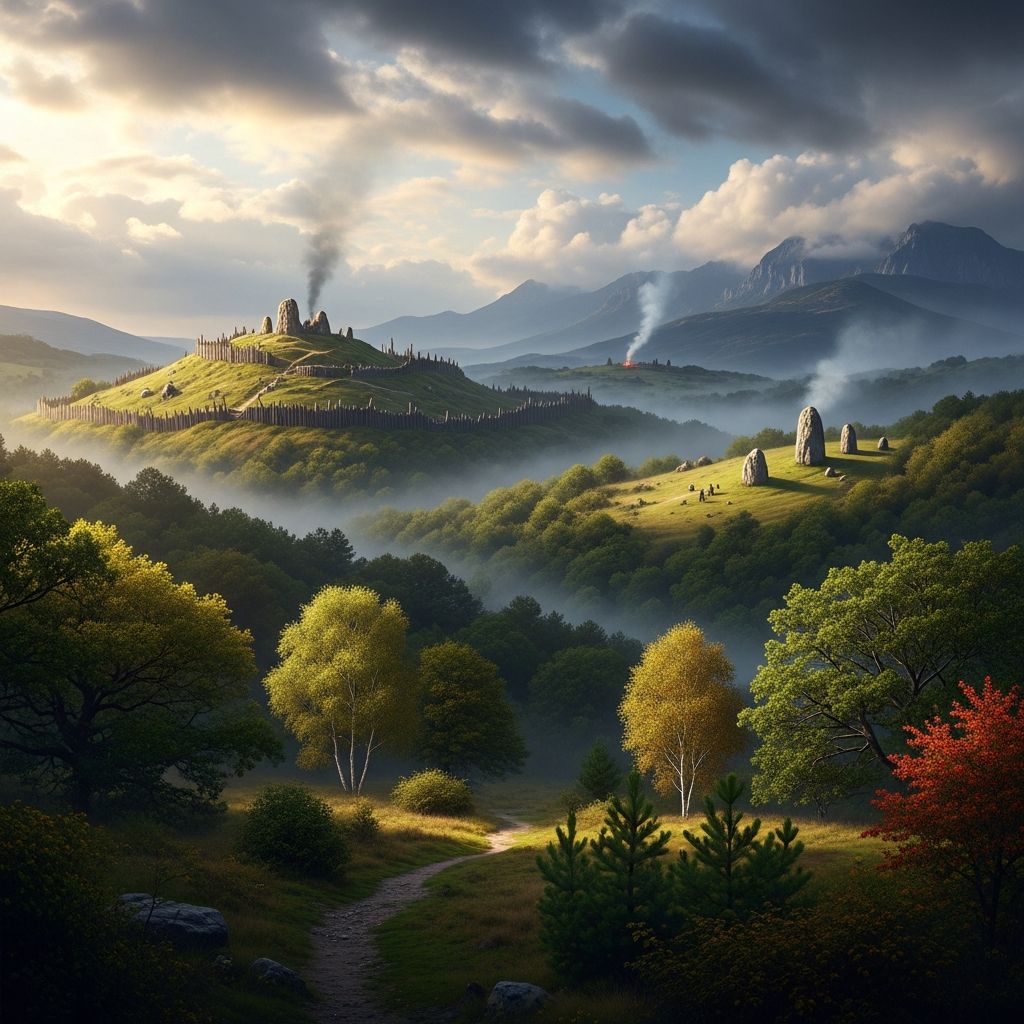
Gaul represented a vast and dynamic region in ancient Western Europe, home to diverse Celtic-speaking peoples whose lives intertwined with rivers, forests, and trade routes long before Roman legions arrived. Spanning roughly 494,000 square kilometers, it included territories now part of France, Belgium, Luxembourg, parts of the Netherlands, western Germany, Switzerland, and northern Italy.
Geographical Boundaries and Natural Features
The landscape of Gaul was defined by formidable natural barriers that both protected and isolated its inhabitants. To the south, the towering Alps separated it from Italy, while the Pyrenees marked the border with Iberia. The Rhine River served as a northern and eastern frontier against Germanic tribes, and the Rhône and Saône rivers facilitated internal connectivity.
Julius Caesar, in his Commentarii de Bello Gallico, famously divided Gaul into three distinct areas: Gallia Celtica in the center, inhabited by Celtic tribes; Gallia Belgica to the northeast, known for its warlike Belgae; and Gallia Aquitania in the southwest, occupied by non-Celtic Aquitani. This tripartite division highlighted not just geography but cultural and linguistic variations across the region.
- Rhine and Rhône Valleys: Major arteries for trade and migration, linking Gaul to the Mediterranean and beyond.
- Central Plateaus: Fertile lands ideal for agriculture, supporting dense populations.
- Coastal Regions: Exposed to Mediterranean influences, especially in the southeast.
Archaeological evidence from the La Tène culture, flourishing from the 5th to 1st centuries BCE, reveals sophisticated metalworking and settlements scattered across this terrain, extending eastward to modern Poland and Hungary.
The Celtic Peoples of Gaul
The Gauls, a collection of Celtic tribes, emerged as a dominant force around the 5th century BCE, bearers of the Iron Age La Tène material culture characterized by intricate art, weapons, and chariots. These groups shared linguistic roots in the Celtic branch of Indo-European languages, though dialects varied regionally.
Society was tribal, led by chieftains (vergobretes) and druids, who held religious, legal, and educational authority. Druids mediated disputes, oversaw sacrifices, and preserved oral traditions, wielding immense influence without written records.
| Tribal Group | Region | Notable Traits |
|---|---|---|
| Arverni | Central Gaul | Powerful under Vercingetorix; resisted Caesar. |
| Belgae | Northeast | Fiercest warriors; highest population density. |
| Aquitani | Southwest | Non-Celtic; Iberian linguistic ties. |
| Helvetii | Switzerland area | Migratory; sparked Caesar’s campaigns. |
Gaulish economy thrived on agriculture—wheat, barley, cattle—and craftsmanship in iron, bronze, and gold. Hillforts (oppida) like Bibracte served as political and economic hubs, housing thousands with advanced fortifications.
Early Interactions and Migrations
Gaulish tribes were not static; they expanded aggressively. In 390 BCE, under chieftain Brennus, Gauls sacked Rome, an event that seared into Roman memory and fueled centuries of enmity. Cisalpine Gaul (northern Italy) saw heavy settlement, leading to conflicts like the Battle of Telamon in 225 BCE.
Further afield, Gauls invaded the Balkans and Anatolia, establishing the Galatians in modern Turkey. These migrations peaked in the 3rd century BCE, driven by population pressures and opportunities along trade routes like the Danube and Rhône.
By the 2nd century BCE, Roman expansion encroached. Gallia Narbonensis was annexed in 121 BCE after conflicts with the Salluvii tribe, establishing Narbo Martius as a colony. Germanic incursions by Cimbri and Teutones in 113–101 BCE were repelled by Gaius Marius, setting the stage for total conquest.
Julius Caesar and the Gallic Wars
The decisive chapter unfolded between 58 and 50 BCE during Caesar’s Gallic Wars. Triggered by Helvetii migration and Germanic Suebi under Ariovistus, Caesar intervened as proconsul, securing his political future in Rome.
Key battles included:
- Battle of Bibracte (58 BCE): Caesar defeated the Helvetii, killing or enslaving tens of thousands.
- Alesia (52 BCE): Vercingetorix’s Arverni-led coalition surrendered after a brutal siege; double fortifications trapped 80,000 Gauls.
Caesar’s campaigns killed over a million Gauls and enslaved another million, per his own estimates, integrating the region into Roman orbit. Gallia Comata (hairy Gaul) became a province, while Cisalpina and Narbonensis were already Romanized.
Romanization and Gallo-Roman Culture
Under Roman rule, Gaul transformed. Roads like Via Agrippa connected oppida to cities; aqueducts and baths symbolized imperial engineering. Latin supplanted Gaulish by the 3rd century CE, blending with local customs into Gallo-Roman identity.
Urban centers flourished: Lugdunum (Lyon) as provincial capital, Autun, and Trier. Christianity spread from the 2nd century, with martyrs like St. Irenaeus. Yet, unrest simmered; the Gallic Empire (260–274 CE) under Postumus briefly seceded amid the Crisis of the Third Century.
Diocletian’s reforms divided Gaul into provinces, but barbarian invasions—from Alamanni to Visigoths—eroded control. By 486 CE, Clovis’s Franks ended Roman rule at Soissons, birthing medieval Francia.
Legacy in Modern Times
Gaul’s influence endures. France derives from ‘Francia,’ evolved from ‘Gallia’ in Latin and Greek. Celtic motifs appear in art, and sites like Gergovia preserve heritage. Genetic studies show continuity between ancient Gauls and modern populations.
The druidic legacy inspired Romantic nationalism, while Caesar’s Gallic Wars remains a historical cornerstone. Gaul’s story illustrates cultural fusion: Celtic vitality meeting Roman order, forging Europe’s foundations.
Frequently Asked Questions
What tribes lived in ancient Gaul?
Major groups included the Arverni, Aedui, Sequani, Belgae, and Aquitani, each with distinct territories and alliances.
Who conquered Gaul for Rome?
Julius Caesar led the conquest from 58–50 BCE, culminating in Vercingetorix’s defeat at Alesia.
What was La Tène culture?
An Iron Age Celtic culture (5th–1st centuries BCE) known for ornate metalwork, spreading across Gaul and Central Europe.
How did Gaul become France?
Roman rule created Gallo-Roman culture; Frankish conquests post-486 CE evolved ‘Gallia’ into Francia, basis for modern France.
Were all Gauls Celtic?
Most were, but Aquitani in the southwest spoke non-Celtic languages akin to Iberian.
References
- Gaul — Wikipedia. 2026 (accessed). https://en.wikipedia.org/wiki/Gaul
- Gaul, A Short History Of France’s Ancient Land — YouTube (History of France channel). N/A. https://www.youtube.com/watch?v=GvTLD-cZlO8
- Gaul | Roman Empire, Map, & People — Encyclopædia Britannica. 2026 (updated). https://www.britannica.com/place/Gaul-ancient-region-Europe
- Gauls — Wikipedia. 2026 (accessed). https://en.wikipedia.org/wiki/Gauls
- The Gauls | History, Map & Culture — Study.com. N/A. https://study.com/academy/lesson/the-ancient-gauls-history-lesson-quiz.html

- Integrated M.A. in Applied Linguistics, University of Hyderabad
- 5+ years in editorial, instructional, SEO, and research-based writing
Sneha is a relationships and lifestyle writer with a strong foundation in applied linguistics and certified training in relationship coaching. She brings over five years of writing experience to theskillvault, crafting thoughtful, research-driven content that empowers readers to build healthier relationships, boost emotional well-being, and embrace holistic living. Her writing and insights reflect the belief that beauty, happiness, and wellness…