
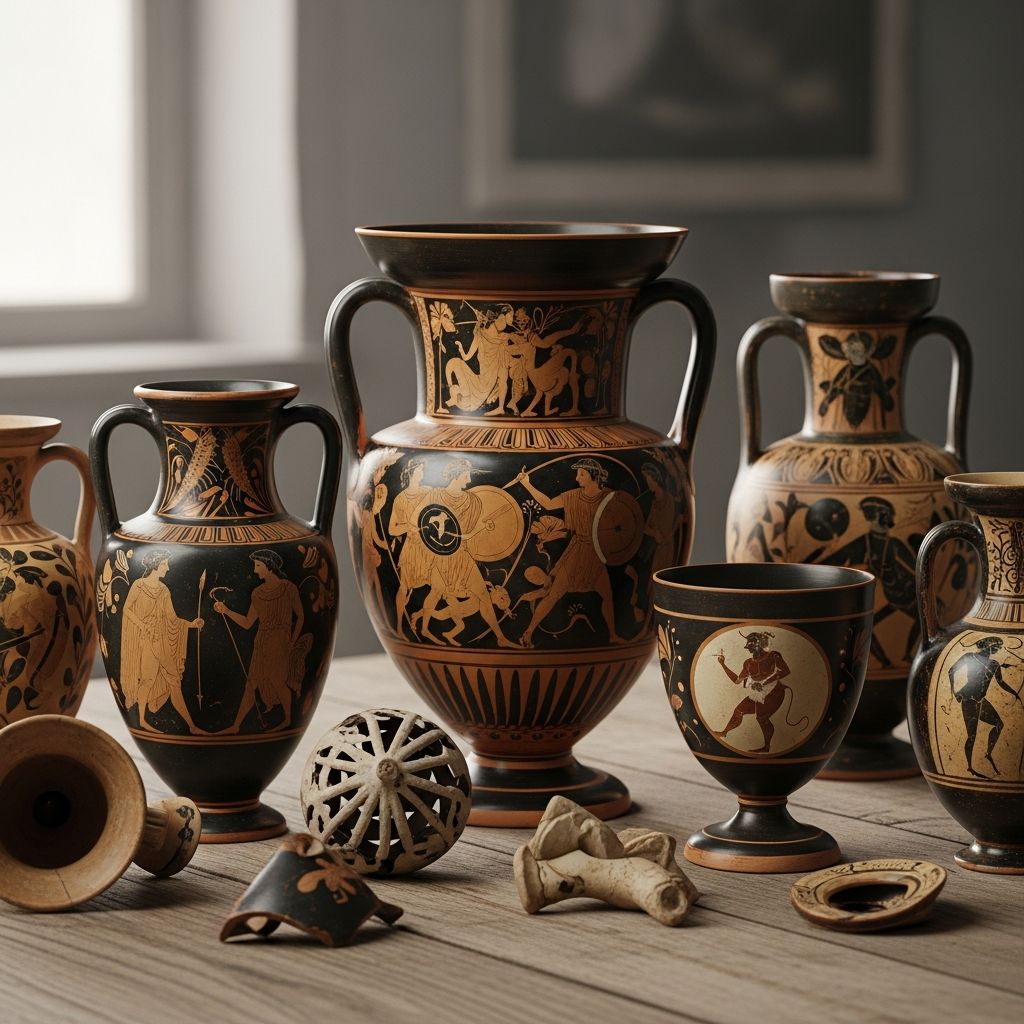
Ancient Greek pottery stands as one of the most enduring testaments to the civilization’s ingenuity, serving both practical purposes and artistic expression. Crafted from locally sourced clay and fired in kilns, these vessels reveal insights into daily life, trade, rituals, and mythology across centuries.
Origins and Early Development of Greek Ceramics
The roots of Greek pottery trace back to the Bronze Age, evolving from Minoan, Cycladic, and Mycenaean traditions. After the disruptions of the Greek Dark Ages, pottery reemerged in the Protogeometric style around 1050 BCE, characterized by simple compass-drawn circles and lines on otherwise plain surfaces. This marked the transition to the Geometric period (c. 900–700 BCE), where abstract patterns dominated, covering entire vessels with meanders, zigzags, and triangles.
During this era, potters refined their craft using the wheel, a technology dating to around 2500 BCE. Clay was kneaded, centered on the wheel, and shaped into sections—base, body, neck, and handles—before being joined with slip and smoothed. Attic clay, rich in iron, produced the signature orange-red hue, while Corinthian clay yielded paler tones.
Key Vessel Shapes in Everyday and Ritual Use
Greek potters created a diverse array of forms tailored to specific functions, from storage and transport to symposia and ceremonies. These shapes balanced aesthetics with utility, often featuring ergonomic handles and stable bases.
- Amphorae: Two-handled jars for storing and transporting wine or oil, with a narrow neck and wide body. Panathenaic amphorae, awarded as prizes, stood taller and bore official inscriptions.
- Hydriai: Three-handled water carriers, ideal for pouring without spilling, with one handle for transport and two for gripping.
- Kraters: Large mixing bowls for diluting wine with water at banquets. Variants included column, volute, calyx, and bell kraters, distinguished by handle and body shapes.
- Oinochoai: Single-spouted jugs for pouring wine, often elegantly curved for controlled flow.
- Kylikes and Skyphoi: Drinking cups; kylikes with offset horizontal handles suited reclining diners, while skyphoi were deeper, conical bowls.
- Lekythoi: Slender oil flasks for perfumes or funeral offerings, frequently white-ground with poignant scenes.
- Other forms: Pelikes for liquids, pithoi for bulk storage, kernoi ring vessels for rituals, and psykters for cooling wine.
| Vessel Type | Primary Use | Key Features |
|---|---|---|
| Amphora | Storage/Transport | Two handles, pointed or flat base |
| Krater | Mixing Wine | Wide mouth, tall handles |
| Hydria | Water Carrying | Three handles |
| Kylix | Drinking | Shallow, stemmed with horizontal handles |
| Lekythos | Oils/Perfumes | Narrow neck, bulbous body |
These forms were not merely functional; their proportions followed ideals of beauty, influencing later architecture and sculpture.
Evolution of Decorative Styles Across Periods
Greek pottery decoration progressed from abstraction to narrative realism, mirroring societal changes.
Geometric and Proto-Geometric Phases
Proto-Geometric pots featured basic motifs like concentric circles and horizontal bands. The Geometric style expanded these with human and animal figures in silhouette, arranged in metopes or friezes. By the late Geometric period (750–700 BCE), dipylon vases from Athens’ Dipylon cemetery displayed prothesis scenes—funerary processions—of mourners in angular profiles.
Corinthian Orientalizing Influence
Around 700 BCE, Corinth led with Orientalizing pottery, incorporating Eastern motifs like lotuses, lions, and rosettes on white-slip backgrounds. Protocorinthian aryballoi—small perfume flasks—exemplified this miniaturist precision, paving the way for black-figure techniques.
Athenian Black-Figure Dominance
By 630 BCE, Athens surpassed Corinth using black-figure: figures painted in glossy slip that turned black in the kiln’s reducing atmosphere, details incised through to reveal red clay. Themes shifted to mythology—Heracles’ labors, Dionysian revels—and daily life, with added purple and white for variety. Exekias and the Francois Vase represent pinnacles of this style.
Red-Figure Innovation and White-Ground
Invented c. 530 BCE, red-figure reversed the technique: backgrounds fired black, leaving figures in natural clay for finer detailing with brushes. This allowed dynamic poses and foreshortening, as seen in Euphronios’ works. White-ground lekythoi, used for graves, employed dilute slip for soft, ethereal effects.
Craftsmanship: From Clay to Kiln
Potters operated in workshops like Athens’ Kerameikos district. Clay was refined in settling tanks for consistency. Vessels were wheel-thrown in parts, luted with slip, and dried to leather-hard before decoration. Firing involved three stages: oxidation for red clay, reduction for black slip, and reoxidation for glossy shine. This complex process ensured durability and vibrancy.
Mould-made elements, like plastic rhyta (animal-head drinking horns), added whimsy. Inscriptions—potter signatures, dedications, or kalos (‘beautiful’) praises—personalized pieces.
Cultural and Economic Significance
Pottery was ubiquitous: plain wares for kitchens, fine painted exports to Etruscans, South Italy, and beyond. It fueled trade, spread Greek myths, and preserved narratives absent from perishable media. Symposia vessels depicted intellectual pursuits; grave goods reflected beliefs in the afterlife.
Athenian dominance from 600 BCE onward made it a Mediterranean staple, cheaper than metal or stone alternatives.
Regional Variations and Legacy
While Attic pottery prevailed, Corinth, East Greece, and South Italy produced distinct wares. Cycladic islands favored large Orientalizing vases; Apulian red-figure grew elaborate.
Today, shards inform archaeology, dating sites and tracing commerce. Museums showcase these as art, though ancients valued utility first.
Frequently Asked Questions
What was the most common clay used in Greek pottery?
Attic clay, with high iron content yielding orange-red color, was prized for fine wares.
How did black-figure and red-figure techniques differ?
Black-figure used incised black slip figures; red-figure painted black backgrounds, leaving red figures for detailed line work.
Why were kraters important in Greek society?
They mixed wine with water for symposia, central to male socializing and philosophical discourse.
What do Geometric pots reveal about early Greece?
Their funerary scenes show burial practices, social structures, and emerging narrative art.
Were all Greek pots painted?
No, many were plain for daily use; painted ones were luxury or export items.
References
- Ancient Greek Pottery — World History Encyclopedia. 2014-10-25. https://www.worldhistory.org/Greek_Pottery/
- Pottery of ancient Greece — Wikipedia. 2023-01-15. https://en.wikipedia.org/wiki/Pottery_of_ancient_Greece
- Ancient Greek Pottery: History, Development and Designs — YouTube (GBH Forum). 2020-05-12. https://www.youtube.com/watch?v=7lWyqbYITQw
- Greek pottery | Types, Styles, & Facts — Britannica. 2023-11-08. https://www.britannica.com/art/Greek-pottery
- 18 Types of Greek Vase Forms & More — The Ancient Home. 2022-06-14. https://theancienthome.com/blogs/blog-and-news/18-types-greek-vase-forms

Medha Deb is an editor with a master's degree in Applied Linguistics from the University of Hyderabad. She believes that her qualification has helped her develop a deep understanding of language and its application in various contexts. Medha specializes in the areas of beauty, health, sports, and wellness and is committed to ensuring that the content on the website is…