
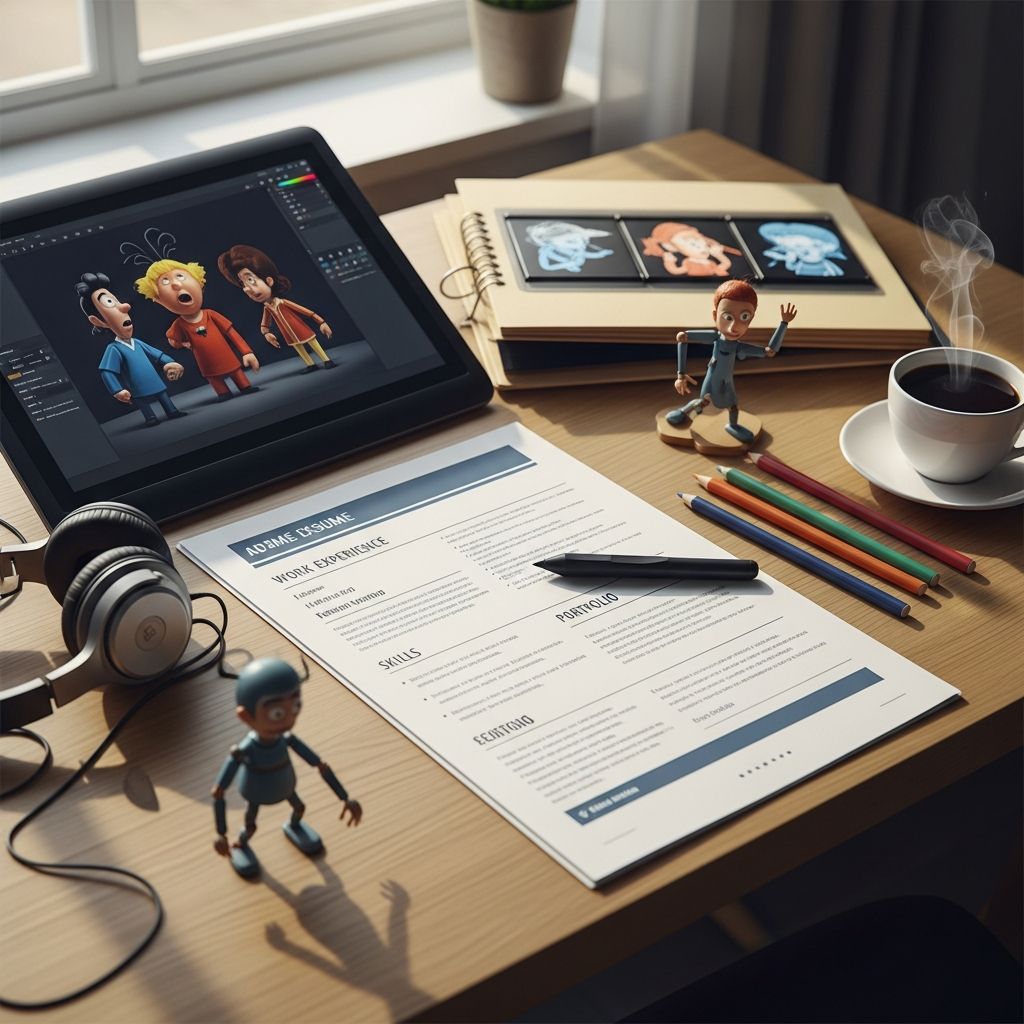
Competition for animation roles in film, TV, gaming, and advertising is intense. A strong animator resume does more than list software; it clearly shows your storytelling ability, technical skills, and the impact of your work on real projects. This guide walks you through how to build a resume that gets your portfolio opened and your reel watched.
Understanding What Studios Look For
Before you write a single line, it helps to understand how animation employers review applications. Most companies screen for a combination of artistic foundations, technical fluency, and professional behavior.
- Core animation principles: timing, spacing, weight, anticipation, and appeal are still the backbone of good work, regardless of whether you animate in 2D or 3D.
- Software proficiency: studios expect you to be comfortable in at least one major production package such as Maya, Blender, 3ds Max, Cinema 4D, or After Effects.
- Production experience: storyboard use, shot planning, versioning, and responding to notes from directors or supervisors.
- Collaboration: the ability to communicate with modelers, riggers, compositors, and producers under tight deadlines.
- Portfolio and reel: hiring teams usually review your reel first; the resume provides the context and proof of professionalism behind it.
Keep these expectations in mind as you choose what to include, where to place it, and how much space to give each section.
Choosing the Right Resume Format for Animators
The ideal structure depends on your level of experience and the type of work you are targeting.
| Profile Type | Best Format | Why It Works |
|---|---|---|
| Recent graduate / junior | Combination (skills + projects) | Lets you emphasize key skills and school or personal projects when professional experience is limited. |
| Mid-level animator | Reverse-chronological | Highlights progression from junior to more complex shots and responsibilities. |
| Freelancer with varied gigs | Hybrid or project-based | Groups work by client, studio, or medium (games, commercials, series) to show range. |
| Specialist (e.g., character animation, FX) | Reverse-chronological + focused skills | Shows depth in one niche with tailored skills and credits. |
Whichever format you choose, keep the layout simple, readable, and friendly to applicant tracking systems (ATS): no complex graphics, minimal columns, and clear headings such as Experience, Skills, and Education.
Building a Strong Header and Contact Section
The header is the first element recruiters see, and in animation it is also where they expect to find direct links to your work.
- Name and title: use a professional title that matches the job: “3D Character Animator,” “2D Animator,” “Motion Graphics Designer,” or “Generalist Animator.”
- Location: city and country are enough; remote or hybrid preferences can be mentioned in your summary instead of the header.
- Email and phone: use a simple, professional email address and a phone number with country code.
- Portfolio and reel links: include a dedicated link to your demo reel hosted on a stable platform and a portfolio or ArtStation/Behance page.
- Optional extras: LinkedIn, personal website, or professional social media if they showcase work and credits.
Make the reel and portfolio links prominent and easy to click; many studios will decide within the first few seconds whether to explore further.
Writing a Focused Animator Summary
A brief summary at the top of your resume can frame everything that follows. Instead of generic statements, target the role and studio type you want.
A strong summary usually:
- Mentions your primary specialization (e.g., 3D character animation, 2D cut-out, motion graphics, gameplay animation).
- Highlights years of experience or notable milestones (such as shipped games or broadcast series).
- References core tools you use in production.
- Signals the kind of projects you want next (series, cinematic trailers, mobile games, explainer videos, etc.).
Keep it to 3–4 lines. Let your reel show your style; the summary should communicate focus and professionalism.
Showcasing Animation Experience with Impact
Many creative resumes fall into the trap of listing tasks instead of results. Transform your experience entries into short case studies that reveal how you contributed to the final project.
Structuring each experience entry
- Role title – Match it closely to the job posting when accurate (e.g., “Junior 3D Animator,” not just “Artist”).
- Studio or client – Include well-known brands, agencies, or game studios when possible.
- Dates – Month and year are sufficient.
- Scope – Specify whether you worked full-time, freelance, contract, or part-time.
Under each role, use bullet points that begin with strong verbs and end with a result or context:
- “Animated mid- to close-up character performance shots for a 10-episode streaming series, working from storyboards and director notes.”
- “Created in-game combat loops and transitions for player characters, collaborating with designers to match timing to input and feel responsive.”
- “Delivered 30+ motion graphics assets for social campaigns under 48-hour turnaround times, coordinating revisions with copywriters and producers.”
When you lack formal experience, substitute with:
- Capstone or thesis films.
- Game jams and collaborative shorts.
- Volunteer animation for non-profits or small businesses.
- Well-executed personal projects where you handled the entire pipeline.
Highlighting Technical and Artistic Skills
Animation roles require a blend of software skills and artistic judgment. Employers look for evidence of both.
Core technical tools
Group tools by function so your skills section is scannable:
- 3D animation & rigging: Maya, Blender, 3ds Max, MotionBuilder.
- 2D & motion graphics: Adobe After Effects, Toon Boom Harmony, TVPaint, Adobe Animate.
- Modeling & sculpting: ZBrush, Maya, Blender, Cinema 4D.
- Compositing & editing: Nuke, DaVinci Resolve, Premiere Pro.
- Game engines: Unity, Unreal Engine.
Foundational artistic skills
- Life drawing and gesture drawing.
- Understanding of anatomy and weight.
- Layout and staging for clear silhouettes.
- Color, light, and composition basics.
Soft skills that matter in studios
- Collaboration: you will constantly exchange files with other departments and must follow naming, versioning, and shot conventions.
- Time management: animators often juggle dozens of shots or assets under broadcast or release deadlines.
- Openness to feedback: iterative revisions from supervisors are standard; your attitude toward notes can be as important as your reel.
- Communication: clear communication with directors and producers to understand story intent and constraints.
Tailor your skills list to each role. If the job is for a real-time gameplay animator, emphasize engines, state machines, and experience with interactive animation rather than compositing tools.
Education, Courses, and Certifications
While many animators are self-taught, formal education can provide structured training, networking, and a recognizable credential.
- Degrees: Bachelor of Arts or Bachelor of Fine Arts in Animation, Digital Media, Game Art, or related fields.
- Diplomas & certificates: intensive programs or bootcamps that cover 2D/3D pipelines, often culminating in a reel.
- Online courses: specialized training in character acting, creature animation, FX, or motion graphics.
- Software certifications: official certifications from software vendors that confirm proficiency with tools like Adobe After Effects or similar applications.
In your resume, include:
- Institution name and location.
- Degree or program title.
- Graduation date or expected completion date.
- Optional: notable projects, awards, or a thesis film if directly relevant.
Projects and Portfolio: Connecting the Resume to Your Reel
Your resume and portfolio should tell one coherent story about the kind of animator you are. Use a dedicated Projects or Selected Work section to bridge the gap.
For 3–6 key projects, list:
- Project title and brief description (film, trailer, game, short, ad).
- Your role (e.g., creature animator, lead animator, motion designer).
- Tools used.
- Link to shot breakdown or timecodes in your reel if available.
This helps reviewers quickly map resume entries to the shots they are seeing on screen, which can significantly improve your chances of being remembered.
Tailoring Your Animator Resume to Different Niches
Animation is not a single career path. Game studios, film productions, and advertising agencies all need animators, but they prioritize skills differently.
| Sector | What to Emphasize | Examples of Relevant Experience |
|---|---|---|
| Feature film / TV series | Character acting, lip sync, shot continuity, collaboration with directors. | Shot quotas, work on episodic series, narrative shorts, participation in dailies. |
| Video games | Gameplay loops, responsiveness, engine integration, state machines. | Game jams, shipped indie titles, animation blueprints or controllers in Unity/Unreal. |
| Advertising & motion graphics | Brand storytelling, typography, fast turnaround, versatility. | Commercial spots, explainer videos, social media campaigns, broadcast graphics. |
| Educational / corporate | Clarity of information, consistency, reliability, client communication. | E-learning modules, training videos, infographics with simple character animations. |
Analyze each job post carefully and mirror the language of required skills where it accurately matches your background. This not only makes your resume more relevant but also helps with ATS keyword matching.
Optimization Tips for ATS and Human Readers
Even creative roles often use automated screening tools. You can respect your artistic identity and still ensure your resume passes basic ATS checks.
- Use standard section headings: Summary, Experience, Skills, Education, Projects.
- Avoid embedding critical information in images or diagrams.
- Include relevant keywords naturally in bullet points (e.g., “Maya,” “character animation,” “Unreal Engine”).
- Save the file as a PDF unless the employer specifies another format.
- Keep fonts readable and colors minimal; your reel is the place to show visual flair.
Common Animator Resume Mistakes to Avoid
Even talented artists get rejected for preventable reasons. Watch out for these issues:
- No direct link to the reel or a broken link.
- Overloading the software list with tools you barely know, which can quickly be exposed in a skills test.
- Unclear role descriptions that do not explain which shots or tasks you owned.
- Typos, inconsistent formatting, or messy file naming, which signal poor attention to detail.
- Irrelevant information, such as unrelated part-time jobs, if they crowd out your animation projects.
Focus on clarity, honesty, and alignment with the job description.
How to Complement Your Resume During the Job Search
A strong resume is one piece of a larger strategy for entering or advancing in animation.
- Network strategically: join online communities and professional organizations dedicated to animation, games, or motion graphics.
- Participate in events: festivals, game jams, online challenges, and portfolio reviews are opportunities to connect with studios and peers.
- Update regularly: replace older work on your reel and resume with newer pieces that better represent your current level.
- Seek feedback: mentors and experienced animators can review your resume and reel, offering suggestions aligned with industry expectations.
Frequently Asked Questions (FAQs)
How long should an animator resume be?
For most animators, a one-page resume is ideal, especially for junior and mid-level roles. Senior artists, supervisors, or those with extensive credits can extend to two pages if every line adds value.
What matters more: the resume or the reel?
Studios usually prioritize your demo reel, but the resume determines whether the reel is opened and how seriously it is considered. Aim for both: a sharp reel and a clear, concise resume that reinforces it.
Should I list every software I have tried?
No. Only list tools you are comfortable using in a production setting or could become comfortable with quickly. It is better to show depth in a few core applications than to list many at a beginner level.
How can students and beginners fill limited experience?
Emphasize school projects, personal shorts, game jam entries, and any collaborative work where you took clear responsibility. Detail your role, the pipeline you followed, and the tools you used, just as you would for paid experience.
Do I need a degree to become an animator?
Many employers prefer candidates with a degree or formal training, but it is possible to enter the field with a strong self-directed portfolio, especially in games and independent productions. The key is demonstrable skill and a professional reel.
References
- Animator Career Path Guide — NYIM Training / CareerCenters. 2023-05-12. https://www.careercenters.com/blog/animator
- How To Become an Animator in 6 Steps — Indeed Career Guide. 2023-02-16. https://www.indeed.com/career-advice/career-development/how-to-become-an-animator
- Conventional Career Paths With an Animation Degree — Rocky Mountain College of Art + Design (RMCAD). 2022-11-03. https://www.rmcad.edu/blog/conventional-career-paths-with-an-animation-degree/
- Animator Requirements: What You Need for a Career in Animation — Noble Desktop. 2023-06-08. https://www.nobledesktop.com/careers/animator/requirements
- How to Become an Animator: Step-by-step — Adobe Certified Professional / Adobe Inc. 2023-09-20. https://certifiedprofessional.adobe.com/en/resources/video-design/become-an-animator/how-to-become-an-animator
- Animation Career Pathways — CG Spectrum. 2023-04-14. https://www.cgspectrum.com/career-pathways/animation
- Careers in animation — ScreenSkills (UK). 2022-10-05. https://www.screenskills.com/job-profiles/browse/animation/

Medha Deb is an editor with a master's degree in Applied Linguistics from the University of Hyderabad. She believes that her qualification has helped her develop a deep understanding of language and its application in various contexts. Medha specializes in the areas of beauty, health, sports, and wellness and is committed to ensuring that the content on the website is…