
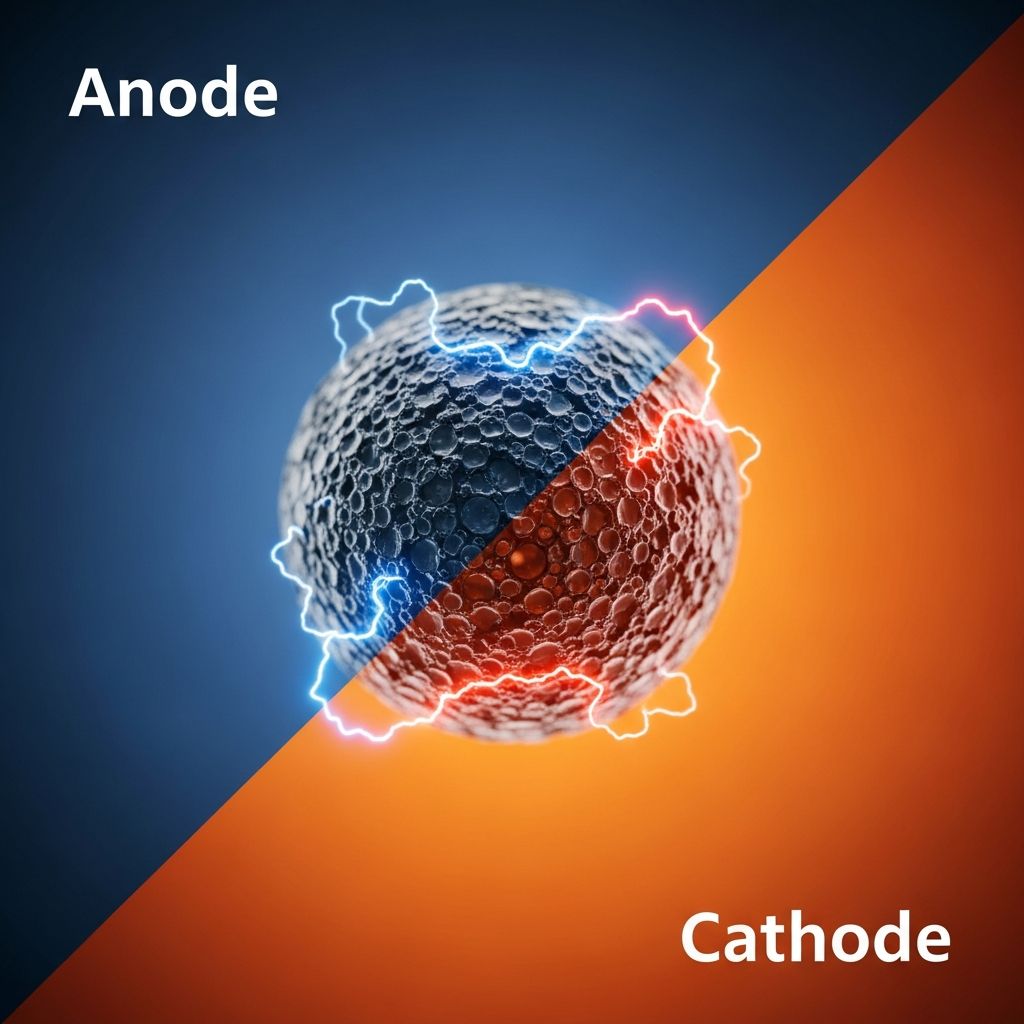
Understanding the roles of the **anode** and **cathode** is fundamental to grasping electrochemistry, powering everything from everyday batteries to industrial processes. These electrodes are defined by the direction of electron flow and the chemical reactions they host, rather than fixed positive or negative charges.
Core Principles of Electrodes in Electrochemistry
In any electrochemical cell, two electrodes facilitate the transfer of electrons: the anode and the cathode. The key distinction lies in the reactions occurring at each. Oxidation, the loss of electrons, happens at the anode, while reduction, the gain of electrons, takes place at the cathode. This mnemonic—’An Ox, Red Cat’ (Anode Oxidation, Reduction Cathode)—helps remember their functions.
Conventional current, the flow of positive charge, enters the device at the anode and exits at the cathode. Electrons, being negative, move oppositely: from anode to cathode through the external circuit.
Electrochemical Reactions Defined
- Oxidation at the Anode: Atoms or ions lose electrons, increasing their oxidation state. For example, in a zinc-copper cell, Zn → Zn²⁺ + 2e⁻.
- Reduction at the Cathode: Species gain electrons, decreasing oxidation state, such as Cu²⁺ + 2e⁻ → Cu.
These half-reactions combine in a full cell reaction, driving electron flow.
Galvanic Cells: Spontaneous Power Sources
Galvanic or voltaic cells generate electricity from spontaneous redox reactions, like in batteries. Here, the anode is the negative electrode, releasing electrons, and the cathode is positive, accepting them.
In a standard Daniell cell:
- Anode (zinc): Oxidation occurs, electrons flow out.
- Cathode (copper): Reduction happens, electrons flow in.
- A salt bridge maintains charge balance by allowing ion migration.
During discharge, the anode depletes as material oxidizes.
Electrolytic Cells: Driven by External Power
Unlike galvanic cells, electrolytic cells use external voltage to force non-spontaneous reactions, such as electroplating or electrolysis of water. Here, the anode is positive, attracting anions for oxidation, and the cathode is negative, attracting cations for reduction.
| Feature | Galvanic Cell | Electrolytic Cell |
|---|---|---|
| Anode Charge | Negative | Positive |
| Cathode Charge | Positive | Negative |
| Reaction Type | Spontaneous | Non-spontaneous |
| Power Source | Chemical energy | Electrical energy |
This reversal highlights that anode/cathode roles are process-dependent, not inherently tied to polarity.
Rechargeable Batteries: Role Reversal
In secondary batteries like lithium-ion, electrodes switch roles during charge and discharge. During discharge (powering a device):
- Negative electrode (anode): Oxidizes, releases electrons.
- Positive electrode (cathode): Reduces, accepts electrons.
During charging:
- Positive electrode becomes anode (oxidation).
- Negative electrode becomes cathode (reduction).
This duality emphasizes naming by function over fixed terminals.
Real-World Applications
Batteries and Energy Storage
Alkaline batteries use zinc as anode (Zn → ZnO) and manganese dioxide as cathode. Lithium-ion batteries feature graphite anodes and lithium metal oxide cathodes, enabling high energy density.
Electrolysis and Industrial Processes
In water electrolysis, the anode oxidizes hydroxide ions to oxygen, while the cathode reduces water to hydrogen. This powers green hydrogen production.
Corrosion Prevention
Sacrificial anodes, like magnesium or zinc blocks attached to ships, corrode preferentially (anodic protection), protecting the hull (cathode).
Electroplating
The object to plate is the cathode, where metal ions reduce onto its surface from an anode-dissolving solution.
Common Misconceptions Clarified
A frequent error is assuming anodes are always negative. In electrolytic cells, the anode is positive. Another is confusing electron vs. conventional current flow.
- Mnemonic: ACID (Anode Current In Device) for conventional current.
- Electron flow: Anode to Cathode externally.
Advanced Concepts: Potentials and Kinetics
Electrode potential shifts with current. For an anode, potential exceeds equilibrium (E_a(I) > E_{I=0}); for cathode, it’s below (E_c(I) < E_{I=0}). This drives reactions.
In batteries, overpotential affects efficiency, influencing charge/discharge rates.
Frequently Asked Questions (FAQs)
What is the main difference between anode and cathode?
The anode is where oxidation (electron loss) occurs; the cathode is where reduction (electron gain) occurs.
Is the anode always negative?
No, in galvanic cells yes, but in electrolytic cells, it’s positive.
How do anodes and cathodes work in rechargeable batteries?
They reverse: discharge anode is negative, charge anode is positive.
What happens if anode and cathode are swapped?
The cell won’t function correctly; reactions rely on specific material potentials.
Why use sacrificial anodes in marine applications?
They oxidize instead of the ship, preventing corrosion.
Experimental Insights
Build a simple galvanic cell with copper and zinc strips in electrolyte (vinegar/saltwater). Connect via wire with LED: electrons flow anode (Zn, bubbles) to cathode (Cu, plating).
Safety: Avoid strong acids; use gloves.
References
- Components of Cells and Batteries — University of Washington, Department of Materials Science & Engineering. Accessed 2026. https://depts.washington.edu/matseed/batteries/MSE/components.html
- Cathode and Anode — BYJU’S (educational resource). Accessed 2026. https://byjus.com/chemistry/cathode-and-anode/
- Anode vs Cathode: What’s the difference? — BioLogic. Accessed 2026. https://www.biologic.net/topics/anode-cathode-positive-and-negative-battery-basics/
- Anode vs Cathode: What’s the Difference? — Dragonfly Energy. Accessed 2026. https://dragonflyenergy.com/anode-vs-cathode/
- Anode — Wikipedia (for reference; primary sources preferred). Accessed 2026. https://en.wikipedia.org/wiki/Anode
- How to Define Anode and Cathode — AV8N.com (physics education). Accessed 2026. https://www.av8n.com/physics/anode-cathode.htm
- What’s the Anode, Cathode, and Salt Bridge? — chemistNATE (YouTube educational video). 2013-01-31. https://www.youtube.com/watch?v=a2v7ph3kLXo

- Integrated M.A. in Applied Linguistics, University of Hyderabad
- 5+ years in editorial, instructional, SEO, and research-based writing
Sneha is a relationships and lifestyle writer with a strong foundation in applied linguistics and certified training in relationship coaching. She brings over five years of writing experience to theskillvault, crafting thoughtful, research-driven content that empowers readers to build healthier relationships, boost emotional well-being, and embrace holistic living. Her writing and insights reflect the belief that beauty, happiness, and wellness…