
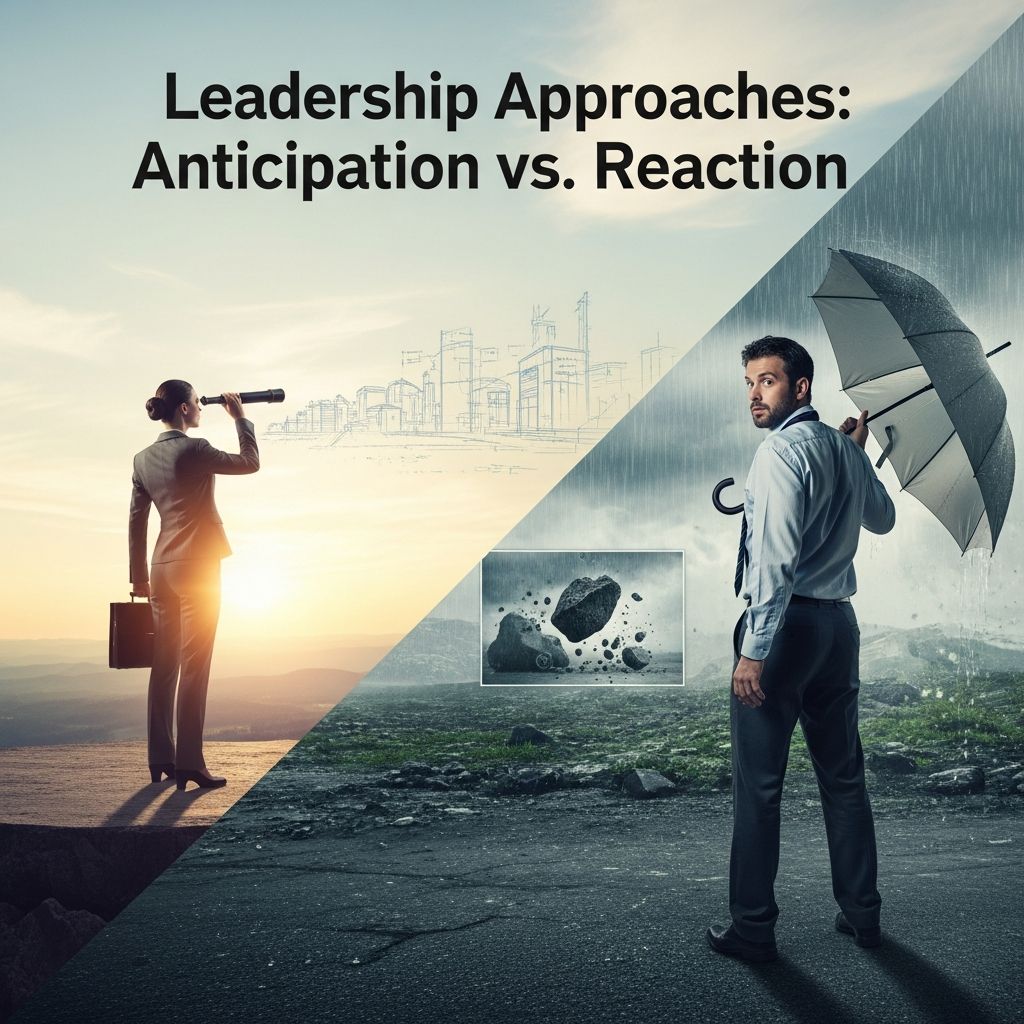
Understanding Two Fundamental Leadership Orientations
Every leader operates along a spectrum defined by how they engage with organizational challenges and opportunities. Some leaders spend considerable energy forecasting potential difficulties and constructing frameworks to prevent them from materializing. Others excel at identifying emerging situations and mobilizing rapid responses. Neither approach exists in a vacuum, and the most effective leaders understand when each orientation serves their organization best.
The distinction between these two leadership orientations shapes everything from team morale to strategic positioning. Leaders who favor anticipation tend to invest heavily in planning cycles, scenario development, and preventive measures. Those who favor responsiveness build capabilities around adaptability, crisis management, and tactical flexibility. Understanding these differences allows organizations to make intentional choices about leadership development and succession planning.
The Foundation of Anticipatory Leadership
Anticipatory leadership rests on a fundamental belief: many organizational challenges can be prevented or minimized through foresight and systematic planning. These leaders invest time studying market signals, analyzing historical patterns, and engaging their teams in horizon-scanning exercises. The goal is to identify potential complications before they demand urgent attention.
Anticipatory leaders typically establish governance structures that prevent bottlenecks and empower team members to address challenges independently. They view their role as creating conditions for success rather than solving every problem personally. This approach creates space for innovation because teams are not constantly responding to crises. Instead, they can experiment, develop new capabilities, and pursue strategic initiatives aligned with long-term vision.
These leaders also recognize that sustainable competitive advantage comes from addressing root causes rather than symptoms. When a delivery system falters, an anticipatory leader investigates whether the vendor relationship requires restructuring, whether logistics infrastructure needs upgrading, or whether demand forecasting processes need refinement. By treating problems as signals of systemic issues, they build organizational resilience that extends far beyond the immediate situation.
The Strengths of Responsive Leadership
Responsive leaders excel in environments where conditions shift rapidly and uncertainty prevails. They develop exceptional intuition about what situations demand immediate attention and what can wait. Their decision-making frameworks prioritize speed and practicality over comprehensive analysis, allowing organizations to seize fleeting opportunities or neutralize emerging threats before they escalate.
Teams led by responsive managers often develop superior crisis management capabilities. These organizations become comfortable operating under pressure and develop creative problem-solving approaches through repeated practice. Individuals in these environments frequently demonstrate high levels of initiative and ownership, recognizing that waiting for perfect information or approval from leadership hierarchy will result in missed opportunities or deteriorating situations.
Responsive approaches prove invaluable in industries experiencing technological disruption, regulatory upheaval, or volatile market conditions. Rather than investing in elaborate plans that may become obsolete within months, responsive leaders maintain organizational agility by staying alert to changing circumstances and adjusting course accordingly. This flexibility can represent a significant competitive advantage in environments where adaptability matters more than predictability.
Comparative Framework: Key Dimensions of Leadership Orientation
| Leadership Dimension | Anticipatory Approach | Responsive Approach |
|---|---|---|
| Primary Focus | Future possibilities and prevention | Present circumstances and adaptation |
| Decision Framework | Data-driven analysis and long-term impact assessment | Situational awareness and intuitive judgment |
| Resource Allocation | Investment in preparation and capability building | Deployment when problems materialize |
| Team Development | Comprehensive training and mentorship programs | Learning through experience and problem-solving |
| Innovation Culture | Encourages experimentation and forward-thinking | May prioritize immediate solutions over exploration |
| Change Management | Planned transitions with clear roadmaps | Rapid adjustment to unexpected shifts |
| Stress Profile | Lower acute stress through prevention and planning | Higher pressure intensity but shorter duration |
| Leadership Perception | Often viewed as visionary or strategic | Often viewed as pragmatic or decisive |
Consequences of Over-Reliance on Responsive Leadership
While responsive approaches offer genuine advantages, exclusive reliance on reactivity creates organizational vulnerabilities. Teams operating in perpetual crisis mode experience elevated stress levels that can lead to burnout and turnover among capable employees. The constant pressure to address immediate problems leaves little bandwidth for the deep thinking required for meaningful improvement.
Organizations trapped in purely reactive cycles often find themselves repeating similar problems. Without systematic analysis of root causes, the same issues resurface repeatedly, each time consuming resources and attention. This pattern creates a culture of exhaustion where success is measured by surviving the current crisis rather than building toward desired futures.
Additionally, the short-term focus inherent in reactive leadership can compromise long-term competitiveness. Strategic investments in new capabilities, market exploration, and organizational infrastructure get deferred because urgent matters always take priority. Over time, organizations find themselves falling behind competitors who invested in anticipatory positioning.
Limitations of Exclusively Anticipatory Leadership
Conversely, leaders who invest exclusively in anticipation risk creating overly complex planning processes that slow decision-making. Extensive preparation can become an excuse for inaction, and organizations may become so focused on preventing problems that they miss emerging opportunities requiring swift response. Anticipatory frameworks built on assumptions that later prove incorrect can channel resources toward non-issues while blind spots create actual problems.
Additionally, anticipatory leaders sometimes underestimate the value of team members’ experiential knowledge. By insisting on following predetermined plans, they may dismiss insights from people closest to operational realities who recognize when circumstances have shifted. This can create cultures where following procedure matters more than achieving results.
Contextual Fitness: Knowing When to Emphasize Each Approach
The most successful leaders recognize that different organizational contexts call for different orientations. In stable industries with predictable conditions, anticipatory leadership creates significant advantages. Market research, long-term planning, and capability development generate substantial returns because the future resembles the past closely enough that forecasting proves reliable. Innovation-driven sectors, infrastructure development, and strategic expansion initiatives all benefit from leaders who invest in thorough planning before execution.
By contrast, crisis situations, rapid market disruptions, and operating environments characterized by high uncertainty demand responsive orientation. When a supply chain suddenly fractures, when regulatory changes require immediate operational adjustments, or when competitive threats emerge unexpectedly, organizations need leaders who can make swift decisions and mobilize rapid action. Speed of response often determines survival in these circumstances.
Many organizations operate in hybrid environments that benefit from blended approaches. A technology company might apply anticipatory thinking to product roadmap development while maintaining responsive capabilities for bug fixes and customer emergencies. A hospital might use anticipatory planning for infrastructure and workforce development while keeping responsive expertise for medical emergencies and infectious disease outbreaks.
Developing Balanced Leadership Capability
Rather than identifying as either anticipatory or responsive leaders, high-performing executives develop competence in both orientations. This requires intentional skill development across several dimensions:
Strategic Foresight Abilities
Leaders benefit from developing stronger capacity to identify emerging trends, scan competitive landscapes, and imagine alternative futures. This might involve formal training in scenario planning, participation in industry conferences, and structured engagement with diverse perspectives outside immediate business operations.
Crisis Management Capabilities
Organizations should invest in building their leaders’ ability to function effectively under pressure, make sound decisions with incomplete information, and mobilize teams during urgent situations. Simulation exercises, case study analysis, and real crisis debriefs all contribute to developing this competence.
Emotional Intelligence and Resilience
Both anticipatory and responsive leadership demand emotional resources. Leaders need self-awareness about their natural preferences, resilience to handle extended periods of uncertainty, and interpersonal skills to maintain team confidence during challenging situations. Coaching and development programs focusing on these dimensions strengthen leadership capacity.
Systems Thinking
Whether operating anticipatorily or responsively, leaders need to understand how organizational systems interact. This enables them to anticipate unintended consequences of decisions and recognize how responding to one crisis might create another. Systems thinking also helps leaders identify high-leverage intervention points where modest effort creates disproportionate results.
Building Organizational Cultures Supporting Both Orientations
Beyond individual leader development, organizations can create cultures that naturally integrate both approaches. Structures that encourage reflection and continuous improvement help responsive-oriented teams extract learning from their crisis experiences. Cross-functional teams mixing people from anticipatory and responsive backgrounds create productive tension that improves decision quality.
Organizations might also implement time horizons that explicitly allocate leadership attention differently. Some planning cycles explicitly create space for anticipatory work—strategy sessions, innovation initiatives, capability development—while other rhythms focus on responsive execution and real-time problem-solving. This prevents either orientation from completely dominating organizational life.
Frequently Asked Questions
Q: Can someone naturally excel at both anticipatory and responsive leadership?
A: Yes, though most leaders have natural preferences for one orientation. The good news is that both capabilities can be developed through deliberate practice, coaching, and exposure to different scenarios. Leaders who work intentionally on their non-preferred style often find it becomes more natural over time.
Q: How do I know which leadership orientation my organization needs most right now?
A: Assess your current environment by considering market stability, competitive threats, team capabilities, and strategic priorities. Stable environments with clear long-term opportunities benefit from anticipatory leadership. Unstable environments with rapid changes require stronger responsive capacity. Most organizations benefit from balanced development of both capabilities.
Q: Can teams have different leadership styles than their leaders?
A: Teams often develop cultural norms that reflect their leader’s orientation, but this isn’t inevitable. Diverse team composition, explicit permission for different working styles, and structures that accommodate both planning and rapid execution allow teams to develop hybrid capabilities even when leaders have strong preferences.
Q: How do I transition a team from reactive to anticipatory mode?
A: This requires patience and deliberate change management. Start by reducing crisis frequency through small improvements to planning processes. Invest in training and tools that support anticipatory thinking. Create protected time for strategic work. Celebrate instances where anticipatory planning prevented problems, not just where teams solved crises brilliantly.
Q: What’s the relationship between leadership orientation and employee engagement?
A: Anticipatory leadership generally correlates with higher engagement because employees feel prepared and supported. However, responsive teams can also show high engagement if members feel trusted to make decisions and their contributions are valued. The key is ensuring team members feel equipped and empowered, regardless of the leadership orientation.
References
- Reactive vs. Proactive Management Styles: Which One Gets Results? — BetterUp. 2024. https://www.betterup.com/blog/reactive-vs-proactive
- Proactive vs Reactive Leadership: Balancing Both Management Styles — ECI Coaching. 2025. https://ecicoaching.com/2025/04/14/proactive-vs-reactive-leadership-balancing-both-management-styles/
- How to Balance a Proactive And Reactive Leadership Approach — The Strath Strategy Group. 2024. https://www.tssg.ca/balancing-proactive-and-reactive-leadership/
- Proactive vs. Reactive Management: Differences & Best Approach — Salesmate. 2024. https://www.salesmate.io/blog/proactive-vs-reactive/
- Proactive vs Reactive Leadership: The Ultimate Guide [2024] — Midwest Teachers Institute. 2024. https://www.midwestteachersinstitute.org/proactive-vs-reactive-leadership/

- Integrated M.A. in Applied Linguistics, University of Hyderabad
- 5+ years in editorial, instructional, SEO, and research-based writing
Sneha is a relationships and lifestyle writer with a strong foundation in applied linguistics and certified training in relationship coaching. She brings over five years of writing experience to theskillvault, crafting thoughtful, research-driven content that empowers readers to build healthier relationships, boost emotional well-being, and embrace holistic living. Her writing and insights reflect the belief that beauty, happiness, and wellness…