
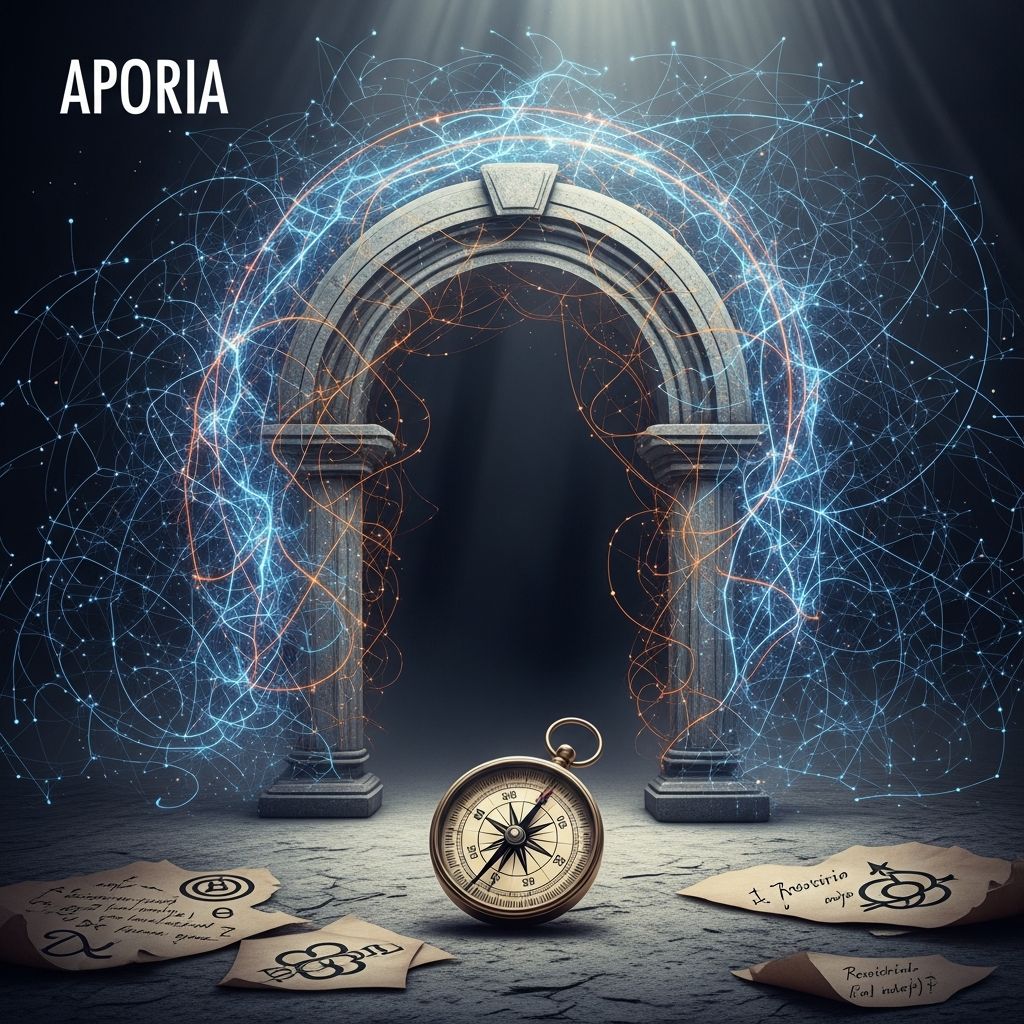
Aporia represents a fascinating intersection of philosophy and language, embodying moments of profound doubt and intellectual deadlock. Derived from ancient Greek, it signifies a pathless state—either a genuine puzzle that halts reasoning or a strategic expression of uncertainty designed to persuade. This article examines aporia’s origins, its philosophical depth, rhetorical applications, literary manifestations, and enduring legacy in contemporary thought.
Origins and Etymology of Aporia
The term aporia stems from the Greek word aporía, meaning ‘lack of passage’ or ‘impasse.’ In classical antiquity, it described situations where no clear way forward existed, evoking a sense of being stranded without resources. Philosophers like Aristotle integrated it into their investigative frameworks, using it to highlight contradictions that demand deeper scrutiny.
Etymologically, ‘a-‘ (without) and ‘poros’ (passage or way) combine to paint a picture of blockage. This metaphor extends beyond physical barriers to mental ones, where arguments collide and reasoning stalls. Early Greek thinkers employed aporia not as defeat but as a catalyst for inquiry, pushing boundaries of knowledge.
- Key linguistic roots: Ancient Greek ᾰ̓πορῐ́ᾱ, implying puzzlement or difficulty.
- Evolution: From literal impasse to abstract philosophical tool.
- Modern connotations: Paradox, deadlock, or feigned hesitation.
Aporia in Philosophical Inquiry
In philosophy, aporia functions as a deliberate puzzle or irresolvable tension arising from conflicting premises. It marks the frontier of understanding, where logic falters and new insights emerge from the friction. Plato’s Socratic dialogues exemplify this, with Socrates guiding interlocutors to aporia, exposing flaws in unexamined beliefs.
Aristotle’s Metaphysics employs aporiai as structured lists of dilemmas to frame debates, methodically dismantling assumptions before reconstruction. This aporetic method underscores philosophy’s dialectical nature: thesis meets antithesis in a standoff, birthing synthesis. Post-structuralists like Jacques Derrida later revived it, viewing texts as inherently aporetic—riddled with undecidable meanings that deconstruct themselves.
| Philosopher | Aporia Application | Example |
|---|---|---|
| Plato/Socrates | Dialogue-induced puzzlement | Interlocutors unable to define justice |
| Aristotle | Methodical impasse lists | Metaphysics puzzles on being |
| Derrida | Deconstructive undecidability | Contradictions in Rousseau’s nature/culture |
Contemporary analytic philosophy uses aporia to test theories, ensuring robustness against paradoxes. Unlike mere confusion, philosophical aporia demands active engagement, fostering humility and openness.
Rhetorical Dimensions of Aporia
Shifting to rhetoric, aporia becomes a performative device: an expressed doubt, often pretended, to engage audiences or undermine opponents. Speakers pose as perplexed to draw listeners in, then resolve the ‘dilemma’ toward their point.
Aristotle classified it among pathos-driven techniques, where feigned ignorance builds ethos. In debates, it discredits rivals by mirroring their inconsistencies back, amplified through humility. Modern oratory, from political speeches to sermons, leverages it subtly—’I wonder how we might resolve this…’ invites collective pondering.
- Genuine aporia: Authentic uncertainty for emphasis.
- Feigned aporia: Strategic pretense to persuade.
- Effects: Builds rapport, highlights contradictions, prompts reflection.
This duality distinguishes aporia from paradox: paradoxes self-contradict logically, while aporia may stem from inquiry’s limits without necessitating contradiction.
Aporia Across Literature and Culture
Literature brims with aporia, where characters or narrators grapple with insoluble riddles. Oscar Wilde’s wit, like ‘I can resist anything except temptation,’ embodies philosophical aporia—a quip revealing human inconsistency. Elizabeth Barrett Browning’s sonnet feigns doubt (‘How do I love thee? Let me count the ways’) to catalog devotion, a rhetorical masterstroke.
In postmodern works, aporia underscores narrative unreliability. Texts by Derrida-inspired critics reveal ‘knots’ where meaning unravels, subverting stable interpretations. Sports philosophy even adapts it: aporia as ‘head-up’ awareness, balancing structure with improvisation, akin to a point guard navigating defenses.
Cultural narratives often embed aporia in origin myths or ethical tales, mirroring life’s ambiguities. From Greek tragedies to existential novels, it humanizes protagonists, inviting readers to ponder alongside.
Modern and Pedagogical Applications
Today, aporia informs education as a Socratic tool. Teachers induce puzzlement to spark critical thinking, echoing Proctor Academy’s view of it as ‘open responsiveness’—questioning without premature closure. In analytic philosophy, it probes AI ethics or quantum paradoxes, where classical logic yields aporia.
Deconstructionists treat aporia as textual inevitability: gaps between intent and expression create undecidable binds. This challenges binary thinking, promoting nuanced discourse in polarized times.
Distinguishing Aporia from Related Concepts
| Concept | Key Traits | Relation to Aporia |
|---|---|---|
| Paradox | Self-contradictory statement | May induce aporia; not all aporiae are paradoxical |
| Dilemma | Forced choice between undesirables | Aporia broadens to any impasse |
| Doubt | Simple uncertainty | Aporia is expressed or structured doubt |
These distinctions clarify aporia’s unique role: not just confusion, but productive perplexity.
Frequently Asked Questions (FAQs)
What is the primary difference between philosophical and rhetorical aporia?
Philosophical aporia is a genuine logical impasse in reasoning, while rhetorical aporia often involves pretended doubt for persuasive effect.
How did Socrates use aporia in his method?
Socrates employed questioning to lead interlocutors to aporia, revealing knowledge gaps and encouraging self-examination.
Is aporia always negative?
No; it catalyzes deeper inquiry and creative breakthroughs, transforming deadlock into opportunity.
Can aporia appear in everyday language?
Yes, phrases like ‘I’m at a loss for words’ echo aporia, expressing momentary impasse.
How does Derrida’s use of aporia differ from classical views?
Derrida sees it as inherent textual deconstruction, undecidable meanings dismantling structure.
Conclusion: Embracing Intellectual Impasses
Aporia endures as a testament to human curiosity’s limits and potentials. By confronting pathless moments, thinkers and speakers alike navigate complexity, enriching discourse. Whether in ancient forums or digital debates, it reminds us: true wisdom begins in doubt.
References
- Aporia – Wikipedia — Wikipedia contributors. 2023-10-15. https://en.wikipedia.org/wiki/Aporia
- What is Aporia — Rhetoric’s Secret Weapon Explained — StudioBinder. 2023. https://www.studiobinder.com/blog/what-is-aporia-definition/
- Aporia – Definition and Examples — LitCharts. 2023. https://www.litcharts.com/literary-devices-and-terms/aporia
- Aporia – Literary Theory and Criticism — Literariness.org. 2016-03-22. https://literariness.org/2016/03/22/aporia/
- Contradiction and Aporia in Early Greek Philosophy — Cambridge University Press (excerpt). 2016. https://assets.cambridge.org/97811071/10151/excerpt/9781107110151_excerpt.pdf

Medha Deb is an editor with a master's degree in Applied Linguistics from the University of Hyderabad. She believes that her qualification has helped her develop a deep understanding of language and its application in various contexts. Medha specializes in the areas of beauty, health, sports, and wellness and is committed to ensuring that the content on the website is…