
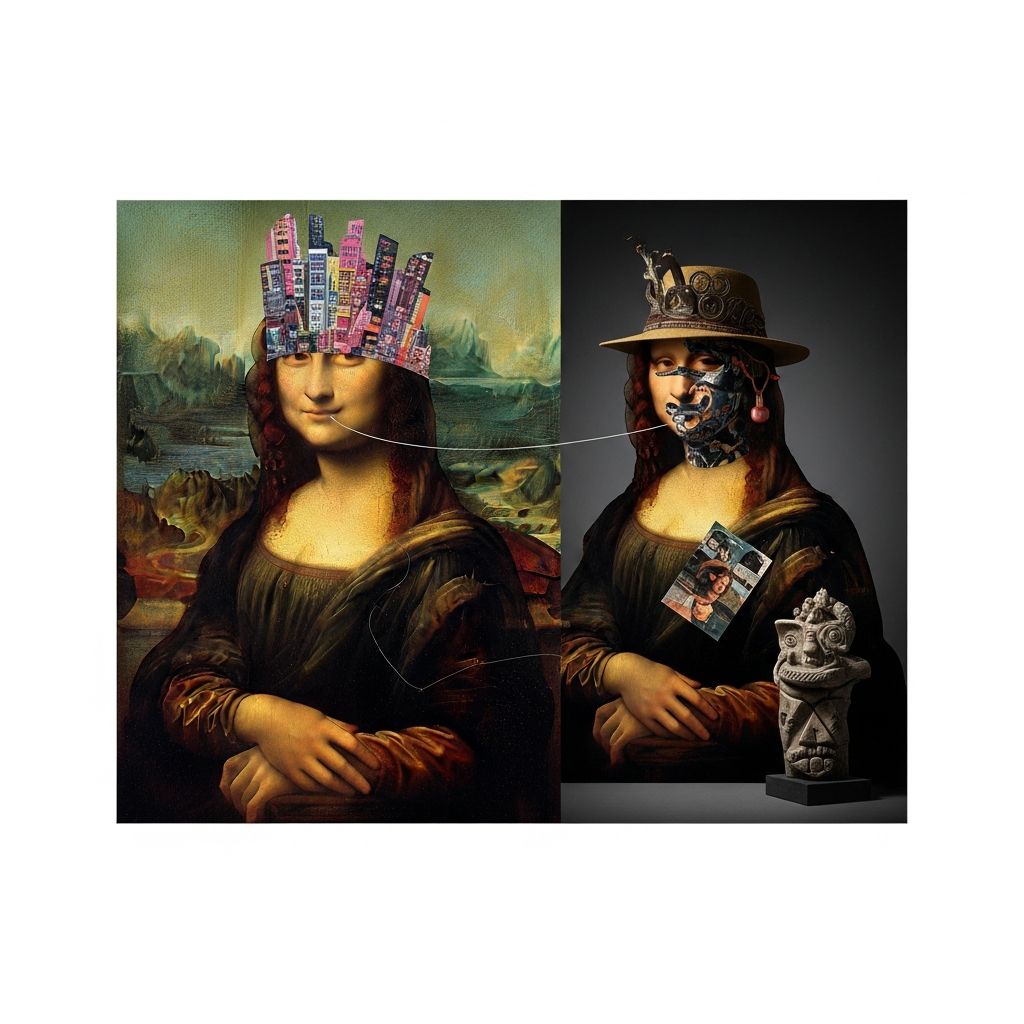
Appropriation in art represents a provocative strategy where creators intentionally draw from pre-existing images, objects, or ideas, often with minimal alteration, to forge new meanings and challenge conventional notions of originality.
Defining the Essence of Artistic Borrowing
At its core, appropriation involves artists selecting elements from established visual culture—be it photographs, sculptures, or everyday items—and integrating them into their own creations through recontextualization. This technique shifts the borrowed material’s original intent, infusing it with fresh interpretations that provoke thought on ownership, authenticity, and cultural value.
Unlike outright copying, true appropriation demands transformation: a subtle repositioning or juxtaposition that alters perception. For instance, placing a mundane object in a gallery setting elevates it to fine art status, questioning what constitutes ‘art’ itself. This practice spans visual arts but echoes in literature, music, and performance, underscoring its versatility as a creative tool.
Historical Foundations: From Cubism to Dada
The roots of appropriation trace back to early 20th-century movements like Cubism, where Pablo Picasso and Georges Braque incorporated real-world fragments such as newspaper clippings into collages, blurring lines between representation and reality. This innovation represented a departure from pure invention, embracing the chaos of modern life.
Dadaism amplified this approach through Marcel Duchamp’s readymades. His infamous Fountain (1917)—a signed porcelain urinal—epitomized appropriation by presenting a mass-produced item as sculpture, mocking artistic pretensions and institutional gatekeeping. Duchamp’s work forced audiences to confront the subjective nature of art valuation.
Surrealism furthered the trend with hybrid objects like Salvador Dalí’s Lobster Telephone, merging disjointed found elements to evoke the subconscious. By the 1950s, Pop Art artists Jasper Johns and Robert Rauschenberg layered appropriated flags, targets, and consumer goods, critiquing postwar materialism.
Pop Art’s Commercial Embrace
Andy Warhol epitomized Pop Art’s appropriation in the 1960s, silkscreening mass-media icons like Marilyn Monroe and Campbell’s soup cans. These repetitions highlighted celebrity culture’s commodification, transforming ephemeral images into enduring critiques of consumerism.
- Warhol’s technique democratized art by mimicking industrial production.
- It blurred distinctions between high art and advertising.
- His works sparked debates on whether repetition diminishes or enhances meaning.
This era solidified appropriation as a mainstream strategy, influencing generations by validating the recycle of cultural detritus.
1980s Renaissance: Postmodern Provocations
The 1980s saw a surge with the ‘Pictures’ generation, including Sherrie Levine, who rephotographed iconic images like Walker Evans’ Depression-era portraits, titling them After Walker Evans. This act interrogated authorship, suggesting all images are reiterations.
Jeff Koons elevated banal objects—vacuum cleaners, inflatables—into polished sculptures, aping luxury goods to satirize taste hierarchies. Neo-Expressionism and Neo-Geo groups similarly borrowed, using appropriation to dismantle modernist myths of genius.
| Artist | Key Work | Appropriation Method | Impact |
|---|---|---|---|
| Sherrie Levine | After Walker Evans | Re-photographing | Questions originality |
| Jeff Koons | New Hoover Quad | Readymade polishing | Satirizes consumerism |
| Cindy Sherman | Untitled Film Stills | Self-appropriation of media tropes | Critiques gender roles |
Ethical and Legal Battlegrounds
Appropriation thrives on tension between inspiration and infringement. Legally, U.S. fair use doctrine permits transformative works under the 1961 Modern Art: Painting, Sculpture, Architecture, Photography precedents, provided they comment on or parody originals. Yet, cases like Richard Prince’s Instagram appropriations have tested boundaries, with courts weighing parody against market harm.
Ethically, critics decry cultural appropriation—non-indigenous artists adopting sacred motifs without context—as exploitative. Distinguishing respectful homage from theft hinges on intent and added value: mere replication fails, but meaningful recontextualization elevates.
- Pro-Appropriation: Fosters innovation, democratizes art.
- Anti-Appropriation: Risks erasure of marginalized voices.
- Balanced View: Requires cultural sensitivity and transformation.
Contemporary Innovations and Digital Frontiers
Today, appropriation flourishes in street art, memes, and AI-generated hybrids. Banksy’s stencils repurpose propaganda imagery for political bite; digital artists mashup NFT screenshots, probing blockchain ownership. Social media accelerates this, with viral remixes embodying postmodern fragmentation.
Emerging tech like deepfakes and generative AI—training on vast image banks—intensifies debates. Artists like Refik Anadol appropriate datasets to birth immersive installations, raising questions of collective authorship in the machine age.
Philosophical Underpinnings: Benjamin to Krauss
Walter Benjamin’s 1934 essay The Work of Art in the Age of Mechanical Reproduction argued replication erodes aura, paving appropriation’s theoretical ground. Rosalind Krauss later championed it as avant-garde myth-busting, affirming borrowed originality.
These ideas underscore appropriation’s role in deconstructing genius myths, affirming art as dialogic—conversing with history rather than inventing in isolation.
Case Studies: Iconic Examples Analyzed
- Duchamp’s Fountain: Urinal as art object; rejected from exhibitions, sparking Dada rebellion.
- Warhol’s Marilyn Diptych: Serial silkscreens mourn celebrity mortality.
- Levine’s Recreations: Doubles challenge photographic truth.
- Koons’ Balloon Dog: Inflatable kitsch as monumental bronze.
Each exemplifies recontextualization’s power to subvert expectations.
Frequently Asked Questions (FAQs)
What distinguishes appropriation from plagiarism?
Appropriation transforms and comments on source material, adding new context; plagiarism copies without alteration or credit.
Is appropriation always controversial?
Not inherently—when transformative, it’s celebrated; issues arise sans meaningful change or cultural insensitivity.
Can appropriation apply outside visual arts?
Yes, in music sampling, literary allusions, and theater remixes, recontextualizing priors innovatively.
How has technology changed appropriation?
Digital tools enable seamless remixing, AI accelerates generation, but intensify ownership disputes.
What’s the future of appropriation art?
With globalization and AI, expect hybrid forms addressing identity, climate, and virtual realities.
Practical Tips for Aspiring Appropriation Artists
For newcomers:
- Research originals deeply for informed commentary.
- Document transformations to claim fair use.
- Engage communities to avoid harm.
- Experiment boldly—context is king.
This approach ensures ethical, impactful work.
References
- Appropriation (art) — Wikipedia. 2023-10-15. https://en.wikipedia.org/wiki/Appropriation_(art)
- Appropriation In The Visual Arts: A Historical And Contemporary Exploration — America’s Collections. 2022-05-12. https://americascollection.com/education/appropriation-in-the-visual-arts-a-historical-and-contemporary-exploration/
- What Is Appropriation in Art? — The Collector. 2023-08-20. https://www.thecollector.com/what-is-appropriation-in-art/
- Appropriation – Art: Visual Plagiarism — Leander ISD LibGuides. 2024-01-10. https://hslibguides.leanderisd.org/c.php?g=1261910&p=9267325
- Appropriation — Tate. 2023-11-05. https://www.tate.org.uk/art/art-terms/a/appropriation
- Appropriation In Art Explained (Updated) — YouTube (Frank Curkovic). 2022-06-18. https://www.youtube.com/watch?v=OZcGi_jzcxo

Medha Deb is an editor with a master's degree in Applied Linguistics from the University of Hyderabad. She believes that her qualification has helped her develop a deep understanding of language and its application in various contexts. Medha specializes in the areas of beauty, health, sports, and wellness and is committed to ensuring that the content on the website is…