
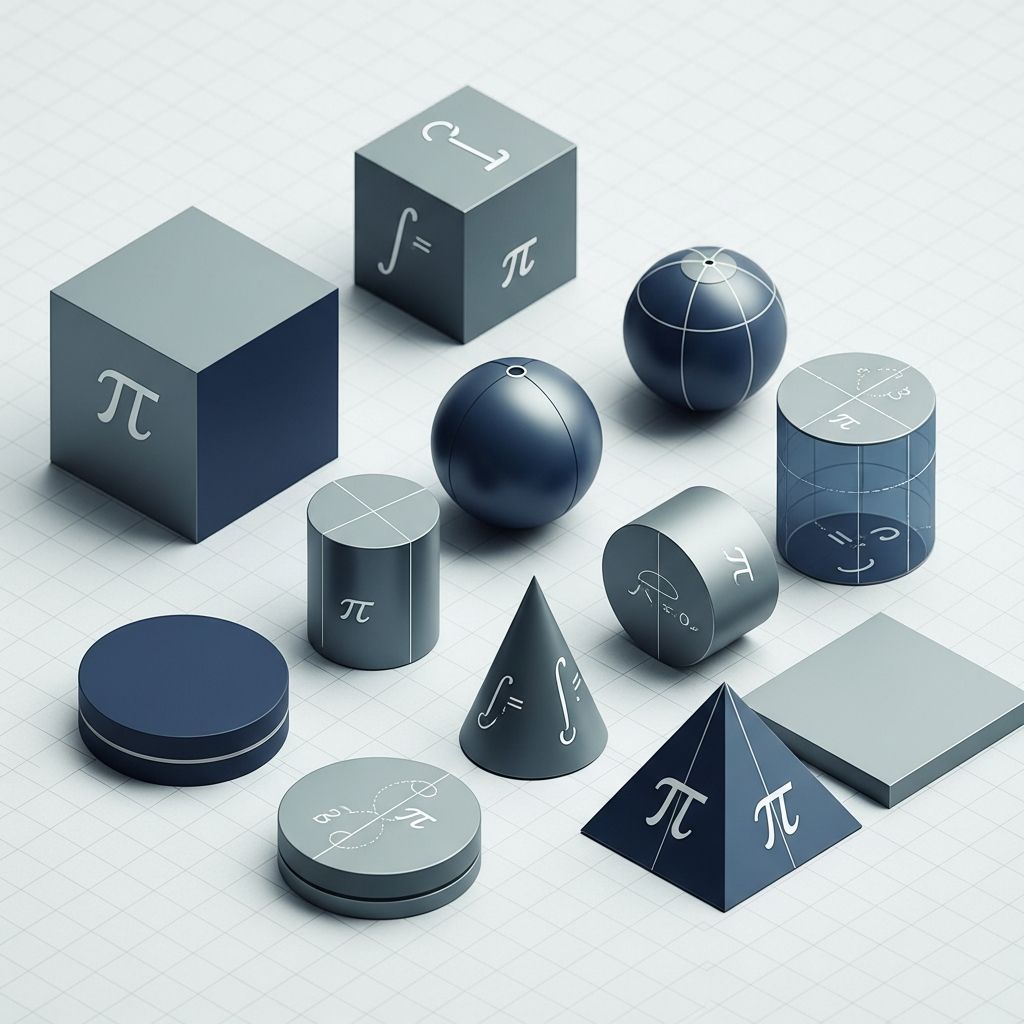
Understanding how to compute the **area** of two-dimensional shapes and the **volume** of three-dimensional objects forms the foundation of geometry. Area measures surface space in square units, while volume quantifies the space inside solids in cubic units. This guide provides essential formulas, derivations, examples, and applications to build confidence in these calculations.
Fundamentals of Area Measurement
Area calculation begins with basic polygons and extends to curved figures. Always ensure measurements use consistent units, such as meters or inches, to yield results in square meters or square inches.
Rectangles and Squares
The simplest shape, a rectangle, has area given by length times width: A = l × w. For a square, where all sides equal s, it simplifies to A = s².
Example: A room measures 12 feet by 10 feet. Area = 12 × 10 = 120 square feet.
Triangles
Any triangle’s area is half base times height: A = (1/2) × b × h. The height is perpendicular distance from base to opposite vertex.
| Triangle Type | Base (b) | Height (h) | Area Example |
|---|---|---|---|
| Right | 5 cm | 4 cm | (1/2)×5×4=10 cm² |
| Equilateral (side a) | a | (√3/2)a | (√3/4)a² |
| Isosceles | base | altitude | Calculate as standard |
Parallelograms and Trapezoids
Parallelogram area mirrors the triangle formula doubled: A = b × h. Trapezoids use average of parallel sides: A = (1/2) × h × (b₁ + b₂).
Example: Trapezoid with bases 10 yd and 24 yd, height 12 yd: A = (1/2)×12×(10+24) = 204 yd².
Circles and Semicircles
Circle area is A = πr², where r is radius. Semicircle: A = (1/2)πr². π approximates 3.1416.
Rhombus area: A = side × height or using diagonals A = (d₁ × d₂)/2.
Advanced 2D Shapes
Polygons like pentagons require dividing into triangles, but regular ones have formulas: regular n-gon A = (1/2) × perimeter × apothem.
- Practical tip: For irregular shapes, use grid paper or decomposition into known figures.
- Annular regions (rings): subtract inner circle area from outer.
Introduction to Volume Concepts
Volume fills 3D space: V = base area × height for prisms, adjusted for pyramids and cones. Units cube: cm³ or m³.
Prisms and Cubes
Rectangular prism: V = l × w × h. Cube: V = a³. Any prism: V = base area × length.
Triangular prism example: base triangle area (1/2)bh, times prism height.
| Prism Type | Formula | Example Volume |
|---|---|---|
| Cube (side 3) | a³ | 27 units³ |
| Rectangular (4×5×6) | lwh | 120 units³ |
| Triangular | (1/2 base height) × prism h | Varies |
Cylinders
Cylinder volume: V = πr²h, base circle area times height.
Example: r=3 cm, h=10 cm: V=π×9×10≈282.74 cm³.
Pyramids and Cones
Pyramids: V = (1/3) × base area × height. Cone: V = (1/3)πr²h.
Pyramid example: square base 60×60=3600, V=66000=(1/3)×3600×h → h=55. Cone: r=7 ft, h=12 ft: V=(1/3)π×49×12=616 ft³.
Spheres
Sphere: V = (4/3)πr³. Diameter 6 m (r=3): V=(4/3)π×27=36π m³.
Surface Area Essentials
Often paired with volume, surface area covers outer faces.
- Cylinder: SA = 2πr(r + h).
- Sphere: SA = 4πr².
- Prism: sum of face areas.
From volume, derive: sphere SA = 4π(3V/4π)^{2/3}.
Composite Shapes and Real-World Applications
Combine volumes: add/subtract, e.g., cylinder + pyramid: 432π + 84π = 516π cm³.
Applications: packaging (box volumes), tanks (cylinder capacity), architecture (room areas), manufacturing (material needs). NIST emphasizes unit consistency for weights/measures.
Common Pitfalls and Tips
- Distinguish area (2D, sq units) from volume (3D, cu units).
- Height perpendicular to base.
- Use exact π or 3.14; calculators for precision.
- Convert units: 1 m³ = 1,000,000 cm³.
Practice Problems
- Rectangle 8m × 5m area?
- Cylinder r=5cm, h=14cm volume?
- Pyramid base 30 sq, h=8 volume?
- Sphere r=10.5 in volume?
Frequently Asked Questions (FAQs)
What units for area and volume?
Area: m², ft²; volume: m³, L (1L=0.001m³).
Difference between prism and pyramid volume?
Prism full base×h; pyramid 1/3 base×h.
How to find height from volume?
Rearrange: h = V / base area.
Volume of hemisphere?
(2/3)πr³.
Real-life volume use?
Pool capacity, soil for gardens.
References
- Volume Formula – Explanation, Examples & Practice Questions — Third Space Learning. 2023. https://thirdspacelearning.com/us/math-resources/topic-guides/geometry/volume-formula/
- Difference Between Area and Volume – Definition, Formulas, FAQs — SplashLearn. 2023. https://www.splashlearn.com/math-vocabulary/difference-between-area-and-volume
- Surface Areas and Volumes — GeeksforGeeks. 2024. https://www.geeksforgeeks.org/maths/surface-areas-and-volumes/
- 6.5: Area, Surface Area and Volume Formulas — LibreTexts (College of the Canyons). 2023-05-01. https://math.libretexts.org/Courses/College_of_the_Canyons/Math_130:_Math_for_Elementary_School_Teachers_(Lagusker)/06:_Geometry/6.05:_Area_Surface_Area_and_Volume_Formulas
- Circumference, Area and Volume — NIST.gov. 2023. https://www.nist.gov/pml/owm/circumference-area-and-volume

- Integrated M.A. in Applied Linguistics, University of Hyderabad
- 5+ years in editorial, instructional, SEO, and research-based writing
Sneha is a relationships and lifestyle writer with a strong foundation in applied linguistics and certified training in relationship coaching. She brings over five years of writing experience to theskillvault, crafting thoughtful, research-driven content that empowers readers to build healthier relationships, boost emotional well-being, and embrace holistic living. Her writing and insights reflect the belief that beauty, happiness, and wellness…