
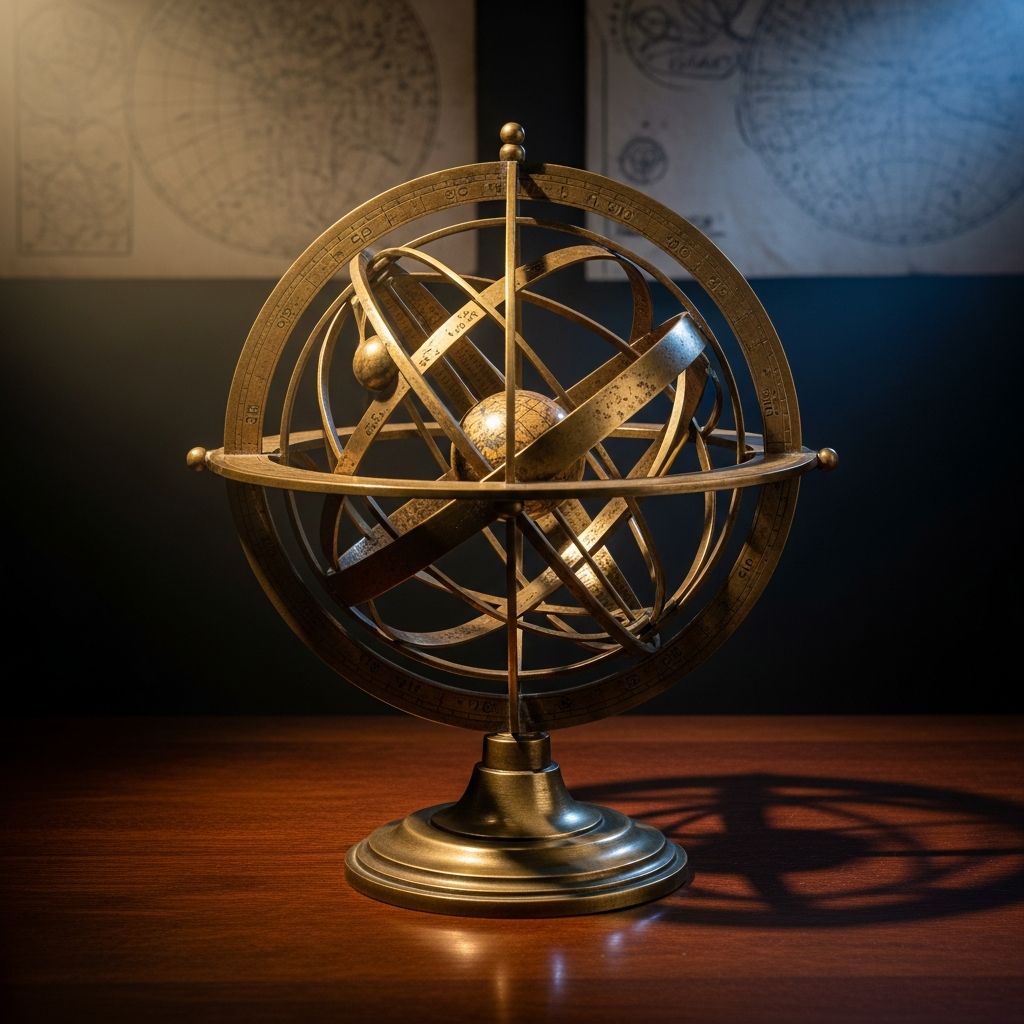
Armillary spheres represent one of humanity’s earliest attempts to physically model the heavens, using interlocking rings to depict celestial paths and positions. These devices, originating in antiquity, served as both observational tools and educational aids, encapsulating the geocentric worldview that dominated for centuries.
Origins and Early Development
The concept of the armillary sphere traces back to ancient civilizations, with foundational designs emerging in China during the Han Dynasty around 25-220 AD. Attributed to astronomer Zhang Heng, early versions featured basic rings representing key celestial coordinates like the equator and meridians. Initially called an ‘armilla,’ these single-ring models evolved by adding more circles to represent the meridian plane, gradually forming the multi-ring structure known today.
In the Western world, Greek astronomers refined these instruments. Ptolemy’s geocentric model, outlined in his Almagest, heavily influenced their design, positioning Earth at the center with rings illustrating the paths of stars, planets, and the Sun around it. By the medieval period, armillary spheres transitioned from pure observational devices to symbolic teaching tools, as seen in illustrations of scholars demonstrating cosmic order to students.
Design and Key Components
An armillary sphere consists of a series of metal or wooden rings arranged in a spherical framework, often mounted on a pedestal for rotation. Central to its construction is a core sphere or pivot representing either Earth (geocentric) or the Sun (heliocentric variants), surrounded by bands for latitude, longitude, the ecliptic, and polar axes.
- Equatorial Ring: Marks the celestial equator, dividing the sky into northern and southern hemispheres.
- Meridian Ring: Aligns with north-south lines, aiding in determining local time and star altitudes.
- Ecliptic Ring: Traces the Sun’s apparent annual path, crucial for calendars and astrology.
- Hour Circles: Smaller rings for tracking hourly motions of stars.
To use one, observers aligned the outer meridian perpendicular to the horizon at their latitude, sighting known stars through sighting devices to calibrate positions. This setup allowed tracking solar paths, predicting sunrises, or locating stars by coordinates.
| Component | Function | Historical Addition |
|---|---|---|
| Armilla (Single Ring) | Equator representation | Ancient Greece/China |
| Meridian Plane | North-South alignment | Early evolution |
| Ecliptic Band | Sun’s path | Ptolemaic era |
| Polar Axis | Earth’s rotation axis | Medieval refinements |
Practical Applications in Astronomy
Before telescopes in the 1600s, armillary spheres were indispensable for positioning celestial objects. They solved problems like calculating a star’s declination or the Sun’s position on a specific date. Navigators, including Portuguese explorers symbolized by the device on their flag, used them to demonstrate stellar motions during voyages.
In education, they illustrated Ptolemaic versus Copernican systems. Teachers rotated rings to show planetary retrogrades under geocentric assumptions, contrasting with emerging heliocentric ideas. Chinese models, like Zhang Heng’s, integrated water clocks for precise timing, enhancing observational accuracy.
Some spheres exceeded 1.5 meters in diameter, offering detailed readings despite mechanical limitations. They also featured in art, from sculptures to flags, symbolizing mastery over the cosmos.
The Geocentric Assumption and Its Limitations
Armillary spheres embodied the geocentric model, placing Earth motionless at the universe’s center with all celestial bodies orbiting it uniformly. This design, rooted in Ptolemy’s epicycles, aimed to explain observed planetary loops but introduced inaccuracies.
Key flaws included:
- Uniform Circular Motion: Assumed perfect circles, ignoring elliptical orbits discovered by Kepler.
- Fixed Earth: Failed to account for stellar parallax or Earth’s motion, evident in precise modern observations.
- Scale Distortions: Rings couldn’t replicate true distances or speeds, especially for outer planets.
These errors limited predictive power; for instance, geocentric alignments mismatched actual alignments, as videos of reconstructions demonstrate. The model’s complexity grew with added epicycles, signaling its inadequacy.
Evolution Toward Heliocentric Understanding
By the Renaissance, Copernicus challenged geocentrism with his Sun-centered model. Armillary spheres adapted, with some featuring swappable centers to demonstrate both systems. Tycho Brahe’s large, accurate spheres provided data for Kepler’s laws, bridging old and new paradigms.
Galileo’s telescope observations—moons orbiting Jupiter, Venus’s phases—disproved pure geocentrism, rendering traditional armillary spheres obsolete for precision work. Yet, they persisted as pedagogical tools into the 18th century.
Modern Relevance and Cultural Legacy
Today, armillary spheres grace museums, gardens, and replicas for public astronomy. They symbolize the transition from myth to science, highlighting how tools shape paradigms. Portugal’s flag retains the motif, honoring Age of Discoveries navigators.
Digital simulations now replicate their functions, allowing virtual alignments without physical constraints. They remind us of science’s iterative nature: early models advanced knowledge despite flaws, paving the way for relativity and exoplanet discoveries.
Frequently Asked Questions (FAQs)
What is the main purpose of an armillary sphere?
It models celestial motions, tracks star positions, and teaches astronomical concepts like the ecliptic and equator.
Why did armillary spheres assume Earth was at the center?
They reflected the Ptolemaic geocentric model, which matched unaided observations but was disproven by later evidence.
Who invented the armillary sphere?
Early forms are credited to ancient Greeks and Chinese like Zhang Heng during the Han Dynasty.
Are armillary spheres still used today?
Primarily as educational replicas and decorative items; modern astronomy uses telescopes and software.
How accurate were historical armillary spheres?
Large ones like Tycho Brahe’s were precise for their time but limited by geocentric assumptions and mechanical friction.
References
- Armillary Sphere Facts — Softschools.com. Accessed 2026. https://softschools.com/facts/astrological_instruments/armillary_sphere_facts/3250/
- What Is An Armillary Sphere? — Sciencing. 2018-05-25. https://www.sciencing.com/armillary-sphere-6112069/
- Ancient Astronomical Invention: “The Geocentric Armillary Sphere” — YouTube (Short). Accessed 2026. https://www.youtube.com/shorts/QkiAyd97mUE
- Astrolabes and Armillary Spheres — YouTube. Accessed 2026. https://www.youtube.com/watch?v=1t-L58gVsB0
- Armillary Sphere — Before Newton Blog. Accessed 2026. https://beforenewton.blog/tag/armillary-sphere/

Medha Deb is an editor with a master's degree in Applied Linguistics from the University of Hyderabad. She believes that her qualification has helped her develop a deep understanding of language and its application in various contexts. Medha specializes in the areas of beauty, health, sports, and wellness and is committed to ensuring that the content on the website is…