
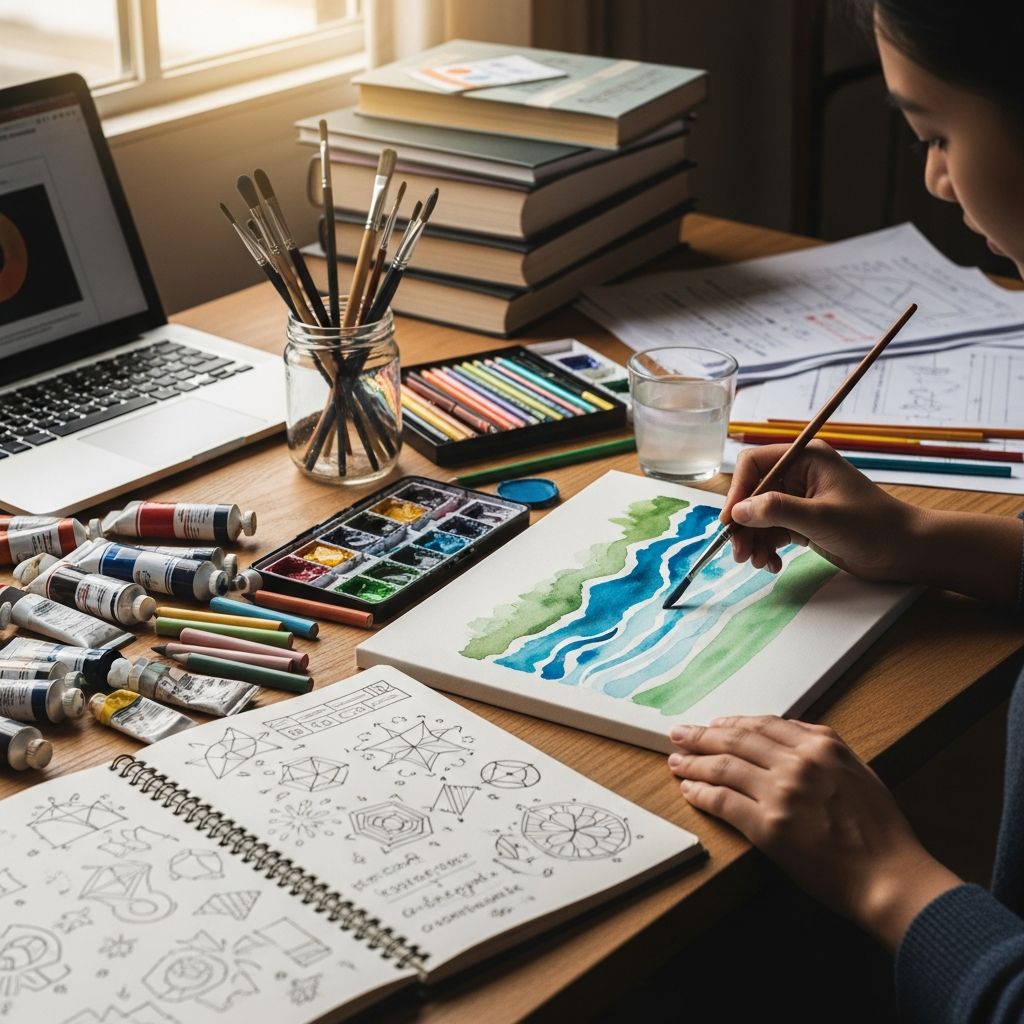
In the high-pressure world of academia, where deadlines loom and expectations soar, maintaining mental equilibrium often feels like an insurmountable challenge. Art therapy emerges as a powerful, accessible tool that harnesses creative expression to alleviate stress and heighten focus. Unlike traditional talk therapies, this approach invites individuals to channel emotions through visual media, offering a non-verbal pathway to emotional release and cognitive clarity. Research consistently demonstrates its efficacy across diverse groups, from undergraduates navigating exams to professors juggling research and teaching loads.
Why Academics Face Unique Stress Challenges
Academic environments breed a perfect storm of stressors: relentless performance demands, information overload, social comparisons, and the perpetual pursuit of perfection. Students report elevated cortisol levels during exam periods, while faculty endure burnout from administrative burdens and publication pressures. These factors not only impair concentration but also erode overall well-being, leading to anxiety, sleep disturbances, and diminished productivity. Creative interventions like art therapy interrupt this cycle by engaging the brain’s right hemisphere, promoting relaxation without requiring artistic expertise.
Studies on college populations reveal that pre-intervention stress metrics, such as perceived stress scales (PSS), show no baseline differences between groups, but post-art sessions yield significant drops in tension and anxiety indicators. This underscores art’s role in recalibrating the autonomic nervous system, shifting from fight-or-flight to restorative states.
Scientific Foundations: How Art Lowers Stress Hormones
At its core, art therapy modulates physiological stress responses. A landmark study from Drexel University involved participants creating art for 45 minutes, resulting in a 75% reduction in cortisol—the primary stress hormone—for most individuals, regardless of prior artistic skill. Participants described sensations of reduced anxiety after mere minutes, with one noting, ‘Doing art allowed me to put things into perspective.’ This effect persists, as follow-up assessments in experimental groups maintained lower stress and tension levels weeks later.
Peer-reviewed evidence further validates these outcomes. In controlled trials with college students, art-making sessions led to statistically significant reductions in stress perception (t=4.061, p<0.01) and tension (t=4.829, p<0.01), with sustained benefits in follow-ups (t=2.145, p<0.05 for stress; t=3.307, p<0.01 for tension). Similarly, Focusing-Oriented Art Therapy (FOAT), incorporating mindfulness elements like Clearing a Space with Art, has shown promise in graduate student cohorts, elevating self-compassion alongside stress relief.
Enhancing Focus Through Creative Flow
Beyond stress reduction, art therapy cultivates a state of ‘flow’—a deep immersion that sharpens attention and blocks distractions. For academics, this translates to improved retention, problem-solving, and sustained concentration during study or writing sessions. The tactile nature of art-making anchors the mind in the present, mirroring mindfulness-based stress reduction (MBSR) techniques proven effective in high-stress professions.
In educational settings, integrating brief art exercises has boosted cognitive functions like self-awareness and emotional regulation, essential for academic success. Techniques emphasizing concentration during creation help integrate fragmented thoughts, fostering clarity amid chaos.
Practical Art Therapy Techniques for Busy Academics
Implementing art therapy requires minimal resources: paper, markers, clay, or digital tools suffice. Here are tailored exercises designed for quick integration into academic routines.
- Mindful Doodling: Spend 5-10 minutes sketching abstract patterns without judgment. This lowers cortisol by narrowing focus to the present moment, ideal for pre-lecture warm-ups.
- Emotion Mapping: Draw representations of current stressors as colors or shapes on a canvas. Externalizing emotions reduces their psychological grip, enhancing focus for subsequent tasks.
- Clay Sculpting for Tension Release: Knead clay while visualizing stress melting away. The physicality promotes relaxation and hand-eye coordination, beneficial for note-taking or lab work.
- Collage of Aspirations: Assemble images symbolizing goals from magazines. This shifts mindset from stress to motivation, improving long-term concentration.
- Finger Painting Flow: Use fingers for spontaneous designs, embracing messiness to bypass perfectionism—a common academic pitfall.
These activities, drawn from validated interventions, can be solo or group-based, with groups amplifying benefits through shared expression and reduced isolation.
Real-World Applications in Universities and Beyond
Institutions are increasingly adopting art therapy. A 12-week creative arts program for healthcare professionals—analogous to academics—yielded measurable drops in anxiety, depression, burnout, and turnover intentions, with high participant satisfaction. Universities could replicate this via workshops, embedding art breaks in syllabi or faculty development.
| Setting | Art Activity | Key Benefits | Duration |
|---|---|---|---|
| Study Sessions | Mindful Doodling | Quick focus reset, cortisol drop | 10 min |
| Lectures | Emotion Mapping | Emotional clarity, engagement | 15 min |
| Research | Clay Sculpting | Idea generation, tension relief | 20 min |
| Group Meetings | Collage | Team bonding, motivation | 30 min |
This table outlines scalable integrations, supported by evidence of persistent effects.
Overcoming Common Barriers to Starting
‘I’m not artistic’ is a frequent objection, yet studies confirm benefits accrue irrespective of skill. Time constraints? Micro-sessions yield results. Self-consciousness in groups? Begin privately. Facilitated programs, like those using FOAT, address these by creating safe spaces.
Frequently Asked Questions
Can art therapy really help with exam stress?
Yes, research shows significant reductions in perceived stress and tension post-art interventions, with effects lasting into follow-ups, making it ideal for high-stakes periods.
Do I need artistic talent to benefit?
No—studies indicate equal stress relief across all skill levels, focusing on process over product.
How often should academics practice art therapy?
Consistent short sessions (3-4 per week) mirror successful trials, yielding cumulative focus and relaxation gains.
Is group art therapy more effective than solo?
Groups enhance intimacy and stress relief via shared experiences, though both are efficacious.
Can art therapy improve academic performance?
By boosting focus, reducing anxiety, and enhancing self-awareness, it indirectly elevates productivity and retention.
Long-Term Strategies for Sustained Benefits
To maximize impact, combine art therapy with routines like journaling outcomes or pairing with mindfulness. Track progress via simple mood logs to witness improvements. For institutions, policy integration—such as art-equipped wellness centers—could amplify reach. Longitudinal data suggests ongoing practice fosters resilience, preventing burnout cycles.
Art therapy’s versatility suits diverse academic needs: visual learners thrive on drawing, kinesthetic types on sculpting. Digital adaptations, like apps for virtual mandalas, extend accessibility. Ultimately, it reframes creativity not as frivolity but as essential cognitive maintenance.
Emerging research explores synergies with tech, such as VR art spaces, promising broader adoption. For now, the evidence is clear: creative expression is a cornerstone for thriving in academia’s demanding landscape.
References
- Assessing the stress-relief impact of an art-based intervention — Yin and Ko. 2024. https://pmc.ncbi.nlm.nih.gov/articles/PMC10864434/
- Focusing-Oriented Art Therapy as a Means of Stress Reduction — Weiland. 2012. https://focusing.org/sites/default/files/legacy/docs/arts_therapy/Weiland-(2012)-%20Focusing-Oriented-Art-Therapy-as-a-Means-of-Stress-Reduction.pdf
- 5 Art Therapy Exercises for Stress Relief — Abundance Therapy Center. 2023. https://www.abundancetherapycenter.com/blog/5-art-therapy-exercises-for-stress-relief
- Creative Arts Therapy May Reduce Stress — CU Anschutz News. 2023. https://news.cuanschutz.edu/medicine/creative-arts-therapy-may-reduce-stress
- Benefits of Art Therapy for Mental and Physical Health — Husson University. 2024-02. https://www.husson.edu/online/blog/2024/02/benefits-of-art-therapy
- At Any Skill Level, Making Art Reduces Stress Hormones — Drexel University. 2016-06. https://drexel.edu/news/archive/2016/june/art_hormone_levels_lower

Medha Deb is an editor with a master's degree in Applied Linguistics from the University of Hyderabad. She believes that her qualification has helped her develop a deep understanding of language and its application in various contexts. Medha specializes in the areas of beauty, health, sports, and wellness and is committed to ensuring that the content on the website is…