
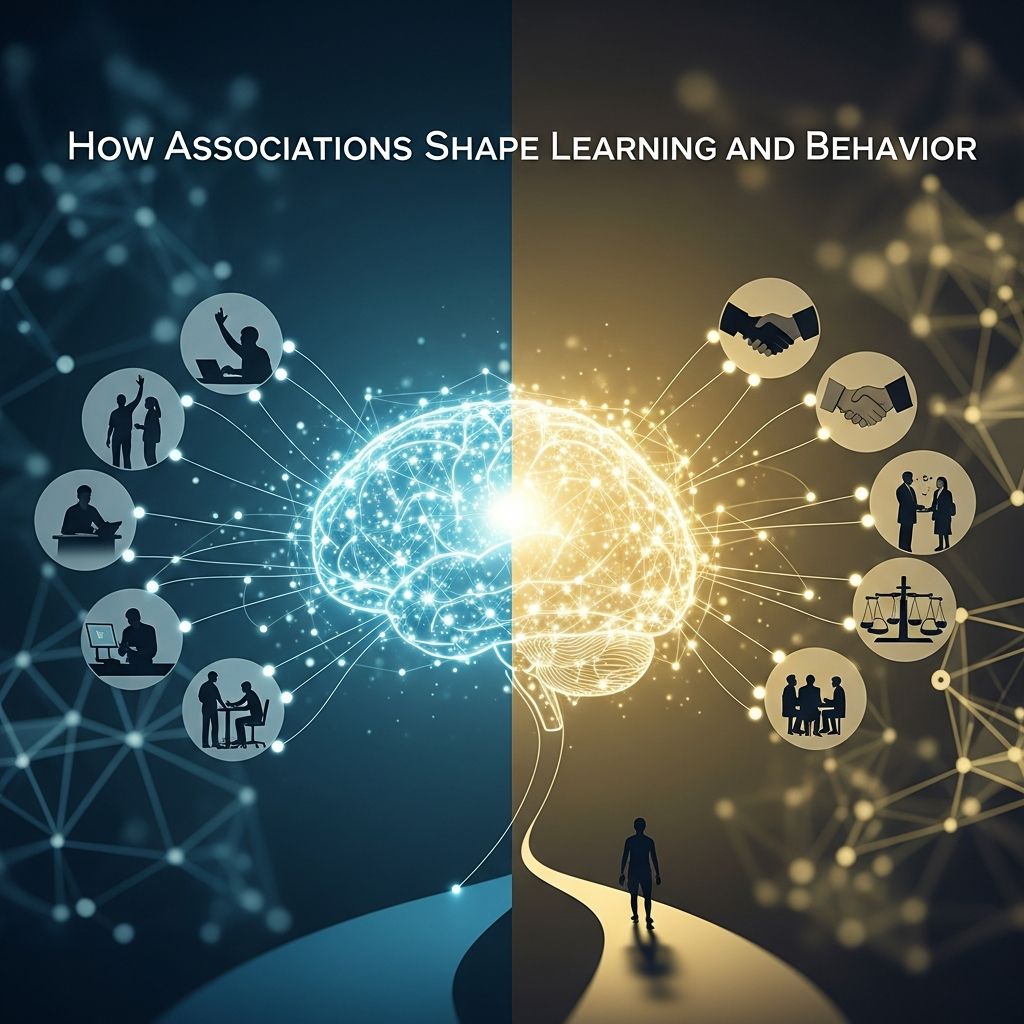
Understanding Connection-Based Learning
Learning is fundamentally about making connections. When we encounter new information, our brains don’t process it in isolation—instead, we link it to existing knowledge, experiences, and patterns we’ve already internalized. This connection-making process is the foundation of what psychologists call associative learning, a mechanism that explains not only how animals develop behaviors but also how humans acquire skills, form habits, and retain information throughout their lives.
Associative learning operates on a simple but powerful principle: two events or ideas become linked in our minds, so that encountering one automatically triggers thoughts of the other. This linking happens constantly, often without our conscious awareness. Whether we’re learning in a classroom, developing new routines, or trying to break problematic patterns, associative mechanisms shape our development and determine the effectiveness of our learning efforts.
Classical Foundations: Early Research That Changed Psychology
The scientific study of associative learning dates back more than a century, with pioneering researchers establishing fundamental principles that remain relevant today. Early experiments demonstrated that organisms could develop new responses to stimuli through repeated pairing. A classic scenario involves an animal learning to associate a neutral signal—such as a sound or light—with a significant outcome, such as the arrival of food or another meaningful event.
These early findings revealed something remarkable: the brain doesn’t distinguish between naturally occurring connections and those created through experience. Once an association forms, the response occurs automatically, even when the original trigger is absent. This discovery opened new fields of inquiry into how learning shapes behavior across species and how understanding these mechanisms could improve human education and development.
From Laboratory Observations to Practical Applications
Decades of research have confirmed that associative learning extends far beyond laboratory settings. The principles discovered through controlled experiments apply directly to everyday situations: why certain songs remind us of specific people, why particular smells trigger vivid memories, or why specific routines become automatic.
One powerful application involves understanding how rewards and incentives shape behavior. When positive outcomes consistently follow certain actions, individuals naturally tend to repeat those actions more frequently. Similarly, when behaviors lead to negative consequences, people learn to avoid them. This straightforward mechanism underlies much of human decision-making, though it operates so naturally that we often don’t recognize it working.
The Complexity of Reward Systems in Educational Settings
While reward-based learning seems straightforward, educational contexts reveal important complications. Consider how grades function as rewards in academic environments. At first glance, grades appear to be a textbook example of associative learning: teachers reward good performance with high marks, students value high marks, therefore students work to achieve them.
However, the actual relationship between grades and learning is significantly more nuanced. The effectiveness of grades as motivators depends critically on how they’re structured and what they actually measure. When grades reflect effort and improvement, they can reinforce productive behaviors and encourage persistence. But when grades measure only outcomes without accounting for effort, they can inadvertently create counterproductive associations.
A student who works diligently on an assignment or studies extensively for an exam, yet still receives a poor grade, faces a troubling association: effort leads to failure. Under these circumstances, the student may become discouraged and reduce effort in the future, even though the grade might not accurately reflect their learning. Conversely, a student who achieves high grades without studying learns to associate success with minimal effort, creating a false sense of competence that may falter when facing genuinely challenging material.
Understanding the Limitations of Performance-Based Evaluation
The challenge with relying solely on performance-based rewards is that performance represents only an imperfect snapshot of what students have genuinely learned. True educational goals emphasize durable, flexible knowledge—the ability to apply concepts in new situations, to connect ideas across domains, and to adapt understanding as circumstances change.
Grades, however well-intentioned, often reinforce associations between specific tasks and specific outcomes rather than promoting deeper learning. A student might associate passing a test with memorizing facts for a few hours, rather than associating the subject matter with genuine understanding. This creates a fundamental mismatch: we reward narrow performance while hoping students develop broad, transferable knowledge.
Recognizing this tension is the first step toward designing better learning environments. When educators understand how associative learning shapes student behavior, they can structure incentives and feedback to promote associations that support genuine knowledge development rather than undermine it.
Harnessing Associations to Strengthen Memory
Beyond formal schooling, associative learning offers practical tools for enhancing memory capacity. Memory specialists and cognitive psychologists have long recognized that deliberately creating associations can transform our ability to retain and recall information.
One well-established technique involves connecting new information to existing knowledge networks. When we encounter unfamiliar names, terms, or concepts, we can improve retention by linking them to established mental structures. For instance, someone meeting multiple new people at a social gathering can enhance name recall by connecting each person to a familiar reference point or characteristic.
This principle extends to more systematic memory approaches. Mnemonic devices operate by creating deliberate, often memorable associations between information we need to remember and patterns or phrases we find easy to recall. These mental tools range from simple acronyms to elaborate visual imagery systems. The underlying mechanism remains consistent: by anchoring new information to something already firmly in our memory, we create stronger retrieval pathways.
Building Effective Habit Patterns Through Strategic Association
Habit formation relies fundamentally on associative learning principles. When we consistently perform an action in a particular context, our brains gradually form associations between the context and the behavior. Over time, encountering that context automatically triggers the associated action without requiring conscious decision-making.
This automatic nature of habitual behavior can work powerfully in our favor. Healthy habits—such as regular exercise, consistent sleep schedules, or nutritious eating—become easier to maintain once they’re established because the contexts automatically trigger the behaviors. However, the same associative mechanism can entrench problematic habits. Breaking unwanted patterns requires disrupting the established associations and creating new ones.
Understanding these mechanisms helps explain why habit change is challenging. Simply deciding to change behavior isn’t enough if the environmental cues continue triggering the old responses. Effective habit modification often requires altering contexts, creating new associations between situations and healthier responses, or introducing deliberate friction that interrupts automatic patterns.
The Science Behind Connection-Based Learning
Modern neuroscience has revealed that associative learning engages sophisticated neural mechanisms. When two events or ideas are repeatedly paired or occur in close temporal proximity, neural pathways strengthen between the brain regions representing these events. This neural reorganization physically embeds the association in the brain’s structure.
Research indicates that associative learning is far more powerful than earlier theories suggested. Rather than being a simple, limited mechanism, it can support complex behaviors including tool use, social learning, self-control, and planning for future scenarios. The brain’s ability to form higher-order associations—connections between already-associated ideas—enables the development of increasingly sophisticated understanding.
This capacity for building associations upon associations means that human learning can progress from concrete, simple connections to abstract, complex conceptual networks. A student might first associate specific formulas with specific problem types, then associate those formulas with underlying mathematical principles, and ultimately associate those principles with broader problem-solving strategies applicable across domains.
Designing Learning Environments Around Associative Principles
Recognizing the power of associative learning suggests practical strategies for improving how we design educational experiences. Rather than treating subjects in isolation, educators can deliberately connect new material to prior knowledge, helping students build comprehensive understanding networks.
Effective teaching acknowledges that learning isn’t about passive reception of information but about actively constructing associations. When students struggle with new concepts, providing connections to familiar territory often facilitates understanding far more effectively than simply explaining the material again using the same approach.
Similarly, assessment practices can better align with learning goals by evaluating whether students have formed productive associations—whether they can apply concepts in new contexts, make meaningful connections between ideas, and recognize patterns across different domains. This approach to evaluation better captures genuine learning while providing more useful feedback about what students actually understand.
The Broader Implications for Personal Development
Associative learning operates throughout our lives, shaping not just academic achievement but also personal relationships, career development, and wellbeing. The associations we develop—between effort and success, between social connection and happiness, between challenges and growth—profoundly influence our trajectories.
Understanding this influence empowers individuals to deliberately cultivate productive associations. Someone might deliberately expose themselves to positive role models to create associations between desired qualities and achievable behavior. Another person might practice gratitude by linking everyday situations to appreciation, gradually rewiring their automatic response patterns toward greater positivity.
Organizations too benefit from understanding associative learning. Corporate training programs, team-building activities, and workplace cultures all function partly through the associations they create. When organizations want to promote innovation, they might deliberately create associations between experimentation and recognition. To develop ethical behavior, they build associations between integrity and career advancement.
Bridging Theory and Practical Change
While associative learning theory emerged from psychological laboratories, its implications extend throughout human experience. The gap between understanding how learning works and translating that understanding into effective practice represents ongoing work for educators, psychologists, and organizational leaders.
One key transition involves moving from thinking about learning as information transfer to thinking about it as association-building. This shift changes what we focus on and how we measure success. Rather than asking whether students can reproduce information, we ask whether they’ve formed flexible, transferable associations that enable them to apply knowledge in new situations.
This perspective also changes how we approach challenges. When students struggle, we look not just at whether they received information but at what associations they’ve formed and whether those associations support or hinder learning. When attempting behavior change, we attend to the environmental contexts and cues that trigger automatic responses, recognizing that willpower alone often fails against established associations.
Frequently Asked Questions
Q: Is associative learning the same as conditioning?
A: Conditioning is a specific type of associative learning where repeated pairings of stimuli or events create automatic responses. Associative learning is broader and includes various ways we connect ideas, information, and experiences.
Q: Can associative learning explain complex human behaviors?
A: Yes, research shows associative learning supports sophisticated behaviors including social learning, planning, self-control, and tool use. Complex understanding develops through building associations upon associations.
Q: How can I use associative learning to improve my memory?
A: Connect new information to knowledge you already have firmly established. Use mnemonics, visual associations, and acronyms to anchor difficult-to-remember information to memorable patterns.
Q: Why do some habits persist even when we want to change them?
A: Habitual behaviors persist because strong associations have formed between environmental cues and automatic responses. Changing habits requires disrupting these associations and deliberately building new ones.
Q: Can understanding associative learning help with education?
A: Absolutely. When educators design learning around building productive associations between concepts, connect new material to prior knowledge, and structure incentives carefully, learning becomes more effective and knowledge becomes more transferable.
References
- Social learning through associative processes: a computational theory — Royal Society Publishing. 2020. https://royalsocietypublishing.org/rsos/article/6/3/181777
- The power of associative learning and the ontogeny of optimal behavior — National Institutes of Health, NCBI. 2016. https://pmc.ncbi.nlm.nih.gov/articles/PMC5180160/
- Understanding Associative Learning Through Higher-Order Conditioning — Frontiers in Behavioral Neuroscience. 2022. https://www.frontiersin.org/journals/behavioral-neuroscience/articles/10.3389/fnbeh.2022.845616
- The Surprising Power of Associative Learning — The Learning Agency Lab. 2024. https://the-learning-agency-lab.com/the-learning-curve/the-surprising-power-of-associative-learning/
- Role of Surprising Nonreward in Associative Learning — Journal of Animal Behavior. 2021. https://www.jstage.jst.go.jp/article/janip/56/1/56_1_35

Medha Deb is an editor with a master's degree in Applied Linguistics from the University of Hyderabad. She believes that her qualification has helped her develop a deep understanding of language and its application in various contexts. Medha specializes in the areas of beauty, health, sports, and wellness and is committed to ensuring that the content on the website is…