
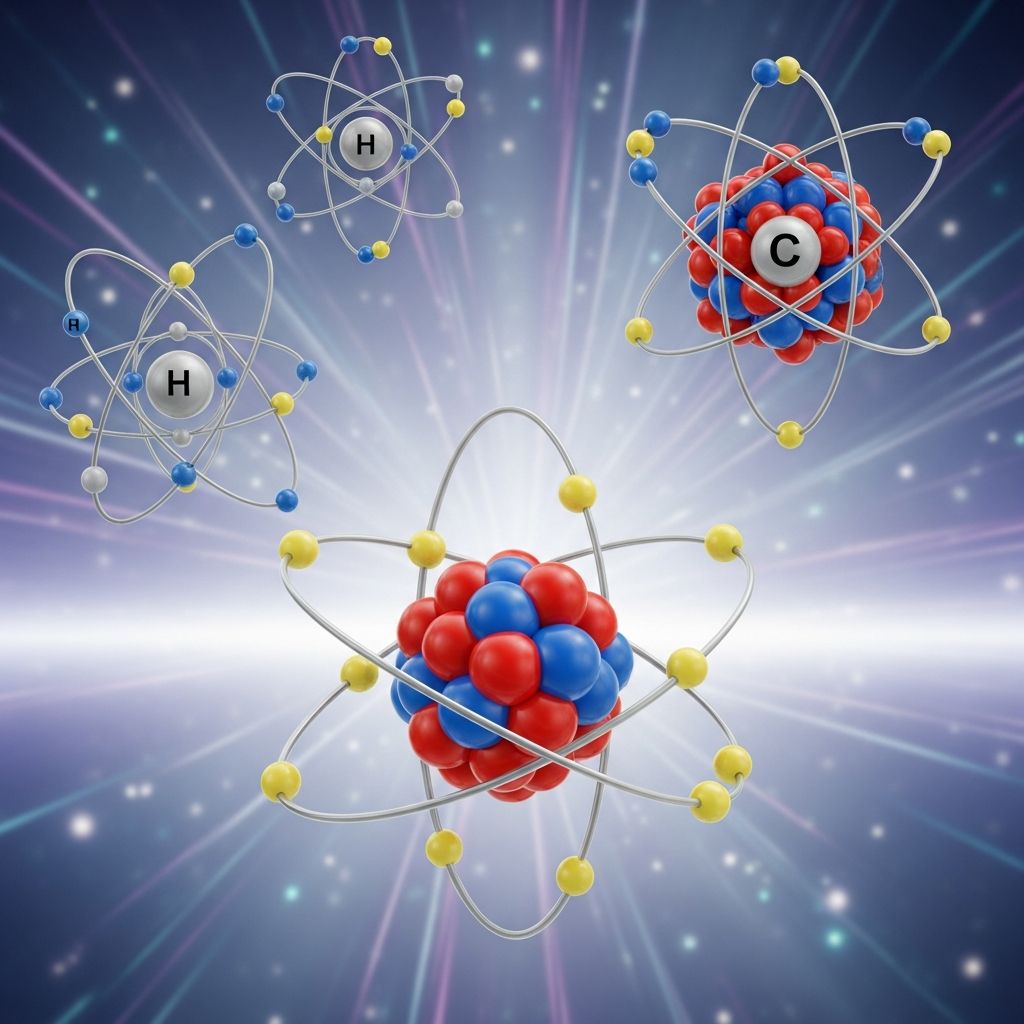
Atoms represent the smallest units of ordinary matter that form all chemical elements, serving as the foundational components of everything from air to diamonds. Each atom consists of a dense nucleus containing protons and neutrons, orbited by electrons in probabilistic clouds.
The Basic Architecture of an Atom
At the heart of every atom lies the nucleus, a tiny, positively charged core that houses nearly all the atom’s mass. Protons, with a positive charge, define the element’s identity through their count, known as the atomic number. For instance, all atoms with one proton are hydrogen, while those with eight are oxygen.
Neutrons, lacking charge, reside alongside protons in the nucleus and contribute to the atom’s mass. Electrons, negatively charged and vastly lighter, occupy outer regions, balancing the protons’ charge in neutral atoms. This configuration enables chemical bonding and reactions.
- Protons: Positive charge, determine element type.
- Neutrons: Neutral, affect isotope stability.
- Electrons: Negative charge, enable bonding and reactivity.
The electron cloud model, derived from quantum mechanics, describes electrons not as orbiting planets but as waves of probability around the nucleus.
Key Components and Their Interactions
Protons and neutrons are held together by the strong nuclear force, overcoming electrostatic repulsion between protons. Electrons are bound electromagnetically. The mass of a proton or neutron is approximately 1 atomic mass unit (amu), while an electron’s is about 1/1836 amu.
| Subatomic Particle | Charge | Mass (amu) | Location |
|---|---|---|---|
| Proton | +1 | 1 | Nucleus |
| Neutron | 0 | 1 | Nucleus |
| Electron | -1 | 0.00055 | Electron cloud |
This table illustrates the fundamental differences, highlighting why the nucleus dominates mass despite its minuscule size relative to the atom.
Defining Elements Through Atomic Number
The atomic number uniquely identifies elements. Hydrogen (atomic number 1) has one proton; helium (2) has two. This proton count dictates electron arrangement, influencing properties like reactivity and bonding.
Isotopes arise when neutron numbers vary, altering mass but not element type. Carbon-12 (6 protons, 6 neutrons) is stable; carbon-14 (6 protons, 8 neutrons) is radioactive.
Prominent Examples of Atoms
Common atoms illustrate diversity in structure and function. Hydrogen, the universe’s most abundant element, features one proton and one electron, fueling stars via fusion.
Helium, with two protons, two neutrons, and two electrons, is inert due to a full electron shell, making it ideal for balloons and cryogenics.
Hydrogen: The Simplest Building Block
Hydrogen (H) is the lightest atom, existing as H-1 (protium, no neutrons), deuterium (one neutron), or tritium (two neutrons). It forms 75% of baryonic matter.
Helium: Noble and Stable
Helium (He) atoms resist reactions, filling the first electron shell completely. Monatomic in nature, it’s crucial in quantum research and welding.
Carbon: Backbone of Life
Carbon (C), with six protons and typically six electrons, enables vast organic compounds. Its isotopes include stable C-12 and dating tool C-14.
Oxygen: Vital for Respiration
Oxygen (O) atoms, boasting eight protons, bond into O2 molecules, essential for combustion and cellular respiration. Ozone (O3) protects from UV.
Nitrogen: Atmospheric Dominant
Nitrogen (N), seven protons strong, comprises 78% of air, integral to proteins and DNA via N2 molecules.
Sodium: Reactive Metal
Sodium (Na), with 11 protons, reacts vigorously with water, forming table salt (NaCl) when paired with chlorine.
Atoms in Molecules and Compounds
While isolated atoms define elements, they combine into molecules. Water (H2O) unites two hydrogen and one oxygen atom; methane (CH4) links carbon to four hydrogens.
Monatomic elements like helium exist singly; diatomic ones like O2 pair up. Elemental sulfur forms S8 rings.
Scale and Ubiquity of Atoms
Atoms are minuscule—about 0.1 nanometers across—yet a water drop holds 10^21 oxygen atoms. A diamond contains 10^22 carbon atoms. Magnify an apple to Earth-size, and its atoms match the original apple’s scale.
Everything tangible comprises atoms: cells, rocks, stars. Biological cells teem with atoms forming complex structures.
Advanced Insights: Quarks and Beyond
Protons (two up quarks, one down) and neutrons (one up, two down) consist of quarks, bound by gluons in the Standard Model. Electrons remain elementary.
Practical Implications in Daily Life
Atomic knowledge drives technology: nuclear power harnesses fission; semiconductors rely on electron flow. Medicine uses isotopes for imaging; chemistry synthesizes materials.
Frequently Asked Questions (FAQs)
What defines an atom’s element?
The number of protons in its nucleus determines the element.
How do isotopes differ?
Isotopes share protons but vary in neutrons, affecting mass and stability.
Are all atoms neutral?
Neutral atoms balance protons and electrons; ions have imbalances.
Can atoms be seen?
Scanning tunneling microscopes image atoms indirectly.
Why is hydrogen special?
As the simplest and most abundant, it forms stars and water.
References
- 6 examples of an atom — Filo. 2023. https://askfilo.com/user-question-answers-smart-solutions/6-examples-of-an-atom-3337393830353630
- Atoms, Molecules, and Compounds — University of Hawaii at Manoa. 2023-10-01. https://manoa.hawaii.edu/exploringourfluidearth/chemical/chemistry-and-seawater/atoms-molecules-and-compounds
- Atom — Wikipedia. 2026-04-04. https://en.wikipedia.org/wiki/Atom
- Atom Overview, Structure & Examples — Study.com. 2023. https://study.com/learn/lesson/video/atom-overview-structure-examples.html
- Atoms & Ions | Protons, Neutrons, Electrons — YouTube. 2023. https://www.youtube.com/watch?v=zuQ469vjwgo
- What is an Atom? Definition & Examples — Study.com. 2023. https://study.com/academy/lesson/video/what-is-an-atom-definition-examples.html
- What is an atom? — Nuclear Regulatory Commission. 2023-05-15. https://www.nrc.gov/reading-rm/basic-ref/students/science-101/what-is-an-atom

Medha Deb is an editor with a master's degree in Applied Linguistics from the University of Hyderabad. She believes that her qualification has helped her develop a deep understanding of language and its application in various contexts. Medha specializes in the areas of beauty, health, sports, and wellness and is committed to ensuring that the content on the website is…