
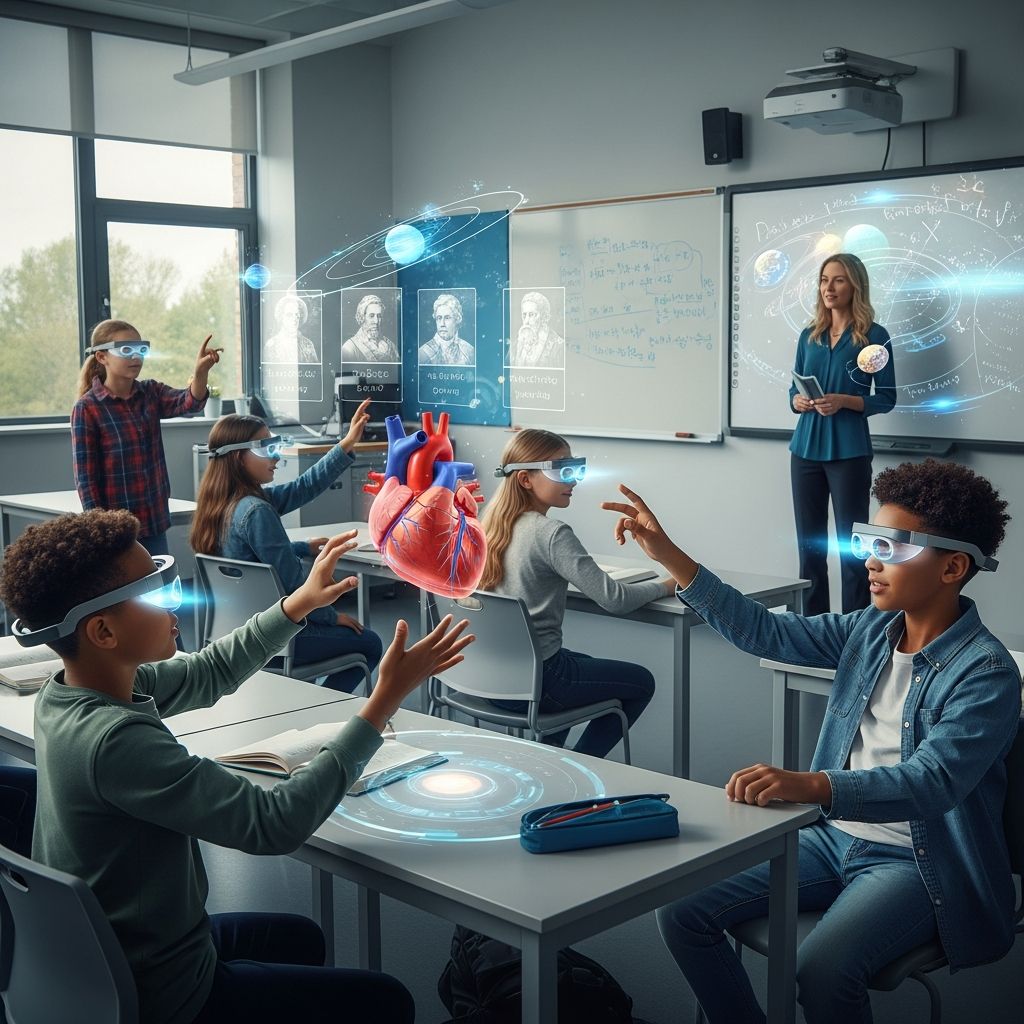
Augmented reality (AR) overlays digital elements onto the physical world, creating immersive experiences accessible via smartphones and tablets. This technology is reshaping education by turning abstract concepts into tangible interactions, fostering deeper understanding and excitement in learning.
Understanding Augmented Reality in Educational Contexts
AR differs from virtual reality by enhancing rather than replacing the real environment. In classrooms, students point devices at textbooks or objects to reveal 3D models, animations, or data visualizations. This approach supports kinesthetic learning, allowing manipulation of virtual solar systems or microscopic cells right on desks.
Educators report that AR bridges theoretical knowledge with practical application. For instance, history lessons gain depth when students ‘visit’ ancient ruins overlaid on their surroundings, promoting curiosity and retention.
Key Advantages of Integrating AR into Teaching
AR delivers measurable improvements in student outcomes. Research shows it enhances academic performance through engaging content that sustains attention longer than traditional methods.
- Boosted Engagement: Interactive elements like rotatable 3D planets captivate students, increasing participation rates significantly.
- Personalized Education: Content adapts to individual paces, supporting diverse learning styles from visual to hands-on.
- Improved Retention: Experiential learning via AR leads to better comprehension and long-term memory of complex topics.
- Fosters Collaboration: Group AR activities encourage discussion and peer teaching, extending learning beyond the classroom.
- Accessibility for All: AR works on existing devices, making advanced simulations available without expensive equipment.
Practical Applications Across Subjects
AR’s versatility spans curricula, from STEM to humanities. In science, students dissect virtual frogs or explore atomic structures without physical labs. Math becomes interactive with manipulable geometric shapes.
| Subject | AR Application | Benefit |
|---|---|---|
| Science | 3D cell models, chemical reactions | Visualizes invisible processes |
| History | Virtual historical sites | Immersive time travel |
| Math | Interactive fractions, geometry | Hands-on problem-solving |
| Art & Music | Virtual instruments, sculptures | Creative exploration |
| Geography | Overlay maps, ecosystems | Real-world context |
These applications make lessons dynamic, helping students grasp scale—holding a virtual planet or zooming into molecules.
Real-World Examples of AR Success in Schools
Several institutions have pioneered AR integration with impressive results. At Bader Intermediate School in New Zealand, media design students combined AR with 3D printing to materialize virtual creations, honing creativity and tech skills.
Montgomery Public Schools in the US equipped STEM labs with AR tools, noting heightened excitement and engagement. Students manipulated virtual objects impossible to procure physically.
Episcopal School of Baton Rouge used AR for drama and music, letting students wield Excalibur or examine instruments, transforming routine classes into adventures.
McGraw Hill AR app enabled bite-sized explorations in multiple subjects, with students observing animations, interacting with models, and self-assessing—proving effective across device types.
Top AR Tools and Apps for Educators
Accessible tools lower entry barriers for teachers. Here’s a curated selection:
- McGraw Hill AR: Free app for K-12 with 3D models in math, science, ELA; supports tablets and web.
- ClassVR: Combines AR/VR for STEM and cross-curricular content, boosting participation.
- Discovery Education AR: Immersive experiences for curiosity-driven learning in various topics.
- General AR Platforms: Apps like those from Edutopia recommendations allow projection-based interactions with artifacts and environments.
These tools require minimal setup, often just scanning QR codes, and many offer teacher dashboards for progress tracking.
Step-by-Step Guide to Implementing AR
- Assess Resources: Inventory devices; most smartphones suffice.
- Select Content: Choose apps aligned with curriculum standards.
- Plan Lessons: Integrate AR as 10-15 minute activities to maintain focus.
- Train Students: Short demos ensure quick adoption.
- Evaluate Impact: Use quizzes and feedback to measure gains.
- Scale Up: Expand to projects where students create AR content.
Start small to build confidence; studies confirm even brief VR/AR sessions improve scores and equity for struggling learners.
Overcoming Common Implementation Challenges
Despite benefits, hurdles exist. Device access varies, but web-based AR mitigates this. Teacher training is crucial—many districts offer workshops. Bandwidth concerns are easing with optimized apps.
Equity issues? Pair students or use shared devices. Content creation empowers educators to customize, reducing reliance on pre-made materials.
The Future of AR in Education
AR is evolving rapidly. Future integrations include AI-driven personalization and mixed reality for collaborative global classrooms. As costs drop, widespread adoption will personalize education at scale, preparing students for tech-driven careers.
Expect hybrid models blending AR with AI tutors, simulating real-world scenarios safely—like dangerous experiments.
Frequently Asked Questions
What devices are needed for classroom AR?
Smartphones, tablets, or laptops with cameras; no specialized hardware required.
Does AR work for all grade levels?
Yes, from kindergarten explorations to high school simulations, adaptable across ages.
How does AR improve learning outcomes?
It enhances engagement, retention, and critical thinking via interactive, multi-sensory experiences.
Is AR expensive to implement?
Many free apps exist; leverage existing devices for low-cost entry.
Can students create their own AR content?
Absolutely—tools enable designing experiences, fostering creativity and ownership.
References
- Virtual and augmented reality in education — Esade. 2023. https://www.esade.edu/beyond/en/virtual-reality-augmented-reality-education/
- Transforming Learning Environments: 3 Examples of Augmented Reality in Education — ClassVR. 2023. https://www.classvr.com/resource-hub/blog/transforming-learning-environments-3-examples-of-augmented-reality-in-education/
- How Augmented Reality Fosters Student Curiosity and Collaboration — EdSurge. 2023-11-29. https://www.edsurge.com/news/2023-11-29-how-augmented-reality-fosters-student-curiosity-and-collaboration
- 7 Augmented Reality Tools for the Classroom — Edutopia. 2023. https://www.edutopia.org/article/7-augmented-reality-tools-classroom/
- Augmented Reality App for Education | McGraw Hill AR — McGraw Hill Education. 2023. https://www.mheducation.com/prek-12/program/microsites/mcgraw-hill-ar.html
- Creative Ways to Bring Augmented Reality and Virtual Reality into the Classroom — Walden University. 2023. https://www.waldenu.edu/online-bachelors-programs/bs-in-elementary-education/resource/creative-ways-to-bring-augmented-reality-and-virtual-reality-into-the-classroom

Medha Deb is an editor with a master's degree in Applied Linguistics from the University of Hyderabad. She believes that her qualification has helped her develop a deep understanding of language and its application in various contexts. Medha specializes in the areas of beauty, health, sports, and wellness and is committed to ensuring that the content on the website is…