
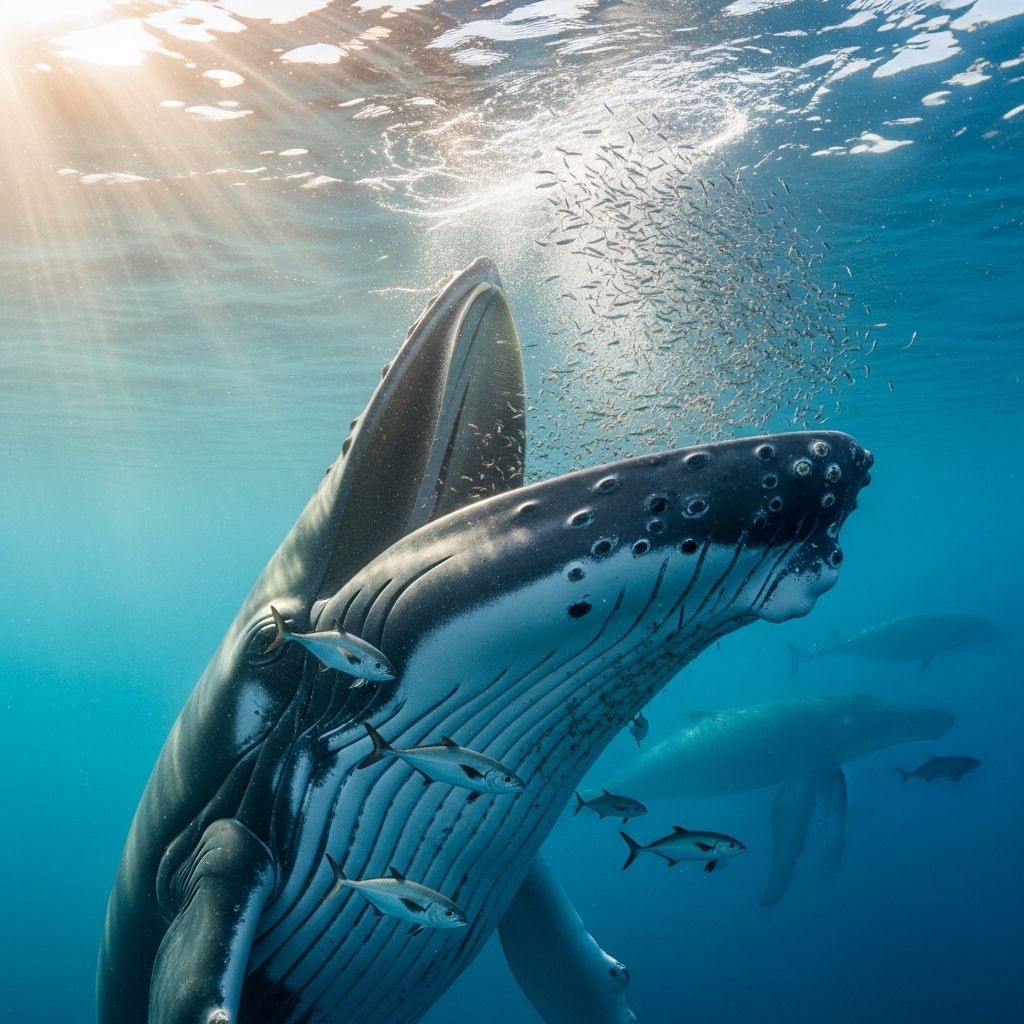
Baleen whales, belonging to the parvorder Mysticeti, represent one of the most remarkable groups of marine mammals, distinguished by their unique filter-feeding mechanism rather than teeth. These gentle giants sieve vast quantities of water to capture tiny prey like krill and plankton, playing crucial roles in oceanic food webs.
Understanding Baleen: The Key to Survival
The hallmark of baleen whales is the baleen, flexible plates made of keratin hanging from their upper jaws. These plates, numbering in the hundreds per whale, form a sieve that traps small organisms while expelling water. Baleen varies in length and thickness across species, adapting to specific feeding styles such as lunge-feeding or skim-feeding.
Unlike toothed whales, which hunt individually with sharp teeth, baleen whales evolved around 34 million years ago, diverging from odontocetes to exploit abundant microscopic prey. This adaptation allows them to consume tons of food daily, supporting their enormous sizes—some reaching over 100 feet in length.
Major Families of Baleen Whales
Baleen whales are classified into four primary families: Balaenidae (right and bowhead whales), Balaenopteridae (rorquals), Eschrichtiidae (gray whales), and Cetotheriidae (pygmy right whale). Each family exhibits distinct physical traits and behaviors suited to their environments.
- Balaenidae: Known for massive heads comprising up to one-third of their body length and thick blubber layers for cold-water endurance.
- Balaenopteridae: Feature expandable throat pleats for engulfing huge water volumes during lunges.
- Eschrichtiidae: Specialized bottom-feeders with a unique dorsal hump instead of a fin.
- Cetotheriidae: The smallest and most elusive, thriving in warmer seas.
Iconic Rorqual Whales: Speed and Power
Rorquals, the largest family in Balaenopteridae, dominate with their streamlined bodies and throat grooves. The blue whale (Balaenoptera musculus), Earth’s largest animal, stretches up to 100 feet and weighs 200 tons, feeding on krill via massive lunges.
Next is the fin whale (Balaenoptera physalus), second-largest at 80 feet, famed for speeds up to 22 mph— the fastest baleen whale. Its asymmetric coloration aids in identifying individuals.
| Species | Average Length | Weight | Key Feature |
|---|---|---|---|
| Blue Whale | 70-100 ft | Up to 200 tons | Massive size, krill diet |
| Fin Whale | 60-80 ft | Up to 120 tons | Speed, V-shaped head pattern |
| Humpback Whale | 40-60 ft | Up to 40 tons | Long flippers, songs |
Humpback whales (Megaptera novaeangliae) captivate with acrobatic breaches and haunting songs used in mating. Their long pectoral fins, up to one-third body length, enable precise bubble-net feeding.
Right Whales and Bowheads: Arctic Survivors
Right whales (genus Eubalaena) earned their name from whalers deeming them the ‘right’ catch due to high blubber yields and slow speeds. Species include North Atlantic (Eubalaena glacialis), critically endangered with under 400 individuals; North Pacific (E. japonica); and Southern (E. australis).
Bowhead whales (Balaena mysticetus) endure Arctic extremes, living over 200 years—the longest-lived mammals. Their thick skulls break ice for breathing.
- Callosities: White, rough skin patches unique to each right whale, like fingerprints.
- Skim-feeding: Swim with mouths open, filtering copepods continuously.
Gray Whales: Migratory Bottom-Dwellers
The gray whale (Eschrichtus robustus), sole Eschrichtiidae member, migrates 12,000 miles annually from Arctic feeding grounds to Baja California lagoons. They stir seafloors with sensitive tongues to unearth amphipods, sporting no dorsal fin but a series of knuckles.
Once hunted to near-extinction, eastern Pacific populations recovered to about 20,000, though western ones remain endangered.
Smaller and Specialized Species
Minke whales (Balaenoptera acutorostrata), the smallest at 23-33 feet, are agile and widespread, lunge-feeding on fish and krill with pointed snouts.
Other notables include Bryde’s (Balaenoptera brydei/edeni, 39-52 feet, tropical waters), sei (B. borealis, sleek and speedy), Omura’s (B. omurai, rare Indo-Pacific), and pygmy right (Caperea marginata), under 25 feet and elusive.
Feeding Strategies and Adaptations
Baleen whales employ diverse tactics:
- Lunge-feeding: Rorquals accelerate, mouths agape, expanding throats to hold water then filtering.
- Skim-feeding: Balaenids glide with open mouths.
- Bottom-feeding: Grays roll sideways, scraping benthos.
Most prefer polar waters for dense krill swarms, migrating equatorially to breed. Sexual dimorphism favors larger females in many species.
Habitats and Global Distribution
From Arctic ice to Antarctic seas, baleen whales traverse oceans. Blues roam all major basins; humpbacks follow krill migrations; grays hug continental shelves.
Climate change disrupts prey availability, forcing range shifts. Pollution, ship strikes, and entanglements compound threats.
Conservation Challenges Facing Baleen Whales
Whaling decimated populations; blues number under 25,000 globally, North Atlantic rights fewer than 350.
Today, NOAA and IFAW monitor via aerial surveys and acoustics. Protected under the Endangered Species Act, successes like gray whale recovery highlight progress, but vessel traffic endangers calves.
Entanglement in fishing gear kills hundreds yearly; noise pollution disrupts communication.
Frequently Asked Questions (FAQs)
What is the largest baleen whale species?
The blue whale (Balaenoptera musculus) holds the title as the largest animal ever, exceeding 100 feet.
How do baleen whales eat without teeth?
They use baleen plates to filter krill and plankton from seawater through lunge or skim methods.
Are all baleen whale species endangered?
No, minkes are least concern, but right whales and some rorquals face critical threats.
Where can I see baleen whales in the wild?
Prime spots include Stellwagen Bank, Arctic cruises, and Baja lagoons during migrations.
How long do baleen whales live?
Species vary: bowheads over 200 years, blues 80-90 years.
Future Prospects for Baleen Whales
Ongoing research into genetics and behavior informs protection. Citizen science via whale watches aids data collection. Reducing ocean plastics and gear modifications promise healthier seas for these icons.
(Word count: 1678)
References
- Baleen Whales – The Gentle Giants of the Ocean — Oceanwide Expeditions. 2023. https://oceanwide-expeditions.com/blog/baleen-whales-the-gentle-giants-of-the-ocean
- Baleen whale — Wikipedia. 2026-04-01. https://en.wikipedia.org/wiki/Baleen_whale
- Baleen Whales — Center for Coastal Studies. 2024. https://coastalstudies.org/connect-learn/stellwagen-bank-national-marine-sanctuary/marine-mammals/cetaceans/baleen-whales/
- Types of whales: meet the largest animals in the ocean — IFAW. 2023-10-15. https://www.ifaw.org/journal/types-of-whales
- Whales — NOAA Fisheries. 2026-03-20. https://www.fisheries.noaa.gov/whales
- Baleen Whale Sizes: Comprehensive Guide — Newport Landing Blog. 2024. https://newportwhales.com/baleen-whales-size.html

- Integrated M.A. in Applied Linguistics, University of Hyderabad
- 5+ years in editorial, instructional, SEO, and research-based writing
Sneha is a relationships and lifestyle writer with a strong foundation in applied linguistics and certified training in relationship coaching. She brings over five years of writing experience to theskillvault, crafting thoughtful, research-driven content that empowers readers to build healthier relationships, boost emotional well-being, and embrace holistic living. Her writing and insights reflect the belief that beauty, happiness, and wellness…