
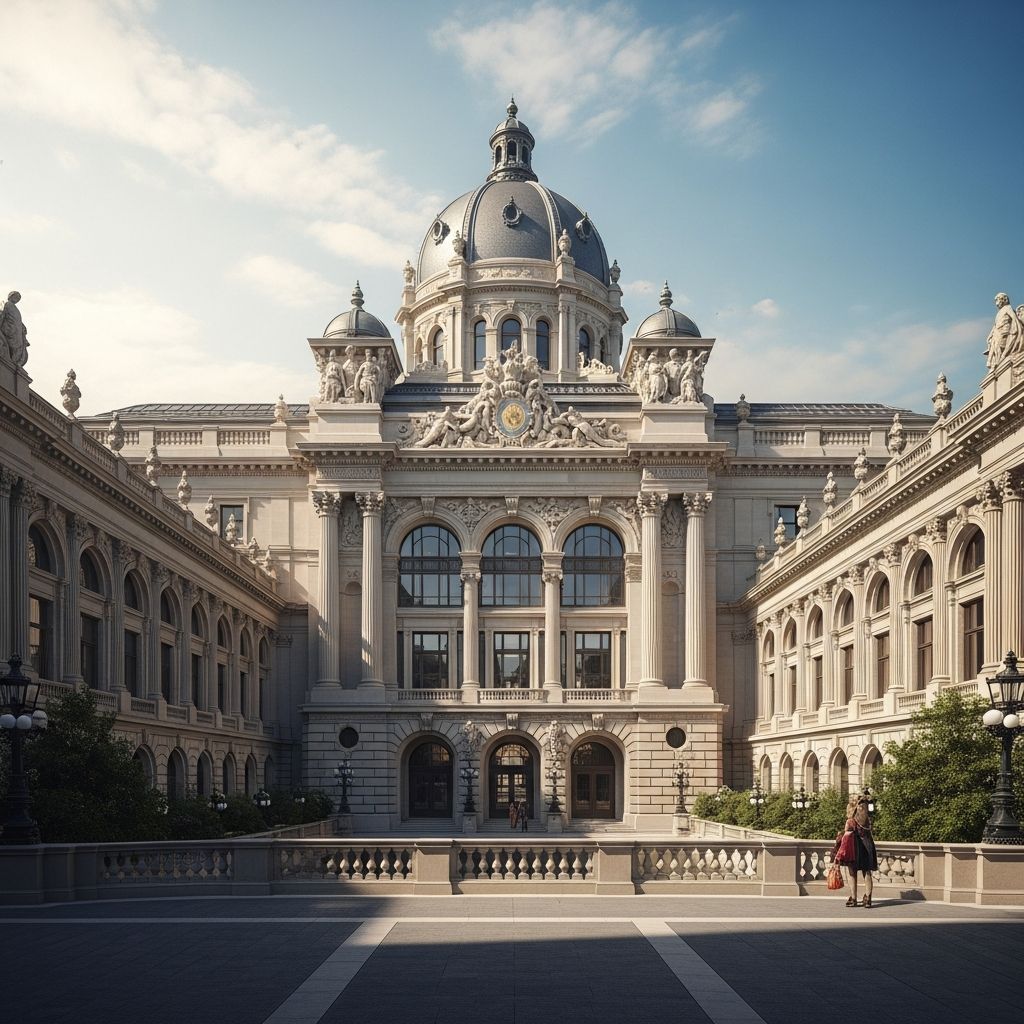
Beaux-Arts architecture represents a pinnacle of grandeur, fusing classical antiquity with 19th-century innovation to create monumental structures that symbolize power, culture, and progress. Emerging from France’s premier art school, this style dominated public building design across Europe and America from the mid-1800s to the early 1900s, emphasizing symmetry, sculptural embellishment, and spatial hierarchy.
Roots in French Academic Tradition
The story of Beaux-Arts begins with the École des Beaux-Arts in Paris, established as the leading institution for architectural training after the French Revolution. This school, evolving from the Académie royale d’architecture founded in 1671, instilled rigorous methods blending neoclassicism with Renaissance and Baroque influences, producing architects who prioritized harmony between form, function, and decoration.
During the Second Empire under Napoleon III (1852–1870) and the subsequent Third Republic, the style reached its zenith. Visionary urban planner Georges-Eugène Haussmann’s renovations of Paris showcased Beaux-Arts principles in wide boulevards lined with imposing facades, setting a model for civic magnificence that inspired international adoption. American architects like Richard Morris Hunt, the first to study there, brought these ideas stateside, training a generation that shaped skylines from New York to Chicago.
The curriculum emphasized architecture parlante—’speaking architecture’—where buildings visually communicated their purpose through symbolic motifs, inscriptions, and integrated sculptures, reflecting both regional identity and universal ideals. This pedagogical approach persisted until the late 1960s, ensuring the style’s profound legacy.
Signature Elements of Design
Beaux-Arts buildings stand out for their bold symmetry and hierarchical organization, creating a sense of ordered majesty. Key features include:
- Raised and rusticated ground floor: The base story features rough-hewn stonework, elevating the structure and grounding it visually.
- Flat roofs with prominent cornices: Often crowned by statues or balustrades, providing a clean, classical termination.
- Arched openings and pediments: Doors and windows framed by graceful arches, topped with triangular pediments echoing Greek temples.
- Rich sculptural integration: Bas-reliefs, figurative statues, and thematic murals unify the facade, drawing from Baroque dynamism and Rococo finesse.
- Spatial progression: Interiors flow from grand ‘noble’ spaces like sweeping staircases to functional areas, enhancing experiential drama.
Materials evolved with technology: early stone and masonry gave way to iron, glass, and steel frames, allowing vast interiors without sacrificing ornate exteriors. Classical orders—Doric, Ionic, Corinthian—were deployed eclectically, synthesizing historicist references into fluent, modern compositions.
Iconic Structures Worldwide
Beaux-Arts left an indelible mark on cityscapes, particularly for institutions embodying civic pride. In Paris, the Palais Garnier opera house (1861–1875) by Charles Garnier exemplifies lavish interiors with coffered ceilings, grand foyers, and gilded sculptures. The Grand Palais and Petit Palais (1897–1900), trapezoidal marvels by Albert Fouilhoux, blend 17th-century French motifs with expansive exhibition halls.
Across the Atlantic, the 1893 World’s Columbian Exposition in Chicago ignited America’s Beaux-Arts obsession, with surviving gems like the Art Institute of Chicago, Chicago Cultural Center, and Museum of Science and Industry showcasing symmetry, columns, and embedded statuary. New York’s Grand Central Terminal (1903–1913) by Warren & Wetmore features a cavernous concourse under a starlit dome, its facade alive with acroteria and allegorical figures.
In Pennsylvania, the State Capitol in Harrisburg (1906) by Joseph Huston, dubbed a ‘palace of art,’ boasts pilasters, marble fireplaces, and opulent detailing rivaling European palaces. These edifices, often clad in stone-like materials, prioritized monumental scale to inspire awe and national identity.
| Building | Location | Key Features | Architect(s) | Completion Year |
|---|---|---|---|---|
| Palais Garnier | Paris, France | Grand staircase, gilded auditorium, sculptural groups | Charles Garnier | 1875 |
| Grand Central Terminal | New York, USA | Vast concourse, celestial ceiling, triumphal arch entry | Warren & Wetmore | 1913 |
| Pennsylvania State Capitol | Harrisburg, USA | Domed rotunda, marble interiors, classical portico | Joseph Huston | 1906 |
| Art Institute of Chicago | Chicago, USA | Symmetrical facade, lion statues, pedimented doors | Multiple (post-1893) | 1893 onward |
Influence and Global Spread
Beaux-Arts transcended France via the École’s international students, becoming the lingua franca of public architecture in the U.S. until the Great Depression shifted tastes toward modernism. In Chicago, post-Exposition fervor dotted the city with libraries, museums, and train stations embodying the style’s decorative exuberance.
Richard Morris Hunt’s Vanderbilt mansion, The Breakers (1892), introduced residential applications, though the style thrived most in civic projects asserting cultural dominance. Its emphasis on Gesamtkunstwerk—total artwork uniting architecture, sculpture, and painting—echoed Versailles’ holistic splendor, influencing even 20th-century eclecticism.
Decline came with World War I, economic woes, and avant-garde movements like Art Deco and International Style, which favored simplicity over ornament. Yet, Beaux-Arts principles of proportion and contextual dialogue persist in contemporary neoclassicism.
Modern Relevance and Preservation
Today, Beaux-Arts buildings anchor urban heritage, their durability and aesthetic appeal justifying restorations amid sustainability pushes. Adaptive reuse—turning terminals into mixed-use hubs or capitols into event venues—preserves their hierarchy while meeting modern needs.
Revivals appear in luxury hotels and cultural centers, blending digital fabrication with classical motifs for a ‘neo-Beaux-Arts’ hybrid. Critics once decried its extravagance as decadent, but proponents celebrate its role in fostering communal identity.
Frequently Asked Questions
What defines Beaux-Arts from other classical styles?
Beaux-Arts uniquely synthesizes neoclassicism with Baroque/Rococo ornament and modern materials, prioritizing sculptural narrative and spatial drama over pure minimalism.
Why was Beaux-Arts popular for public buildings?
Its monumental scale and symbolic decoration conveyed authority and cultural prestige, ideal for museums, libraries, and government halls.
Is Beaux-Arts still used today?
Direct use has waned, but influences persist in neoclassical designs and restorations, adapting to steel and glass eras.
How did the École des Beaux-Arts shape the style?
Through competitions and ateliers emphasizing historicism, symmetry, and integrated arts, training architects for global impact.
What materials typify Beaux-Arts construction?
Stone facades over iron/steel frames, with lavish interiors of marble, mosaics, and frescoes.
References
- Beaux-Arts architecture — Wikipedia. 2023-10-15. https://en.wikipedia.org/wiki/Beaux-Arts_architecture
- Beaux-Arts — Chicago Architecture Center. 2024-01-12. https://www.architecture.org/online-resources/architecture-encyclopedia/beaux-arts
- Beaux-Arts Architecture Movement Overview — TheArtStory. 2023-05-20. https://www.theartstory.org/movement/beaux-arts-architecture/
- Beaux Arts Style 1885 – 1930 — Pennsylvania Historical and Museum Commission (.gov). 2022-08-10. https://www.phmc.state.pa.us/portal/communities/architecture/styles/beaux-arts.html
- From Paris to New York: The Legacy of Beaux-Arts Architecture — HowToRhino. 2024-03-05. https://howtorhino.com/blog/architecture-styles/beaux-arts-architecture/
- Introduction to Beaux-Arts — Weylin. 2023-11-28. https://weylin.com/introduction-beaux-arts-style/

Medha Deb is an editor with a master's degree in Applied Linguistics from the University of Hyderabad. She believes that her qualification has helped her develop a deep understanding of language and its application in various contexts. Medha specializes in the areas of beauty, health, sports, and wellness and is committed to ensuring that the content on the website is…