
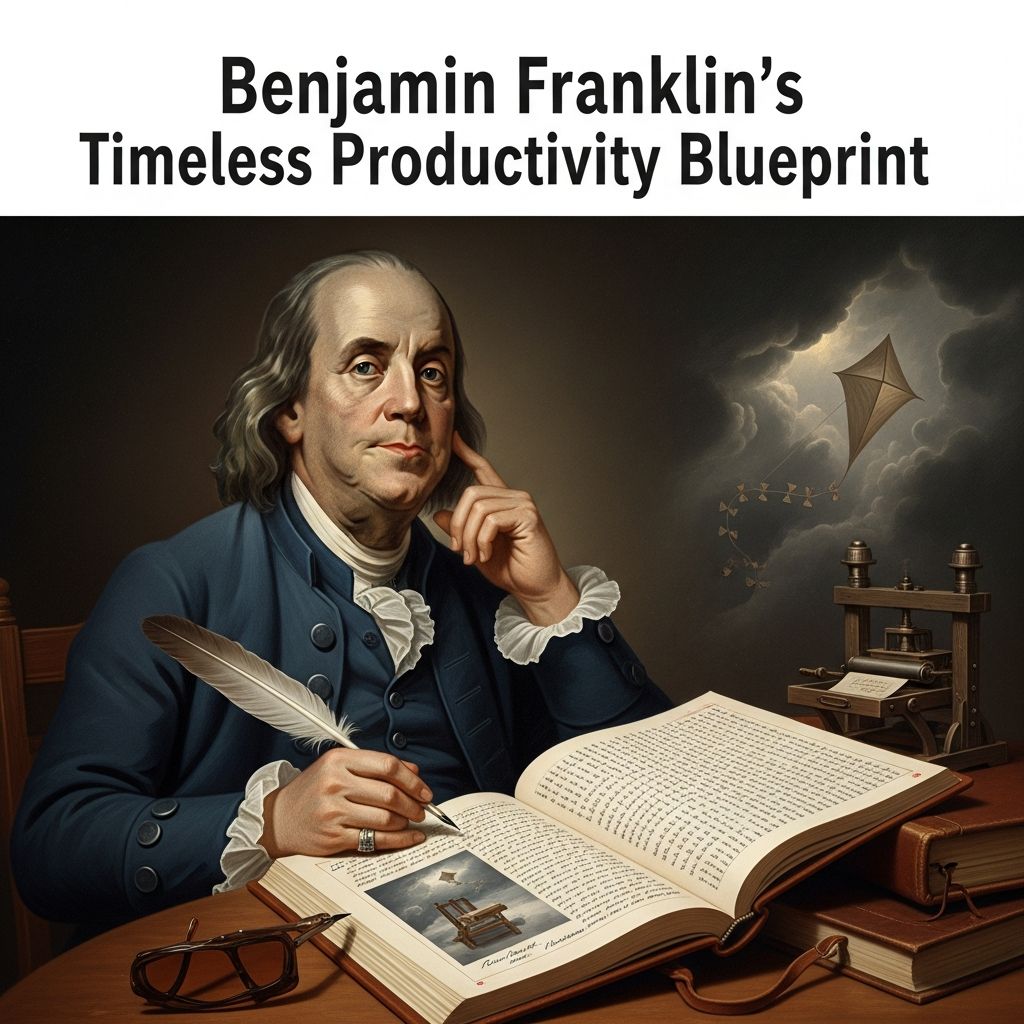
Benjamin Franklin, one of America’s founding fathers, was not only a statesman and inventor but also a master of personal efficiency. His daily routine, crafted over two centuries ago, remains a gold standard for achieving more in less time. By dividing his day into deliberate blocks and framing it with purposeful questions, Franklin maximized output while maintaining balance. This article delves into his methods, offering practical ways to integrate them into contemporary life for sustained high performance.
Establishing a Rock-Solid Daily Rhythm
Consistency forms the foundation of Franklin’s approach. He rose at 5 a.m. every day, regardless of circumstances, to seize control of his schedule from the start. This early wake-up allowed time for essential personal care, a light meal, and quiet contemplation before the demands of work intruded. Modern research supports this: consistent sleep-wake cycles regulate circadian rhythms, enhancing focus and energy levels throughout the day.
To replicate this, identify your optimal rising time based on natural tendencies. Aim for 7-9 hours of sleep nightly. Use alarms sparingly; instead, build habits like dimming lights early or avoiding screens an hour before bed. Franklin’s routine proves that a predictable start combats decision fatigue, freeing mental resources for high-value tasks.
Framing Your Day with Purposeful Intentions
Franklin began each morning by posing a single, profound question: “What good shall I do this day?” This intentional act shifted his mindset from reaction to proaction, aligning actions with meaningful goals. He would select a core virtue—such as temperance or industry—to emphasize, then outline key priorities.
In practice, spend 10-15 minutes post-wake-up journaling your top three objectives. Make them specific: instead of “work on project,” write “complete first draft of report by noon.” This clarity prevents drift into low-priority activities. Studies on goal-setting, like those in goal-setting theory, show that vivid, intention-driven plans increase completion rates by up to 42%.
- Review yesterday’s wins and shortfalls briefly.
- Choose one guiding principle (e.g., focus, kindness).
- List 1-3 non-negotiable tasks.
- Anticipate obstacles and countermeasures.
Mastering Deep Work Through Time Blocking
Franklin’s genius lay in segmenting his day into focused blocks: 8 a.m. to noon and 2 p.m. to 6 p.m. for intensive efforts, bookended by nourishment and lighter duties. These four-hour deep work sessions tackled complex inventions, writings, and diplomatic strategies when mental acuity peaked.
Deep work, as later termed by Cal Newport, demands undivided attention on cognitively demanding tasks. Franklin protected these windows ruthlessly, minimizing interruptions. Today, with constant notifications, this is revolutionary. Block your calendar similarly: mornings for creation, afternoons for continuation if energy holds.
| Time Block | Franklin’s Use | Modern Adaptation |
|---|---|---|
| 5-8 a.m. | Prep, plan, study | Exercise, meditate, prioritize |
| 8 a.m.-12 p.m. | Deep work | Core project focus (no email) |
| 12-2 p.m. | Lunch, reading | Meal, walk, light learning |
| 2-6 p.m. | More deep work | Continuation or meetings |
| 6-10 p.m. | Dinner, music, tidy | Family, hobbies, prep tomorrow |
| 10 p.m.-5 a.m. | Sleep | Uninterrupted rest |
This structure ensures high-energy periods align with demanding work, while breaks recharge.
Balancing Intensity with Strategic Pauses
Franklin allocated midday for lunch and reading, recognizing the need for recovery. This two-hour window included reviewing accounts—shallow tasks requiring less bandwidth. He also incorporated music and diversion, preventing burnout.
Adopt themed breaks: use lunch for nourishing walks in nature, which boost creativity per environmental psychology findings. Reading non-fiction expands knowledge without overload. Avoid work bleed; strict boundaries preserve evening sanity.
Cultivating Continuous Self-Improvement
Daily study slots in Franklin’s schedule fueled lifelong learning. He pursued sciences, languages, and philosophy systematically, turning idle moments into growth opportunities. In a knowledge economy, this habit separates achievers.
Dedicate 30-60 minutes daily to skill-building: online courses, books, or podcasts. Track progress quarterly. Franklin’s virtue focus evolved into a moral perfection project, blending ethics with productivity.
Maintaining an Orderly Environment
Evenings ended with workspace cleanup, ensuring a fresh start. This ritual conserved willpower, as decision science confirms: cluttered spaces sap mental energy.
Implement the “Franklin close”: 15 minutes nightly organizing desk, files, and tools. Digital equivalent: clear inbox, file docs. This micro-habit compounds into macro-gains.
Evening Reflection for Course Correction
Franklin’s nightcap question, “What good have I done today?” prompted honest review. Celebrate successes, analyze misses, adjust tomorrow.
Journal three gratitudes, one lesson learned, one tweak. Weekly, assess against monthly goals. This meta-cognition, rooted in reflective practice, accelerates improvement.
Adapting Franklin’s System for the Digital Age
While Franklin lacked smartphones, his principles counter modern distractions. Theme days (e.g., Mondays for planning), batch shallow tasks, use apps like Clockify for tracking.
Experiment: track a week unstructured vs. Franklin-style. Metrics like tasks completed or deep hours logged reveal benefits. Scale to teams by sharing schedules.
Potential Challenges and Solutions
- Irregular schedules: Flexible blocks (e.g., 90-minute Pomodoros).
- Family demands: Involve them in routines.
- Motivation dips: Accountability partners or apps.
- Overplanning: Limit to essentials; allow 20% buffer.
Frequently Asked Questions (FAQs)
Q: Can Franklin’s routine work for night owls?
A: Yes, shift blocks to personal chronotype (e.g., start at 7 a.m.), prioritizing deep work during peak alertness.
Q: How long to see results?
A: Habits form in 18-254 days; most notice gains in 2-4 weeks with consistency.
Q: Does it suit creative professions?
A: Absolutely; batching frees flow states, as seen in writers using similar structures.
Q: What if my job has fixed hours?
A: Apply within constraints—morning prep, lunch reflection, evening wind-down.
Q: How to handle unexpected interruptions?
A: Buffer time and quick rescheduling; protect deep blocks with ‘Do Not Disturb’.
Real-World Transformations
Professionals adapting Franklin’s methods report 30-50% productivity surges. One physician batched admin, reclaiming deep study time. Writers hit word goals via fixed blocks. CEOs theme days, slashing fatigue.
Start small: adopt one element weekly. Franklin’s blueprint isn’t rigid—it’s a flexible framework for purposeful living.
References
- Benjamin Franklin’s Secret To Productivity — Evolving Medic. 2023-05-15. https://www.evolvingmedic.com/newsletters/weekly-growth/posts/benjamin-franklin-s-secret-to-productivity
- 10 Productivity Hacks We Can Learn From Benjamin Franklin’s Daily Schedule — Success Series LLC. 2019-10-01. https://www.successseriesllc.com/wordpress/2019/10-productivity-hacks-we-can-learn-from-benjamin-franklins-daily-schedule/
- 10 Secrets From Benjamin Franklin’s Daily Schedule that… — YouTube (James Clear channel). 2022-08-10. https://www.youtube.com/watch?v=gL5qJece-Sw
- Benjamin Franklin’s Simple Daily Strategy That Will Make You Super Productive — Writing Cooperative. 2021-03-20. https://writingcooperative.com/benjamin-franklins-simple-daily-strategy-that-will-make-you-super-productive-f668b8122886
- Benjamin Franklin’s Daily Routine: A Blueprint for Success — Clockify. 2023-11-12. https://clockify.me/blog/managing-time/benjamin-franklin-schedule/

- Integrated M.A. in Applied Linguistics, University of Hyderabad
- 5+ years in editorial, instructional, SEO, and research-based writing
Sneha is a relationships and lifestyle writer with a strong foundation in applied linguistics and certified training in relationship coaching. She brings over five years of writing experience to theskillvault, crafting thoughtful, research-driven content that empowers readers to build healthier relationships, boost emotional well-being, and embrace holistic living. Her writing and insights reflect the belief that beauty, happiness, and wellness…