
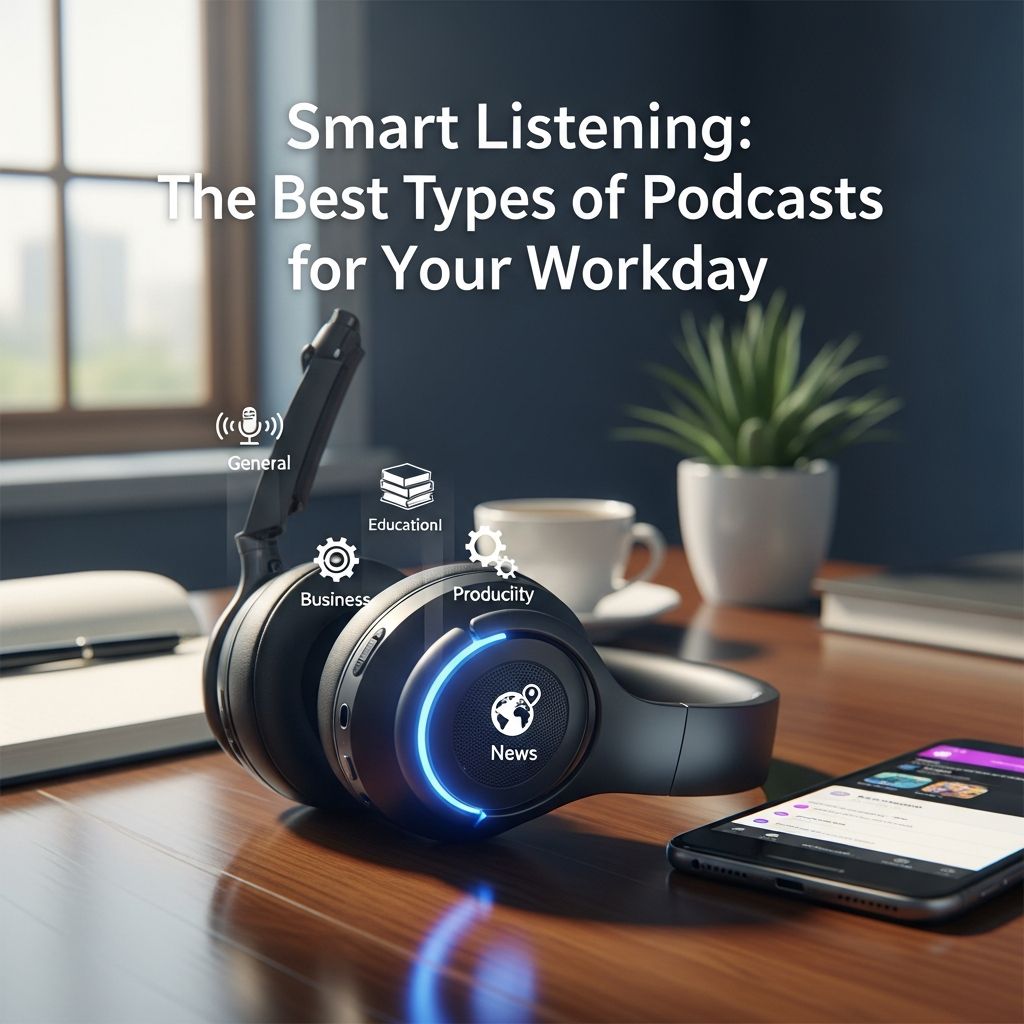
Podcasts can turn routine work hours into time for learning, reflection, and even relaxation—if you choose the right kind of show for the task in front of you. Instead of just hitting play on whatever is trending, you can be intentional about what you listen to and when, so your audio habits support your career instead of distracting from it.
This guide explains how to pick podcasts that fit your workload, personality, and energy level. You will learn which categories of shows work best for different tasks, how to avoid cognitive overload, and simple rules for staying productive while you listen.
Why Podcasts Belong in Your Workday
Used thoughtfully, podcasts can be a powerful complement to your job rather than a distraction from it.
- On-demand learning: Podcasts give you quick access to experts in leadership, psychology, technology, and more without leaving your desk.
- Low-friction habit: You can listen while commuting, organizing files, or doing repetitive tasks, slipping learning into time that might otherwise be wasted.
- Motivation and perspective: Hearing how others navigate career challenges can normalize your struggles and spark new ideas.
- Stress relief: Short breaks that involve something enjoyable and absorbing can help reset your mood and reduce job stress when used in moderation.
At the same time, research on multitasking shows that trying to process two demanding streams of information at once—like complex work and rich spoken content—can reduce accuracy and slow you down. The key is to match podcast complexity with task complexity.
Match Your Podcast to Your Task: A Simple Framework
Before you press play, mentally check which type of work you are doing. Use this simple framework to choose the right listening level.
| Work Type | Best Podcast Intensity | Recommended Categories |
|---|---|---|
| Deep focus (writing, coding, analysis) | Very low or none | Instrumental, ambient sound, or silence |
| Routine tasks (admin, filing, data entry) | Medium | Productivity, career, creativity, soft skills |
| Light creative work (brainstorming, sketching) | Medium to high | Storytelling, creativity, interviews |
| Breaks and transitions | High | News recaps, culture, humor, wellness |
Research on attention suggests that frequent task-switching can lower performance and increase mental fatigue. Treat podcasts as either background sound for simple tasks or focused learning during breaks—not as a constant layer over every kind of work.
Productivity & Time-Management Podcasts
When you are doing relatively simple or repetitive tasks, productivity-focused podcasts are a smart way to upgrade your workflows without scheduling a separate training session.
These shows typically cover:
- Time-blocking, prioritization, and planning systems
- Handling procrastination and perfectionism
- Digital organization and task management tools
- Realistic routines from entrepreneurs and high-performers
Best time to listen:
- While cleaning up your inbox
- Doing light spreadsheet or data entry work
- Organizing documents or digital files
What to look for in a productivity podcast:
- Short, practical episodes that end with clear takeaways.
- Hosts who share both successes and failures, not just polished routines.
- Content grounded in research or well-tested methods, not just trendy hacks.
Career Growth, Leadership & Workplace Strategy Podcasts
Career-focused shows are ideal for anyone who wants to grow in their role, manage people, or navigate office politics. Many feature organizational psychologists, HR leaders, and executives reflecting on what actually works at work.
Common themes include:
- How to advocate for promotions and raises
- Effective feedback and performance conversations
- Managing teams, conflict, and hybrid work arrangements
- Reframing failure and building resilience
Best time to listen:
- During lunch or a walk break
- On your commute
- Before or after 1:1s and performance reviews, to collect ideas
How to turn listening into action:
- Keep a running digital note where you capture one concrete idea per episode.
- Translate advice into a small experiment, such as trying a new way of structuring your weekly check-in.
- Bring a favorite insight into your next team meeting as a conversation starter.
Creativity, Innovation & Big-Idea Podcasts
Creative and idea-driven podcasts offer mental cross-training—even if they are not directly about your industry. They push you to see patterns across fields and can make you more inventive in your own job.
These episodes might include:
- Long-form interviews with designers, authors, or entrepreneurs
- Explorations of how habits, environment, and routine shape creativity
- Stories behind innovative products, campaigns, or social movements
Best time to listen:
- On a walk when you are stuck on a project
- During commutes before a strategy or brainstorming session
- At the very end of the day to seed ideas for tomorrow
Tips for capturing creative sparks:
- Pause occasionally to jot down phrases or metaphors that resonate.
- Ask: “How would this guest approach a challenge I am facing at work?”
- Share thought-provoking episodes with colleagues and discuss what you might apply.
Wellness, Mindset & Mental Health Podcasts
Work is mentally demanding, and chronic stress can undermine performance, decision-making, and creativity. Wellness-focused podcasts can teach you practical tools for managing stress, building healthier habits, and improving your relationship with work.
Typical episode topics include:
- Short guided breathing or mindfulness exercises
- Cognitive-behavioral strategies for reframing anxious thoughts
- Setting boundaries and recovering from burnout
- Evidence-based approaches to sleep, movement, and mood
Best time to listen:
- Morning commute to set a calm tone for the day
- Five-minute reset between intense meetings
- After work while transitioning out of “office mode”
How to use these shows without over-pathologizing normal stress:
- Look for hosts who reference credible research or clinical experience, not just anecdotal advice.
- Use episodes as gentle nudges for self-care, not as pressure to optimize every moment.
- If you are struggling with severe or persistent symptoms, podcasts should supplement—not replace—professional help.
News, Business & Industry Update Podcasts
Short news briefings and niche industry shows can help you stay informed without doomscrolling. Instead of constantly checking headlines, you can contain your updates to a focused, time-limited audio slot.
These shows often deliver:
- Daily or weekly summaries of major global events
- Market, technology, or policy updates relevant to your field
- Interviews with analysts and subject-matter experts
Best time to listen:
- Once in the morning and/or once in the late afternoon
- During low-stakes tasks that do not require deep focus
Boundaries for news listening:
- Set a time limit to avoid constant low-level anxiety from breaking news.
- Prefer analytical shows over sensational, opinion-heavy formats.
- Skip episodes that you notice leave you distracted or tense for the rest of the day.
Light Entertainment & Humor Podcasts
Not every minute of your workday needs to be relentlessly optimized. Light entertainment shows—humor, storytelling, culture, or conversational banter—can provide much-needed mental distance from tricky projects.
Healthy ways to use entertainment at work:
- As a genuine break between cognitively heavy tasks.
- As a reward when you finish a big deliverable.
- During simple chores like tidying your workspace or restocking supplies.
Signs the entertainment is becoming a distraction:
- You keep pausing your work to rewind and catch jokes you missed.
- You notice tasks taking significantly longer when episodes are playing.
- Co-workers mention that they can hear your show through your headphones.
How to Listen at Work Without Losing Focus
Even the best podcast can hurt your performance if you listen at the wrong moment. Use these guidelines to protect your focus and your reputation.
1. Decide if the task or the audio is primary
The human brain cannot give full attention to two demanding tasks simultaneously. Before you start, choose which one matters more right now:
- If work is primary, pick low-intensity background audio or skip podcasting altogether.
- If learning is primary, treat the episode like a mini-class—pause your work and take notes.
2. Set time boundaries
- Use timers: listen for one episode or 20–30 minutes, then switch back to silence or music.
- Schedule podcast blocks into your calendar just like meetings or deep-work sessions.
3. Respect your workplace culture
- Use closed-back headphones and keep the volume low enough that others do not hear.
- Avoid listening during meetings, client calls, or conversations—even if you are muted.
- Follow your organization’s policies on phones, media, and confidentiality.
4. Capture and review what you learn
To make sure episodes translate into real-life improvement:
- Keep a “podcast journal” with one insight and one possible action per episode.
- Review your notes weekly and choose 1–2 ideas to apply at work.
- Drop unhelpful shows rather than feeling obligated to keep up with every feed.
Building a Work-Friendly Podcast Playlist
Instead of deciding in the moment, design a few go-to playlists you can click on depending on what the day demands.
Sample playlist structure
- Deep Work Mode: Instrumental or low-voice ambient mixes only.
- Admin & Chores Mode: Productivity and career episodes you can follow without intense concentration.
- Growth Mode: One longer, high-quality interview or big-idea show for lunch or a walk.
- Reset Mode: Short wellness or humor segments for 5–10 minute breaks.
Over time, regularly prune your subscriptions. Aim for a small number of high-quality shows that consistently deliver value, rather than dozens you never quite catch up with.
Frequently Asked Questions (FAQs)
Q: Is it okay to listen to podcasts during work hours?
A: It depends on your role and company culture. For many knowledge workers, listening is fine during individual tasks as long as it does not disrupt performance or violate policies. When in doubt, ask your manager and avoid podcasts during meetings or client-facing work.
Q: Do podcasts help or hurt productivity?
A: For simple, routine tasks, podcasts can make work more pleasant and provide useful learning. For complex tasks that require deep focus, spoken audio often reduces accuracy and speed, because your brain must split attention between work and words.
Q: How many episodes should I listen to in a workday?
A: There is no universal rule, but many people do well limiting themselves to one focused learning session and one or two lighter listening blocks. If you notice your output slipping or your brain feeling overloaded, reduce your listening time.
Q: Are business and productivity podcasts better than music for focus?
A: For tasks involving language—like writing or reading—instrumental music or silence usually supports concentration better than spoken-word shows. Spoken podcasts are better saved for nonverbal tasks, breaks, or commutes.
Q: How can I remember what I hear in podcasts?
A: Treat key episodes like mini-courses. Take quick notes, write down one action item, and review your highlights at the end of the week. Discussing episodes with colleagues can also strengthen recall and spark new ideas.
References
- Using podcasts to promote student learning: A literature review — Kay, R. H. International Journal of Technology in Teaching and Learning. 2012-01-01. https://files.eric.ed.gov/fulltext/EJ895223.pdf
- Mental health and work: Impact, issues and good practices — World Health Organization & International Labour Office. 2000-01-01. https://www.who.int/publications/i/item/mental-health-and-work-impact-issues-and-good-practices
- Multitasking: Switching costs — American Psychological Association. 2006-03-20. https://www.apa.org/research/action/multitask
- Top Productivity Podcasts in 2025 — Routine.co Blog. 2025-05-10. https://routine.co/blog/posts/top-productivity-podcasts-in-2025
- Digital News Report 2024 — Reuters Institute for the Study of Journalism, University of Oxford. 2024-06-15. https://reutersinstitute.politics.ox.ac.uk/digital-news-report/2024

- Integrated M.A. in Applied Linguistics, University of Hyderabad
- 5+ years in editorial, instructional, SEO, and research-based writing
Sneha is a relationships and lifestyle writer with a strong foundation in applied linguistics and certified training in relationship coaching. She brings over five years of writing experience to theskillvault, crafting thoughtful, research-driven content that empowers readers to build healthier relationships, boost emotional well-being, and embrace holistic living. Her writing and insights reflect the belief that beauty, happiness, and wellness…