
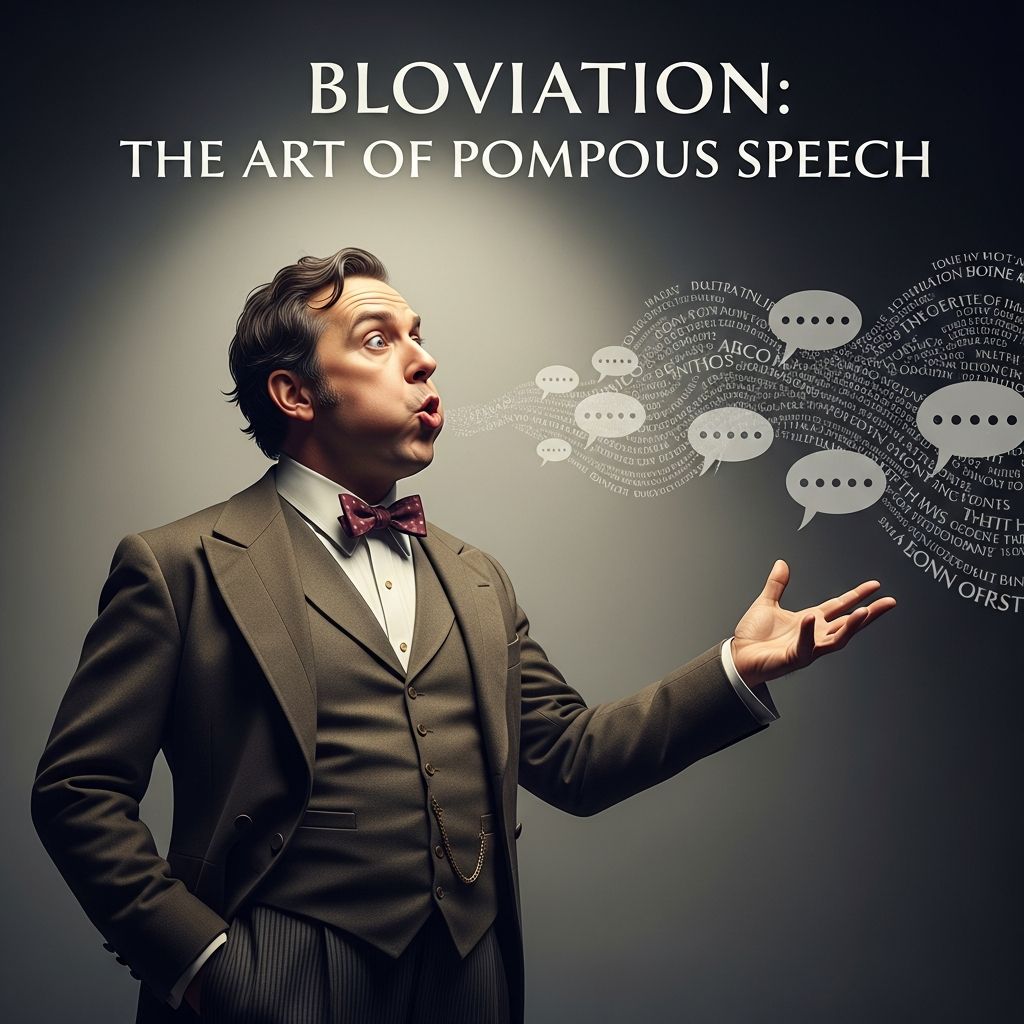
Bloviation refers to speaking or writing in a verbose, pompous manner that prioritizes style over substance, often filling time with hot air rather than meaningful content. This rhetorical style, deeply embedded in American political discourse, has evolved from regional chatter to a widely recognized term for pretentious verbosity.
Defining Bloviation in Modern Terms
At its core, to bloviate means to orate at length without delivering substantial ideas, typically in a boastful or inflated tone. Dictionaries like Merriam-Webster describe it as speaking “verbosely and windily,” evoking images of endless monologues that puff up the speaker’s ego but deflate listener interest. The noun form, bloviation, captures the act itself, while a bloviator is the practitioner—often a politician, pundit, or windbag dominating airtime with grandiloquence.
Consider the sensory hint in the word: it echoes “blow,” suggesting the expulsion of empty rhetoric like hot air from a balloon. Unlike casual conversation, bloviation demands an audience, thriving in public forums where volume masquerades as profundity.
Historical Roots: From Ohio Idle Talk to National Phenomenon
The term bloviation traces back to mid-19th century Ohio, initially denoting aimless, boastful chatter in everyday Midwestern speech. Records from the Debates and Proceedings of the Convention for the Revision of the State of Ohio mark its early political use, transforming casual gab into a formalized style of evasion.
Etymologists propose it’s a blend of “blow” (to boast, as in “blowhard”) with a mock-Latin suffix, lending faux sophistication to idle bluster. By the late 1800s, it had faded, only to resurge in the 1920s during Warren G. Harding’s presidential bid.
Warren G. Harding: The Patron Saint of Bloviation
Warren G. Harding, the 29th U.S. President (1921–1923), epitomized bloviation, proudly claiming it as “the art of speaking for as long as the occasion warrants, and saying nothing.” His 1920 campaign speeches, laced with vague normalcy rhetoric, propelled him to victory amid post-WWI fatigue.
Harding’s rival, William Gibbs McAdoo, lampooned it as “an army of pompous phrases moving over the landscape in search of an idea,” a vivid critique that endures. Poet e.e. cummings later mocked Harding’s prose as incomprehensible, underscoring how bloviation masked intellectual voids. This revival cemented its association with political grandstanding.
Bloviation in Political Arenas: Timeless Tactic
Politicians remain prime bloviators, using soaring rambles to dodge scrutiny or inflate achievements. Harding’s era set the template: lengthy addresses brimming with patriotism but barren of policy.
In contemporary settings, cable news pundits bloviate on talk shows, dissecting events with bombast over insight. Party broadcasts and stump speeches often feature bloviators promising vague glories, echoing “the wonderful things he’s going to do for us” without specifics.
- Classic Traits: Exaggerated vocabulary, repetitive flourishes, evasion of direct answers.
- Modern Examples: Filibusters stretched with anecdotes; press conferences filled with “thoughts and prayers” sans action plans.
Beyond Politics: Bloviation in Media and Daily Life
Bloviation permeates broadcasting, where radio hosts and podcasters expound verbosely on trivialities. Social media amplifies it, with influencers crafting thread-long treatises that prioritize likes over logic.
In workplaces, meetings devolve into bloviation when executives deploy jargon-laden soliloquies: “Leveraging synergistic paradigms to optimize stakeholder value streams.” Grandparents reminiscing endlessly about “how things used to be” exemplify familial bloviation.
| Context | Bloviation Example | Clear Alternative |
|---|---|---|
| Politics | “In the grand tapestry of our nation’s destiny…” | “We will cut taxes by 15% next year.” |
| Media | “Unprecedented paradigm shifts in the zeitgeist…” | “Sales dropped 10% due to inflation.” |
| Business | “Holistic ideation sessions for quantum leaps.” | “Brainstorm ideas to boost efficiency.” |
The Psychology Behind Bloviation
Bloviators often seek to project authority through linguistic fireworks, compensating for sparse content. This ties to “blowhard” syndrome, where boasting signals dominance in group dynamics. Audiences tolerate it briefly for entertainment but disengage when substance lags.
Cognitive load theory explains its failure: verbose pomp overwhelms listeners, reducing retention. Effective speakers, conversely, prioritize brevity, respecting attention spans.
Spotting and Dismantling Bloviation
Key indicators include disproportionate length-to-content ratio, lofty synonyms for simple terms, and circular logic. Test by summarizing: if it fits in one sentence, the rest was bloviation.
- Listen for filler: “Frankly,” “Let me be clear,” ad nauseam.
- Probe for specifics: Bloviators pivot to generalities.
- Watch body language: Grand gestures amplify empty words.
Cultivating Clear Communication: Antidotes to Bloviation
To avoid bloviating, embrace the “soaring ramble’s” opposite: concise, audience-focused speech. Replace “I, with my extensive knowledge, shall elucidate…” with “Here’s how it works.”
Techniques include:
- Outline key points first.
- Use active voice and short sentences.
- Practice the elevator pitch: 30 seconds max.
Studies from communication experts affirm brevity boosts persuasion and recall. In debates, crisp rebuttals deflate bloviators effortlessly.
Bloviation’s Cultural Legacy and Evolution
From Harding’s heyday to today’s 24/7 news cycles, bloviation persists as critique and style. Its 2000 U.S. election revival highlighted media’s role in amplifying it. Bloggers and vloggers now bloviate digitally, turning essays into endurance tests.
Yet, pushback grows: audiences crave authenticity, punishing hot air with clicks elsewhere. Platforms rewarding substance may curb its dominance.
Frequently Asked Questions (FAQs)
What is the difference between bloviation and normal speaking?
Bloviation is pompous, substance-light verbosity; normal speech conveys ideas efficiently.
Who coined bloviation?
No single coiner; it emerged in 19th-century Ohio politics.
Is bloviation always negative?
Typically yes, implying emptiness; rarely neutral for stylistic flair.
Can bloviation be effective?
Short-term for stalling or entertaining, but erodes trust long-term.
How do I stop bloviating?
Edit ruthlessly, seek feedback, prioritize listener needs.
Conclusion: Speak with Substance
Bloviation, while colorful, underscores communication’s pitfalls. By shunning empty eloquence for precise expression, speakers honor audiences and amplify impact. Next time you hear a rambling oration, smile—it’s just bloviation at work.
References
- Word of the Day: Bloviate — Vocabulary.com. 2023-08-04. https://www.vocabulary.com/word-of-the-day/2023-08-04
- Bloviate — Speakipedia. N/A. https://speakipedia.com/bloviate/
- Bloviation — Wikipedia. N/A. https://en.wikipedia.org/wiki/Bloviation
- Bloviate Definition & Meaning — Merriam-Webster. N/A. https://www.merriam-webster.com/dictionary/bloviate
- Bloviate Meaning – Formal US Vocabulary — YouTube (iswearenglish). N/A. https://www.youtube.com/watch?v=diHhCQ1pd30
- What does ‘bloviate’ mean? — Publication Coach. N/A. https://www.publicationcoach.com/bloviate/

- Integrated M.A. in Applied Linguistics, University of Hyderabad
- 5+ years in editorial, instructional, SEO, and research-based writing
Sneha is a relationships and lifestyle writer with a strong foundation in applied linguistics and certified training in relationship coaching. She brings over five years of writing experience to theskillvault, crafting thoughtful, research-driven content that empowers readers to build healthier relationships, boost emotional well-being, and embrace holistic living. Her writing and insights reflect the belief that beauty, happiness, and wellness…