
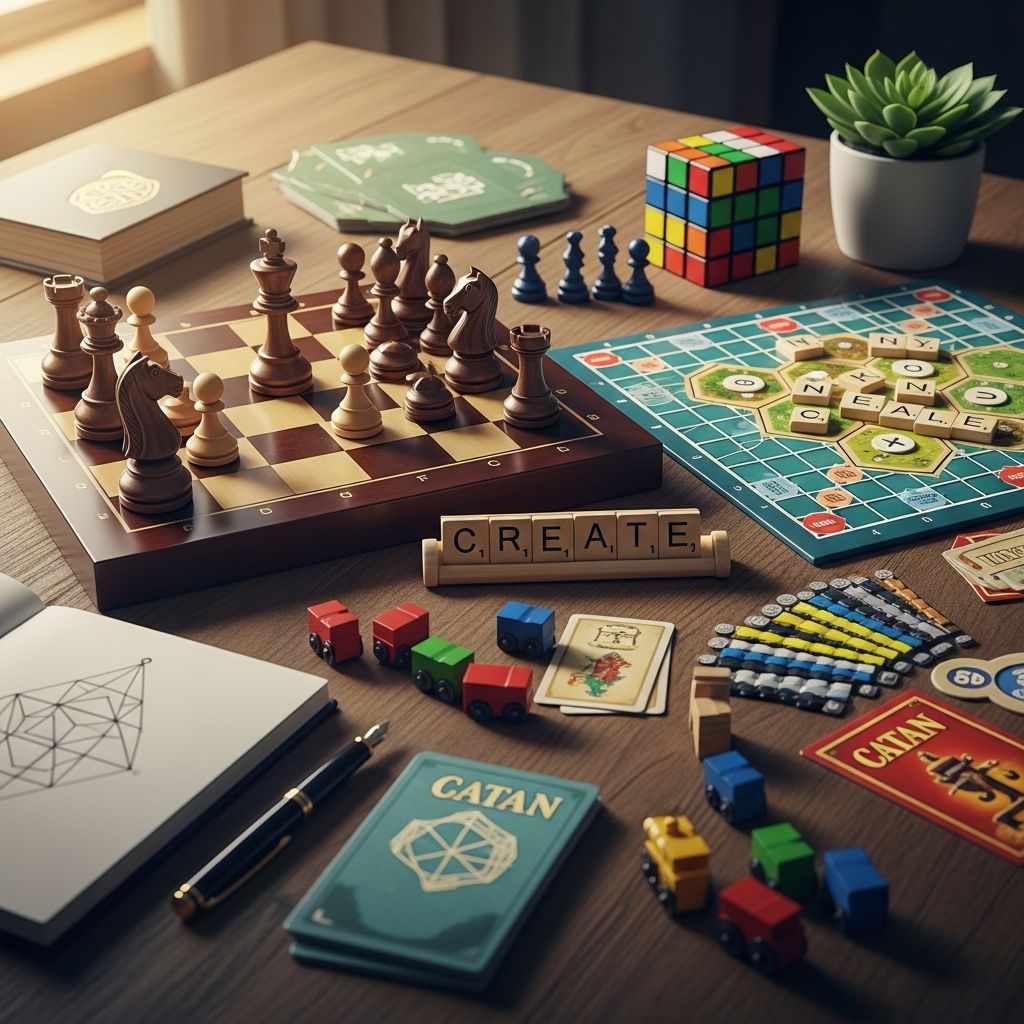
Board games offer more than casual entertainment; they serve as powerful tools for cognitive development, creative expression, and social bonding. Research highlights their role in improving critical thinking, memory, and emotional regulation, making them essential for personal growth across all ages.
Why Board Games Transform Your Brain
Engaging in board games stimulates multiple brain regions simultaneously, promoting neuroplasticity—the brain’s ability to form new connections. Unlike digital distractions, these analog experiences demand sustained focus, strategic planning, and adaptability, leading to measurable gains in executive functions.
- Critical Thinking Enhancement: Players must evaluate options, predict outcomes, and adjust tactics in real-time, mirroring real-world decision-making.
- Memory and Recall Boost: Remembering rules, positions, and past moves strengthens short-term and working memory.
- Creativity Ignition: Open-ended mechanics encourage innovative solutions and narrative building.
A study in Psychiatry Investigation showed children playing strategic games like Go improved attention and self-control after consistent play, activating the prefrontal cortex. Similarly, modern board games correlate with higher fluid intelligence and verbal working memory.
Top Games for Sharpening Logical Reasoning
Games emphasizing logic train the mind to dissect problems methodically. Here’s a selection that challenges deduction and pattern recognition.
| Game | Core Skill | Player Count | Playtime |
|---|---|---|---|
| Chess | Strategic foresight | 2 | 30-60 min |
| Carcassonne | Tile placement logic | 2-5 | 45 min |
| Splendor | Resource optimization | 2-4 | 30 min |
Chess, for instance, has been linked to improved fluid intelligence and decision-making, with practitioners showing enhanced short-term memory. Carcassonne requires spatial reasoning as players build medieval landscapes, fostering adaptability without direct confrontation.
Games That Fuel Mathematical and Linguistic Mastery
Many titles embed math and language skills seamlessly, turning abstract concepts into tangible fun. They reinforce arithmetic, vocabulary, and pattern detection far more engagingly than rote drills.
- Scrabble: Builds vocabulary and anagram-solving prowess, boosting literacy in a competitive format.
- Ticket to Ride: Involves route calculation and set collection, honing geometry and probability.
- Settlers of Catan: Teaches resource management and trade negotiation, applying real arithmetic to empire-building.
Board games like these develop number knowledge and abstract concepts, as noted in child development research. Families report children tackling math homework with newfound confidence after regular sessions.
Building Resilience Through Playful Adversity
Losses in games teach gracious defeat and strategic pivots, cultivating a growth mindset. This emotional training translates to academic and professional perseverance.
Neuroscience backs this: cooperative play releases oxytocin, strengthening bonds and empathy. A 2017 study found board gaming reduces stress, promoting calmness amid competition.
Creativity Unleashed: Narrative and Invention Games
For imagination, select games with storytelling or improvisational elements. They push players to invent scenarios, enhancing divergent thinking essential for innovation.
- Dixit: Players describe surreal cards poetically, decoding others’ metaphors to score points.
- Tales of the Arabian Nights: Branching stories demand creative choices with unpredictable outcomes.
- Mysterium: Ghosts convey clues via abstract art, training intuitive interpretation.
Creative play correlates with superior problem-solving later in life, as it encourages unconventional perspectives.
Social Dynamics: Games for Connection and Negotiation
Board games excel at teaching turn-taking, cooperation, and diplomacy. Modern titles like Codenames sharpen verbal cues and team synergy.
| Game | Social Focus | Ideal Group Size |
|---|---|---|
| Codenames | Word association | 4-8 |
| Azul | Pattern sharing | 2-4 |
| 7 Wonders | Simultaneous strategy | 3-7 |
These foster prosocial behaviors, vital for family and classroom harmony. Research from the American Academy of Pediatrics underscores play’s role in social-emotional development.
Advanced Titles for Deep Cognitive Workouts
Seasoned players seek complexity. Games like Terraforming Mars demand long-term planning, while Scythe blends engine-building with tactical combat.
- Terraforming Mars: Simulate planetary engineering, balancing resources and milestones.
- Twilight Struggle: Cold War simulation hones geopolitical deduction.
- Clank!: Risk assessment in dungeon delves.
Modern board games improve logical thinking and social skills more than traditional ones in some studies.
Games Tailored for Different Age Groups
Young Learners (Ages 5-8)
Start simple: Chutes and Ladders teaches probability basics; Candyland introduces sequencing.
Tweens and Teens (Ages 9-14)
King of Tokyo adds light strategy; Pandemic promotes collaboration against global threats.
Adults and Families
Wingspan explores ecosystems; Everdell builds whimsical villages.
ADHD research supports games like Go for attention gains.
Implementing Board Games into Daily Routines
Incorporate 30-60 minutes weekly. Schools use them for breaks, enhancing focus. Families bond over evenings, reaping emotional benefits.
Frequently Asked Questions (FAQs)
What are the best board games for improving math skills?
Games like Ticket to Ride and Splendor excel, as they require calculating routes, resources, and probabilities in engaging scenarios.
Can board games help with ADHD?
Yes, strategic play like Go improves attention and executive function, per a study in Psychiatry Investigation.
Do board games prevent cognitive decline?
They stave off decline, boost cooperation, and reduce loneliness, according to academic reviews.
How often should you play for cognitive benefits?
Consistent play, even 2 hours weekly, yields improvements in memory and flexibility.
Are board games better than video games for the brain?
Board games uniquely enhance fluid intelligence and social skills, while video games target visuospatial areas.
Start Your Cognitive Adventure Today
With endless variety, board games adapt to any skill level, delivering joy alongside profound mental gains. Gather friends or family, unbox a title, and watch intelligence and creativity flourish.
References
- The Benefits of Board Games for Students — Great Plains Gaming Project. 2023. https://greatplainsgamingproject.com/the-benefits-of-board-games-for-students/
- Benefits of Board Games for Children and their Families — Child Development Clinic. 2023. https://www.childdevelopmentclinic.com.au/benefits-of-board-games-for-children-and-their-families.html
- Video games and board games: Effects of playing practice on cognitive performance — NIH/PMC. 2023-03-15. https://pmc.ncbi.nlm.nih.gov/articles/PMC10042352/
- Wellness Wednesday – 5 Mental Benefits of Board Games — City of Asheville. 2020-05-13. https://www.ashevillenc.gov/news/wellness-wednesday-5-mental-benefits-of-board-games/
- Word Puzzles and Board Games Boost Brain Health — Psychology Today. 2024-12. https://www.psychologytoday.com/us/blog/the-full-picture/202412/word-puzzles-and-board-games-boost-brain-health

Medha Deb is an editor with a master's degree in Applied Linguistics from the University of Hyderabad. She believes that her qualification has helped her develop a deep understanding of language and its application in various contexts. Medha specializes in the areas of beauty, health, sports, and wellness and is committed to ensuring that the content on the website is…