
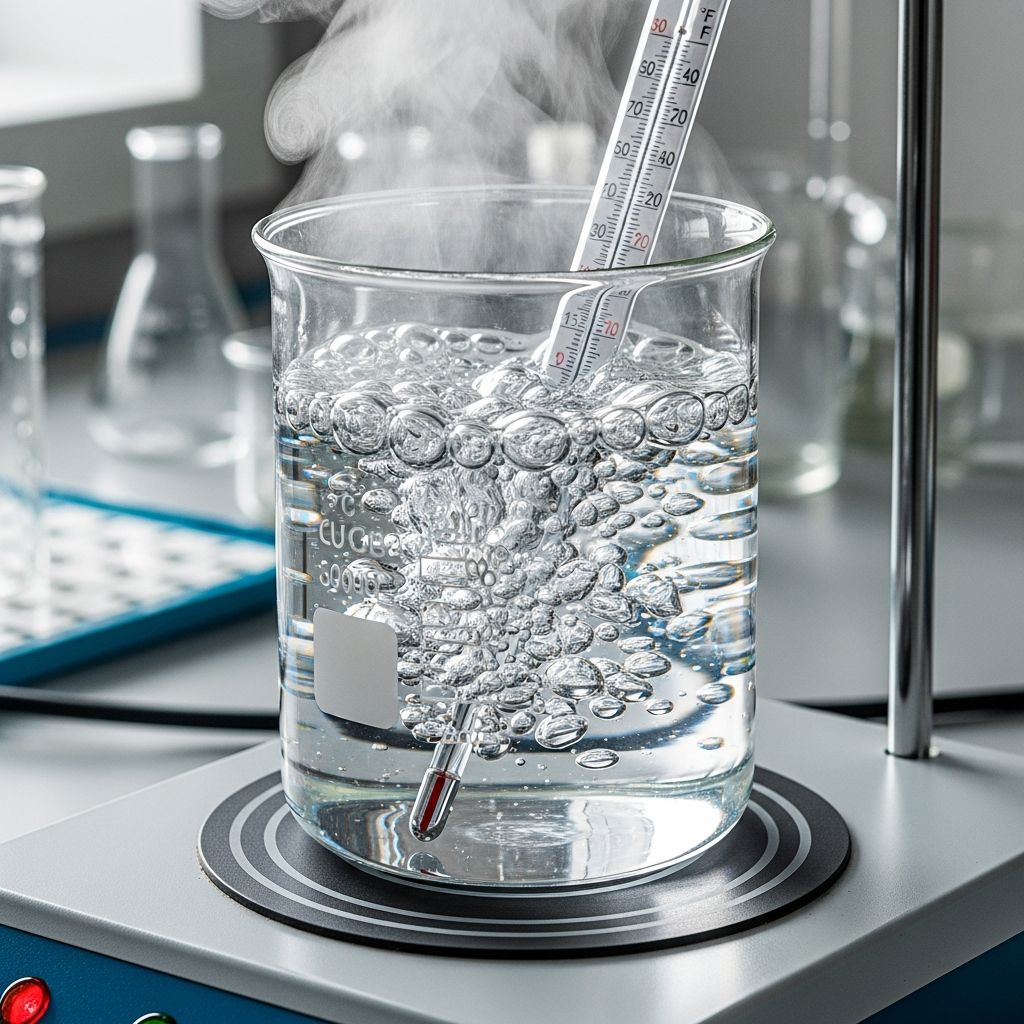
The boiling point of water is the temperature at which it transitions from liquid to gas, occurring at **100°C (212°F)** under standard atmospheric pressure at sea level. This fundamental property underpins countless processes in nature, cooking, and industry, but it varies significantly with environmental conditions like pressure and altitude.
Defining the Boiling Process
Boiling happens when a liquid’s vapor pressure equals the surrounding atmospheric pressure, allowing bubbles of vapor to form within the liquid and rise to the surface. For water, this equilibrium is reached at 100°C when exposed to one atmosphere (101.325 kPa), the standard pressure at sea level. Below this temperature, water remains liquid because its vapor pressure is lower than the air pressure pushing down on it; above it, rapid vaporization ensues.
This phase change, known as vaporization, involves molecules gaining enough kinetic energy from heat to overcome intermolecular forces, primarily hydrogen bonding in water. Unlike evaporation, which occurs only at the surface, boiling produces vapor throughout the liquid volume, creating the characteristic bubbles.
Standard vs. Normal Boiling Points
Distinguishing between the normal boiling point and standard boiling point is crucial. The normal boiling point is defined at exactly 1 atm (101.325 kPa), where pure water boils at precisely 99.97°C (211.95°F), often rounded to 100°C. The IUPAC standard boiling point, set at 1 bar (100 kPa), is slightly lower at 99.61°C (211.3°F).
These definitions ensure consistency in scientific measurements. For most practical purposes, 100°C at sea level suffices, but precision matters in labs and engineering.
How Pressure Influences Boiling
Atmospheric pressure directly dictates boiling temperature: lower pressure lowers the boiling point, while higher pressure raises it. At sea level, 1 atm holds water at 100°C; in a vacuum, it boils at room temperature since minimal external pressure allows easy vapor escape.
In pressure cookers, elevated pressure (up to 2 atm) increases the boiling point to around 120°C, speeding cooking by enabling higher temperatures without burning food. Conversely, on mountains, thinner air means lower pressure and thus lower boiling points, affecting everything from tea brewing to sterilization.
| Pressure (relative to 1 atm) | Boiling Point of Water (°C) | Boiling Point of Water (°F) |
|---|---|---|
| 0.5 atm | 81.3 | 178.3 |
| 1 atm (sea level) | 100 | 212 |
| 2 atm | 120.2 | 248.4 |
| Critical point (~218 atm) | 374 | 705 |
This table illustrates pressure’s impact, derived from thermodynamic principles. Beyond the critical point, water becomes a supercritical fluid with no distinct boiling.
Altitude’s Effect on Water Boiling
Elevation reduces atmospheric pressure, lowering water’s boiling point proportionally. At 1,000 meters (3,281 feet), it drops to about 96.7°C (206.1°F); at Mount Everest’s summit (8,848 m), it’s merely 71°C (160°F).
This has practical implications: high-altitude cooking takes longer since food can’t exceed the lower boiling temperature effectively. Pasta in Denver boils at 95°C, requiring extended simmer times.
| Elevation (meters) | Boiling Point (°C) | Elevation (feet) | Boiling Point (°F) |
|---|---|---|---|
| 0 | 100.0 | 0 | 212.0 |
| 500 | 98.4 | 1,500 | 209.3 |
| 1,000 | 96.7 | 3,000 | 206.6 |
| 2,000 | 93.4 | 6,000 | 201.1 |
| 5,000 | 83.0 | 16,000 | 181.4 |
Data adapted from elevation-pressure correlations. Hikers and aviators must adjust for safe water purification, as pathogens may survive suboptimal boiling.
Impurities and Boiling Point Elevation
Adding solutes like salt raises water’s boiling point via colligative properties—a phenomenon called boiling point elevation. Seawater or salted pasta water boils at slightly above 100°C, around 102°C for typical concentrations.
The formula is ΔT_b = K_b * m * i, where K_b is water’s ebullioscopic constant (0.512°C/kg/mol), m is molality, and i is the van’t Hoff factor. One mole of NaCl per kg raises it by about 1°C. This explains why pressure cookers sometimes use salt for minor boosts, though pressure dominates.
- Salt water: ~102°C at sea level.
- Sugar solution: Similar elevation based on concentration.
- Pure vs. impure: Distilled water boils sharper; tap water slightly higher.
Comparing Boiling Points Across Liquids
Water’s 100°C is moderate; volatiles like ethanol boil at 78.4°C (173°F), while robust sulfuric acid requires 310°C (590°F). Vapor pressure dictates this: high-vapor-pressure liquids boil cooler.
| Liquid | Boiling Point (°C) | Boiling Point (°F) | Key Factor |
|---|---|---|---|
| Water | 100 | 212 | Hydrogen bonding |
| Ethanol | 78.4 | 173.2 | Weaker H-bonding |
| Chloroform | 61.2 | 142.2 | Low polarity |
| Sulfuric Acid | 310 | 590 | Strong bonds |
These differences arise from intermolecular forces: stronger forces mean higher boiling points.
Real-World Applications and Everyday Impacts
In kitchens, altitude adjustments prevent undercooked rice; pressure cookers compensate for high elevations. Industrially, distillation separates mixtures by exploiting boiling variances, vital for petroleum refining where fractions boil at 210°C+.
Labs use boiling for sterilization: autoclaves at 121°C (15 psi) kill microbes. Aviation and space demand pressure control to maintain potable water. Climate change subtly affects via barometric variations, though minimally.
Advanced Concepts: From Triple Point to Critical Point
Water’s triple point (0.01°C, 611 Pa) is where solid, liquid, and gas coexist; below, no liquid phase exists. The critical point (374°C, 218 atm) erases liquid-gas distinction.
The Clausius-Clapeyron equation predicts boiling: \( T_B = \left( \frac{1}{T_0} – \frac{R \ln(P/P_0)}{\Delta H_{vap}} \right)^{-1} \), linking temperature, pressure, and vaporization enthalpy. This models non-ideal behaviors accurately.
Frequently Asked Questions (FAQs)
Why does water boil at a lower temperature in the mountains?
Lower atmospheric pressure at higher altitudes reduces the pressure on the liquid, so vapor pressure equals it sooner, at a lower temperature.
Does adding salt make water boil faster?
No, it slightly raises the boiling point, requiring more energy to reach, though it aids cooking post-boil.
What is the boiling point of water on Mars?
At Mars’ average pressure (0.006 atm), water boils around 10°C, explaining its instability.
Can water boil above 100°C without a pressure cooker?
Yes, if external pressure exceeds 1 atm, like underwater or in a sealed container.
How precise is water’s boiling point at 100°C?
It’s 99.97°C at exactly 1 atm, per thermodynamic Celsius definition.
References
- Boiling Points | Science | Research Starters — EBSCO. Accessed 2026. https://www.ebsco.com/research-starters/science/boiling-points
- Boiling Point — Wikipedia (informed by NIST/IUPAC standards). Accessed 2026. https://en.wikipedia.org/wiki/Boiling_point
- Boiling Point | Definition, Examples, Temperature, & Facts — Britannica. Accessed 2026. https://www.britannica.com/science/boiling-point
- The Melting and Boiling Point of Water — LabXchange (Harvard-affiliated). Accessed 2026. https://www.labxchange.org/library/items/lb:LabXchange:9792ef1b:html:1

- Integrated M.A. in Applied Linguistics, University of Hyderabad
- 5+ years in editorial, instructional, SEO, and research-based writing
Sneha is a relationships and lifestyle writer with a strong foundation in applied linguistics and certified training in relationship coaching. She brings over five years of writing experience to theskillvault, crafting thoughtful, research-driven content that empowers readers to build healthier relationships, boost emotional well-being, and embrace holistic living. Her writing and insights reflect the belief that beauty, happiness, and wellness…