
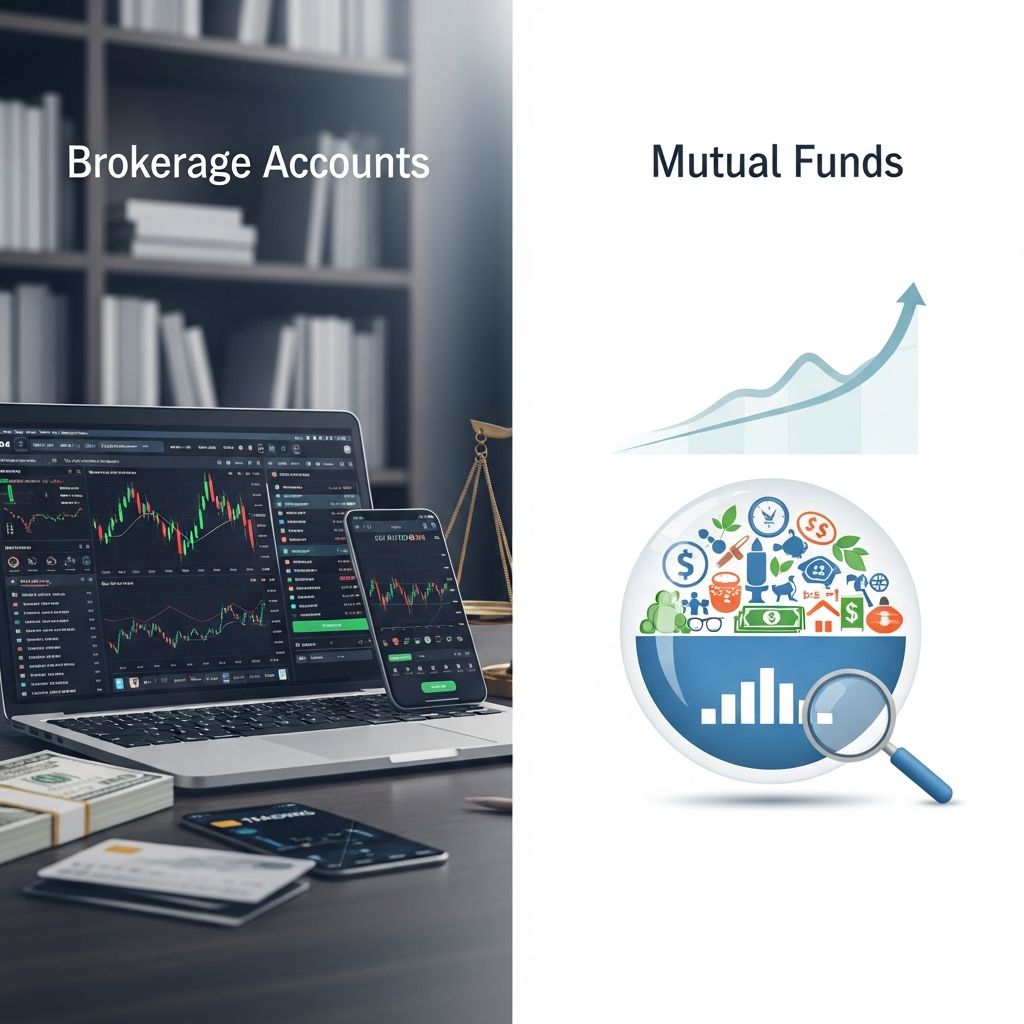
If you are starting to invest, the terms brokerage account and mutual fund can sound similar but they describe very different things. One is a flexible investing container; the other is an investment product that can often be held inside that container. Understanding how they work together and how they differ is essential before putting your money at risk.
This guide explains, in clear language, what each option is, how they compare on risk, control, fees, and convenience, and how to decide which combination is right for your goals.
Big Picture: Account vs Investment
The key distinction is simple:
- A brokerage account is an investment account you open with a financial institution that lets you buy and sell different securities such as stocks, bonds, ETFs, and mutual funds.
- A mutual fund is an investment vehicle that pools money from many investors and invests it in a portfolio of securities managed by a professional manager.
In other words, a brokerage account is like a toolbox; a mutual fund is one of the tools that can sit in that toolbox.
What Is a Brokerage Account?
A brokerage account is a standard, taxable investment account you open at a firm such as a bank, investment company, or online broker. Once funded, it allows you to place orders to buy and sell a wide range of investments.
Main features of a brokerage account
- Wide choice of assets: You can typically invest in stocks, bonds, mutual funds, ETFs, and sometimes options and other products.
- Direct ownership: When you buy a stock or ETF in a brokerage account, you directly own those shares.
- High flexibility: You can trade during market hours and decide exactly when to buy or sell.
- Taxable by default: Earnings such as dividends, interest, and capital gains are generally taxable in the year they occur unless the account is a tax-advantaged subtype.
Common types of brokerage accounts
- Individual taxable brokerage account: Opened in one person’s name; most flexible, but all gains are taxable.
- Joint brokerage account: Shared between two or more people, often couples.
- Brokerage-based retirement accounts: Some firms let you hold IRAs in a brokerage framework, but these have different tax rules than ordinary taxable brokerage accounts.
Who typically uses a brokerage account?
- Investors who want to pick their own stocks, ETFs, or bonds.
- People comfortable researching investments and monitoring markets.
- Those who value flexibility and control more than convenience.
What Is a Mutual Fund?
A mutual fund is a pooled investment that collects money from many investors and invests it according to a specific strategy, such as tracking an index or selecting bonds for income. An investment company or asset manager runs the fund and a professional team makes the day-to-day decisions.
Core traits of mutual funds
- Diversification: Even a single mutual fund usually holds dozens or hundreds of securities, spreading risk across many issuers or sectors.
- Professional management: A portfolio manager and research team decide what to buy and sell on behalf of all investors.
- Share-based ownership: You own shares of the fund, not the underlying stocks or bonds directly.
- End-of-day pricing: Traditional mutual funds are usually priced once per day, after markets close; you trade at that day’s net asset value (NAV).
Types of mutual funds
- Index funds: Aim to replicate the performance of a specific market index, such as a broad stock or bond benchmark, and usually have lower fees.
- Actively managed funds: Try to beat a benchmark using research and security selection; they often carry higher expense ratios.
- Stock (equity) funds: Focus primarily on shares of companies.
- Bond funds: Invest mostly in fixed income securities like government or corporate bonds.
- Balanced or allocation funds: Mix stocks and bonds in one portfolio.
Where you can hold mutual funds
- Inside a brokerage account: Most modern brokerage platforms let you buy mutual funds along with other investments.
- Directly with the fund company: Some investors open an account directly at a mutual fund provider instead of going through a brokerage.
Side-by-Side Comparison: Brokerage Account vs Mutual Fund
The table below summarizes how a typical taxable brokerage account compares with owning a mutual fund investment.
| Feature | Brokerage Account | Mutual Fund |
|---|---|---|
| What it is | An account where you hold various investments | An investment product you can buy, often inside a brokerage account |
| Who makes decisions | You (or an advisor) choose each security to buy and sell | Professional manager chooses and trades underlying holdings |
| Ownership | You own each stock, bond, or ETF directly | You own shares of the fund, not the underlying securities |
| Diversification | Depends entirely on what you buy; can be concentrated or broad | Typically diversified across many securities by design |
| Fees | May include trading commissions, bid–ask spreads, advisory fees | Ongoing expense ratio; some funds also have sales loads or other charges |
| Time commitment | Higher: research, monitor, and rebalance your portfolio yourself | Lower: manager handles security selection and trading |
| Risk level | Can be higher or lower depending on what you buy; concentrated stock portfolios can be volatile | Generally lower single-stock risk due to diversification, but still subject to market risk |
How Risk and Return Differ
Both brokerage accounts and mutual funds are tools for long-term growth, but they expose you to risk in different ways.
Risk in a brokerage account
- Concentration risk: If you hold just a few individual stocks, poor performance in one company can heavily affect your portfolio.
- Behavioral risk: Having full control can tempt you to trade often or react emotionally to market swings, which may hurt returns.
- Strategy flexibility: On the upside, you can tailor risk by mixing different asset classes, such as stocks, bonds, and cash equivalents.
Risk in mutual funds
- Market risk: A diversified fund can still fall in value if its overall market or sector declines.
- Manager risk: Actively managed funds depend on the skill and decisions of the manager; poor choices may lead to underperformance relative to benchmarks.
- Style risk: A fund focused on a narrow niche—like a single industry—may be more volatile than a broad market index fund.
Fees and Costs: What You Pay and Why It Matters
Costs can significantly influence your long-term investing results because they reduce the portion of returns you keep. Even small fee differences can compound over time.
Typical costs of using a brokerage account
- Trading commissions: Many large online brokers now offer commission-free trading for stocks and many ETFs, though some products may still carry transaction fees.
- Account fees: Some firms charge maintenance or inactivity fees, though these have become less common.
- Bid–ask spreads: The difference between the price you pay to buy and the price you receive to sell can be a hidden transaction cost.
Typical costs of mutual funds
- Expense ratio: An annual fee expressed as a percentage of assets that covers management and operating costs; index funds generally charge less than actively managed funds.
- Sales loads: Some mutual funds charge fees when you buy (front-end load) or sell (back-end load) shares.
- Other fees: Certain funds may have purchase, redemption, or 12b-1 marketing fees disclosed in their prospectus.
Control vs Convenience: Which Do You Value More?
Choosing between using a self-directed brokerage approach and relying more heavily on mutual funds often comes down to how involved you want to be in day-to-day decisions.
When more control is an advantage
- You enjoy researching individual companies or ETFs.
- You want to customize your portfolio by sector, region, or theme.
- You are comfortable monitoring markets and reviewing your portfolio regularly.
When convenience is more important
- You prefer a hands-off approach, letting professionals make security selections.
- You like the idea of automatic diversification with one or a few funds.
- You do not have the time or desire to track markets closely.
Building a Portfolio: It Is Not Either/Or
You generally do not have to choose only one path. Many investors combine brokerage accounts and mutual funds to get the best of both worlds.
Examples of blended approaches
- Core–satellite model: Hold a few low-cost, diversified mutual funds or index funds as the core of your portfolio, then use part of your brokerage account for a limited number of individual stocks or sector ETFs around the edges.
- Goals-based investing: Use broad mutual funds for long-term goals such as retirement, and a brokerage sub-portfolio for shorter-term or more speculative ideas.
- Risk layering: Construct a foundation of conservative bond or balanced mutual funds, and add growth-oriented stock holdings in the brokerage account for higher potential return.
Key Questions to Help You Decide
Use the questions below to clarify which mix of brokerage control and mutual fund convenience suits you.
- How much time will you realistically spend on investing?
If the answer is “very little,” a portfolio built primarily from diversified mutual funds may be more appropriate. - What is your comfort level with market volatility?
If sharp price swings are stressful, a broad set of funds with automatic diversification may feel safer than a concentrated stock portfolio. - Do you prefer doing your own research or delegating?
Enthusiastic do-it-yourself investors often favor brokerage accounts; those who prefer guidance often lean toward fund-based solutions. - How important are costs?
Look closely at both brokerage trading costs and mutual fund expense ratios to avoid overpaying for performance you could get with cheaper alternatives.
Practical Tips for New Investors
If you are just starting out, the variety of choices can be overwhelming. The ideas below can help you move from theory to action.
- Start with clarity on your goal and time horizon. Investing for a goal 20 years away can justify more stock exposure than saving for a purchase two years from now.
- Consider beginning with simple, diversified funds. Many investors use a small number of broad index mutual funds or ETFs as a foundation.
- Keep an eye on total costs. Prioritize low-cost options when possible, especially for long-term holdings.
- Revisit your plan periodically. As your income, goals, and knowledge grow, you can adjust the balance between hands-on brokerage investing and fund-based investing.
Frequently Asked Questions (FAQs)
Can I buy mutual funds inside a brokerage account?
Yes. Most brokerage firms allow you to purchase mutual funds in addition to stocks, bonds, and ETFs, so you can manage all of these investments in a single account.
Is a mutual fund safer than investing through a brokerage account?
Neither option is automatically safer. A broadly diversified mutual fund can reduce the impact of any single security’s decline, but it is still exposed to overall market risk. A brokerage account can be safe or risky depending on how you invest inside it.
Do I need a brokerage account to own mutual funds?
Not necessarily. You can often open an account directly with a mutual fund company. However, a brokerage account may provide a wider selection of funds from multiple providers in one place.
Which is better for beginners: brokerage account or mutual fund?
Many beginners find it easier to start with diversified mutual funds or index funds because they provide instant diversification and professional management, requiring less research and day-to-day decision-making.
Can I lose money in mutual funds?
Yes. Mutual funds invest in market-based assets whose prices can go up or down. There is no guarantee of profit, and it is possible to lose money, especially over shorter periods.
References
- Brokerage accounts: What they are, benefits & services — TIAA. 2023-06-01. https://www.tiaa.org/public/invest/financial-products/brokerage-accounts
- What is a Brokerage account and how does it work? — Vanguard. 2024-02-15. https://investor.vanguard.com/accounts-plans/brokerage-accounts
- ETF vs. Mutual Fund: It Depends on Your Strategy — Charles Schwab. 2023-08-10. https://www.schwab.com/learn/story/etf-vs-mutual-fund-it-depends-on-your-strategy
- Brokerage Account vs. Mutual Fund: What's the Difference? — Benzinga. 2024-01-05. https://www.benzinga.com/money/brokerage-account-vs-mutual-fund

- Integrated M.A. in Applied Linguistics, University of Hyderabad
- 5+ years in editorial, instructional, SEO, and research-based writing
Sneha is a relationships and lifestyle writer with a strong foundation in applied linguistics and certified training in relationship coaching. She brings over five years of writing experience to theskillvault, crafting thoughtful, research-driven content that empowers readers to build healthier relationships, boost emotional well-being, and embrace holistic living. Her writing and insights reflect the belief that beauty, happiness, and wellness…