
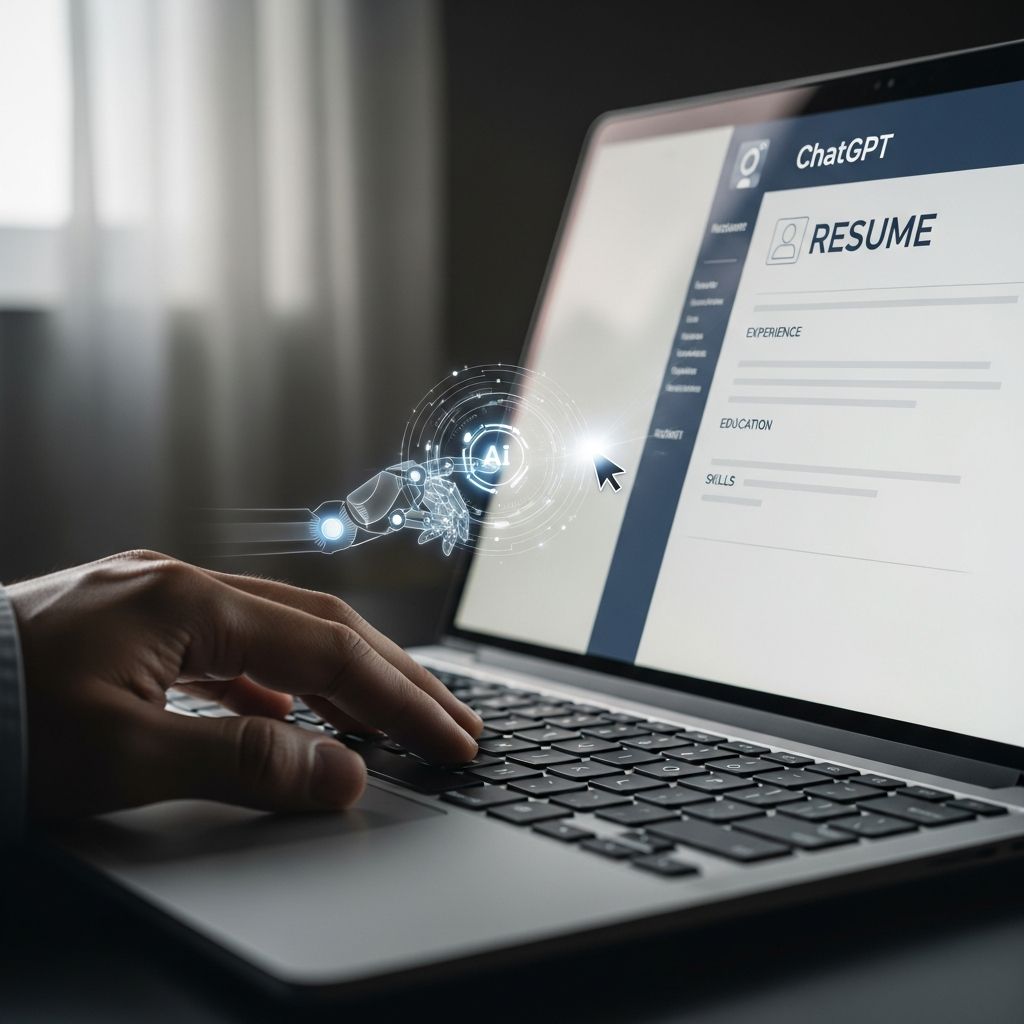
Generative AI tools like ChatGPT have become tempting shortcuts for job seekers who want a polished resume in minutes. But hiring managers are increasingly wary of applications that look and sound as if they were written by a chatbot rather than a real person. Understanding what these tools can and cannot do is critical if you want to stand out for the right reasons.
This article explores when ChatGPT can help, where it can damage your chances, and how to use AI responsibly so your resume remains accurate, authentic, and tailored to your target roles.
Why AI-Generated Resumes Are So Appealing
Before looking at the risks, it helps to understand why so many candidates reach for ChatGPT in the first place.
- Speed: AI can turn bullet points or a LinkedIn profile into a full resume draft in seconds.
- Low cost: Many tools are free or inexpensive compared with professional resume services.
- Language support: For non-native speakers, AI can improve grammar, clarity, and word choice.
- Confidence boost: People who feel uncomfortable writing about themselves may find it easier to start from an AI draft than from a blank page.
Used thoughtfully, these advantages can help you create a stronger document. Used carelessly, they can produce a generic, inaccurate, or misleading resume that hurts rather than helps.
How Recruiters View AI-Written Resumes
Recruiters and hiring managers increasingly recognize the “voice” of AI. Career experts report that many employers can now spot AI-heavy content quickly and may see fully AI-written resumes as less credible or less authentic.
- AI often produces similar phrasing and structure across different candidates, which makes applications blend together instead of standing out.
- Overly polished but vague wording can raise doubts about whether the candidate genuinely possesses the skills described.
- Some organizations are experimenting with policies or guidance around AI use in applications, especially for roles where writing is a core competency.
That does not mean you must avoid AI completely. It does mean that relying on an untouched AI draft is risky, especially in communication-heavy or senior roles where your own writing skills are part of the evaluation.
Benefits of Using ChatGPT As a Resume Assistant
When treated as a helper rather than an author, ChatGPT can improve both the quality and clarity of your resume.
1. Overcoming Blank-Page Syndrome
Many job seekers struggle to decide what to include or how to phrase achievements. AI can help you generate a rough structure or sample bullet points based on your career history.
- Transform a list of responsibilities into achievement-focused bullet points.
- Suggest action verbs or alternative wording to reduce repetition.
- Provide a starting summary that you can then refine to match your goals.
2. Improving Clarity, Grammar, and Flow
Large language models are particularly strong at editing and polishing text. Universities and career centers highlight that AI can be useful for refining language and structure when you already know what you want to say.
- Fixing grammar and spelling issues.
- Rewriting long sentences for readability.
- Aligning tone with professional norms for your field.
3. Tailoring Keywords for Applicant Tracking Systems (ATS)
Many employers use ATS software to scan resumes for relevant keywords before a human ever reads them. AI can help identify and incorporate important terms from a job description, such as specific tools, technologies, or certifications, as long as you genuinely have those skills.
- Highlighting job-specific skills that you already possess.
- Suggesting ways to phrase your experience so it aligns with the target role.
- Ensuring critical keywords appear in natural, honest context.
Major Risks of Letting ChatGPT Write Your Resume
The convenience of AI comes with significant downsides if you allow it to control the content rather than assist your thinking.
1. Generic, Overused Language
Because ChatGPT is trained on large amounts of text, it tends to reproduce common phrases, buzzwords, and structures. Professional resume writers note that AI-generated documents often sound generic and interchangeable, making it harder for recruiters to see what is unique about you.
- Common AI phrases like “results-driven professional” or “dynamic team player” say little about your actual impact.
- Different candidates using similar prompts can end up with nearly identical bullet points for very different roles.
- Generic language can give the impression of low effort or over-reliance on tools.
2. Limited Understanding of Context and Nuance
AI does not truly understand your industry, company culture, or the strategic impact of your work; it works by predicting plausible text based on patterns. Career services and resume experts warn that this lack of deeper context can lead to content that is technically fluent but strategically off-target.
- Misplaced emphasis on minor tasks instead of high-impact achievements.
- Inclusion of irrelevant skills or jargon that does not fit the role.
- Missed opportunities to show alignment with the specific employer or function.
3. Potential Inaccuracies and Exaggerations
Generative AI tools are known to occasionally produce incorrect or fabricated details if your prompt is vague or incomplete. On a resume, that can become a serious integrity issue.
- Incorrect dates, job titles, or technologies you never used.
- Inflated metrics that you cannot substantiate in an interview.
- Descriptions that subtly misrepresent your level of responsibility.
If a recruiter discovers inconsistencies between your resume, LinkedIn profile, and interview answers, your credibility can suffer immediately.
4. Loss of Your Voice and Professional Identity
Resumes are not only about listing skills; they are also a tool to communicate your professional identity and style. Relying too heavily on AI can flatten your voice and make it harder for employers to understand who you are as a colleague or leader.
- Soft skills, values, and leadership style may not come through clearly.
- AI tends to avoid specific anecdotes or unconventional paths that could make you memorable.
- At senior levels, a resume that reads like generic AI output can undermine perceptions of your communication skills.
5. Ethical and Transparency Concerns
While most employers do not ban AI outright, there is an evolving conversation about how transparent candidates should be when using it. Misrepresenting your capabilities, even unintentionally, can raise ethical questions.
- Some organizations may ask directly whether you used AI in your application materials.
- If your resume is clearly AI-written but your real writing samples are weaker, that gap can be damaging.
- Trust is central to the hiring relationship, and any hint of deception can end a candidacy quickly.
Using ChatGPT For Resumes: Smart vs. Risky Practices
The key is not whether you use AI, but how you use it. The following table compares safer, strategic practices with approaches that are more likely to backfire.
| Smart AI Use | Risky AI Use |
|---|---|
| Editing your own bullets for clarity and grammar. | Generating an entire resume from a one-line prompt and submitting it unchanged. |
| Asking for keyword suggestions based on a job ad, then adding only what you truly have. | Letting AI insert skills or tools you have never used just to match a posting. |
| Using AI to brainstorm ways to quantify your achievements with metrics you provide. | Accepting AI-generated numbers or claims that you cannot verify. |
| Customizing each section so it reflects your voice and career story. | Sending the same AI-generated resume to every job without tailoring. |
| Combining AI help with feedback from mentors or career advisors. | Relying solely on AI and skipping human review. |
Step-by-Step: A Responsible Workflow For Using ChatGPT
If you decide to involve AI in your resume writing, follow a structured process that keeps you firmly in control of the content.
Step 1: Define Your Target Role Clearly
AI output is only as good as your input. Before opening ChatGPT, gather:
- 2–3 job descriptions for roles you genuinely want.
- Your existing resume or a detailed list of roles, dates, and achievements.
- Any performance reviews or project summaries that contain concrete results.
Step 2: Use AI To Draft, Not Decide
Start with specific prompts that limit what AI can change. For example:
- “Rewrite these three bullet points to focus on measurable results, without adding new information.”
- “Suggest alternative verbs for ‘managed’ in a project management context.”
- “Based on this job description, what skills should I highlight if I already have them?”
Keep your factual content (titles, dates, achievements) as the source of truth and treat AI suggestions as options, not instructions.
Step 3: Personalize and Localize the Content
Once you have AI-assisted drafts, go through each section to ensure it sounds like you and fits your market.
- Replace vague claims with specific examples tied to your experience.
- Adapt language to local norms (for example, CV vs. resume, spelling conventions, or industry terms).
- Ensure that any leadership or collaboration claims match how you actually work.
Step 4: Fact-Check Every Line
AI sometimes produces plausible but wrong information. Review your resume with a critical eye:
- Confirm all dates, job titles, tools, and certifications.
- Verify that metrics and claims can be backed up with evidence or stories in an interview.
- Check that the resume is consistent with your LinkedIn profile and application forms.
Step 5: Get Human Feedback
Combine AI assistance with human expertise. Career centers, mentors, or professional resume writers can spot issues AI cannot.
- Ask whether the resume reflects your strengths and goals clearly.
- Check that the tone and style fit your target industry or level.
- Request specific examples of sections that feel generic or unclear.
Balancing AI Help With Authentic Storytelling
Research shows that resumes and cover letters remain crucial tools for communicating your fit and potential. AI can optimize wording, but it cannot replace the introspection required to understand your own strengths, values, and long-term direction.
To keep your story at the center:
- Spend time reflecting on career themes: What problems do you solve best? What type of environment helps you thrive?
- Use AI to refine how you express those themes, not to invent them.
- Prioritize honesty and clarity over trying to “game” algorithms or sound impressive.
Frequently Asked Questions About ChatGPT and Resumes
Q: Is it cheating to use ChatGPT on my resume?
Using AI as an editing or brainstorming tool is generally considered acceptable, especially when you remain truthful and maintain control over the final content. Ethical issues arise when AI-generated text misrepresents your skills, fabricates achievements, or hides your real level of communication ability.
Q: Can employers tell if I used AI?
Many recruiters say they can often recognize AI-written content because of its repetitive phrasing, vague achievements, and identical wording across different applications. Even if they cannot be certain, suspiciously generic language may still reduce their confidence in your candidacy.
Q: Will an AI-optimized resume beat applicant tracking systems?
Including relevant keywords can help ensure your resume is correctly parsed and ranked by ATS tools, but there is no guarantee of success. Systems vary widely, and human review is still involved in most hiring processes. Matching your genuine skills to the job description matters more than stuffing in extra terms.
Q: Should I mention that I used AI to write my resume?
Most candidates do not explicitly mention AI in their resume, and employers rarely require disclosure. However, if asked directly, it is advisable to answer honestly and emphasize that you used AI as a support tool while taking responsibility for the final document.
Q: When should I avoid AI entirely for my resume?
Consider limiting or avoiding AI for roles where writing is a core function (such as communications, policy, or content creation), or when an employer explicitly requests materials created without AI assistance. In those cases, AI-heavy drafts can undermine the very skills you are being hired for.
References
- Should You Use ChatGPT to Write Your Resume? — McKelvey School of Engineering, Washington University in St. Louis. 2024-04-26. https://mckelveyconnect.washu.edu/blog/2024/04/26/should-you-use-chatgpt-to-write-your-resume/
- Why you shouldn’t create a resume using ChatGPT — Successful Resumes Australia. 2023-08-17. https://www.successfulresume.com.au/why-you-shouldnt-create-a-resume-using-chatgpt/
- Should You Use ChatGPT or other AI for Resume Writing and Job Search? — Executive Career Brand. 2024-05-01. https://executivecareerbrand.com/should-you-use-chatgpt-for-resume-writing-and-job-search/
- AI and Your Resume: Advantages, Limitations, and Tips — Piper Center, St. Olaf College. 2023-10-10. https://wp.stolaf.edu/pipercenter/ai-and-your-resume/
- The Pros and Cons of Using ChatGPT to Write Your Resume — JOHNLEONARD. 2023-04-13. https://johnleonard.com/blog/the-pros-and-cons-of-using-chatgpt-to-write-your-resume/
- The pros and cons of using AI to write resumes for job seekers — Michael Page Australia. 2023-09-05. https://www.michaelpage.com.au/advice/career-advice/resume-and-cover-letter-advice/pros-and-cons-using-ai-write-resumes-job-seekers

Medha Deb is an editor with a master's degree in Applied Linguistics from the University of Hyderabad. She believes that her qualification has helped her develop a deep understanding of language and its application in various contexts. Medha specializes in the areas of beauty, health, sports, and wellness and is committed to ensuring that the content on the website is…