
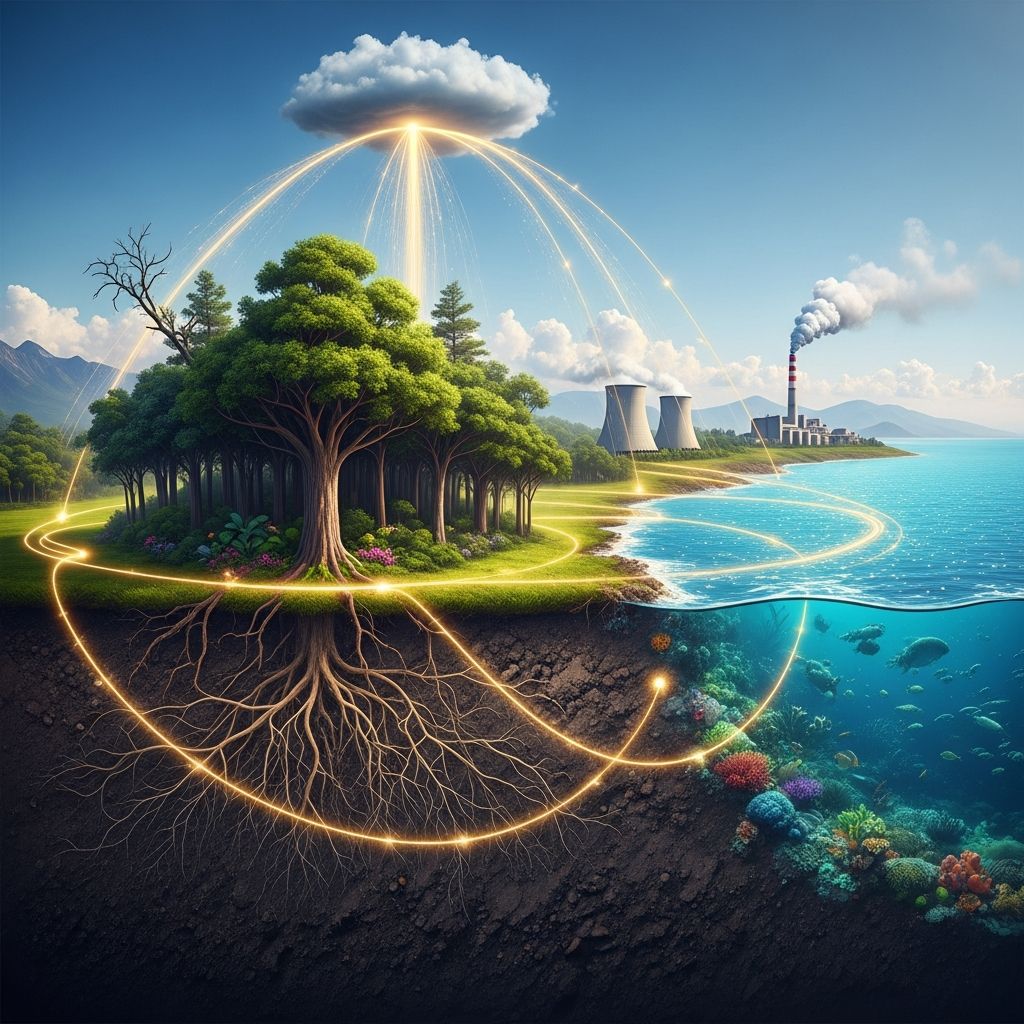
Carbon forms the backbone of life on Earth, cycling continuously through the atmosphere, oceans, land, and deep geological layers. This essential process maintains ecological balance, supports all living organisms, and regulates planetary temperature. Understanding its mechanisms reveals why disruptions from human activities pose profound environmental challenges.
Core Components of Carbon Movement
The carbon cycle involves the exchange of carbon among four primary reservoirs: the atmosphere, biosphere, hydrosphere, and geosphere. In the atmosphere, carbon exists mainly as carbon dioxide (CO₂), a key greenhouse gas that traps heat to keep Earth habitable. The biosphere encompasses all living organisms that incorporate carbon into their tissues through biological processes. Oceans act as massive carbon sinks, absorbing vast quantities of CO₂, while the geosphere stores carbon in rocks, sediments, and fossil fuels over geological timescales.
These reservoirs interact via natural fluxes. Short-term cycles occur rapidly through biological activity, spanning days to centuries, while long-term geological processes unfold over millions of years. This dual structure ensures carbon availability for life while sequestering excess over time.
Biological Pathways: Life’s Carbon Exchange
Photosynthesis stands as the primary entry point for atmospheric carbon into the biosphere. Plants, algae, and cyanobacteria capture CO₂, combining it with water and sunlight to produce glucose and oxygen. The simplified equation illustrates this: CO₂ + H₂O + energy → (CH₂O)ₙ + O₂. This process fixes approximately 120 billion tons of carbon annually, forming the base of food webs.
Carbon then transfers through trophic levels as herbivores consume plants and carnivores eat herbivores. Cellular respiration reverses photosynthesis in all organisms, breaking down glucose for energy and releasing CO₂: (CH₂O)ₙ + O₂ → CO₂ + H₂O. Decomposers like bacteria and fungi process dead matter, returning carbon to the soil and atmosphere efficiently.
- Key biological fluxes: Photosynthesis removes ~120 GtC/year; respiration and decomposition release ~120 GtC/year, maintaining near balance.
- Forest fires and natural decay events accelerate carbon release, injecting organic carbon back into the air rapidly.
Oceanic Carbon Dynamics
Oceans hold about 50 times more carbon than the atmosphere, primarily as dissolved CO₂, bicarbonate, and carbonate ions. Surface waters absorb CO₂ through physical diffusion and biological uptake by phytoplankton. These microbes perform photosynthesis akin to land plants, fueling marine food chains.
The biological pump transports carbon to ocean depths: phytoplankton die and sink as particulate organic matter, or get consumed and excreted as fecal pellets. This ‘rain’ of carbon reaches depths where cold temperatures slow decomposition, sequestering it for centuries. Chemical reactions further stabilize carbon; CO₂ reacts with seawater to form carbonic acid, which dissociates into bicarbonate and hydrogen ions, leading to ocean acidification as pH drops.
| Process | Description | Carbon Flux (GtC/year) |
|---|---|---|
| Surface Absorption | CO₂ dissolves directly | ~90 |
| Biological Pump | Phytoplankton sinking | ~10-15 |
| Solubility Pump | Cold deep water upwelling | ~80 |
Data adapted from global estimates; oceans absorb ~25% of anthropogenic CO₂ emissions.
Geological Slow Cycle: Millions of Years in Motion
The slow carbon cycle operates over vast timescales, linking the geosphere with the atmosphere and oceans. Weathering of silicate rocks consumes atmospheric CO₂: CO₂ + H₂O + rock → bicarbonate ions, which rivers carry to seas for shell formation and sedimentation. Volcanic eruptions and metamorphism release CO₂ from subducted rocks and magma, balancing long-term inputs.
Fossil fuel formation represents a critical geological sink. Ancient organic matter from swamps and marine plankton, buried under sediment, transforms into coal, oil, and natural gas over 100-400 million years. This sequesters carbon outside active cycling until human extraction. Plate tectonics recycles carbon through subduction zones, where oceanic crust returns to the mantle.
Human Disruption: Accelerating the Cycle
Anthropogenic activities have perturbed the carbon cycle profoundly since the Industrial Revolution. Burning fossil fuels—coal, oil, and gas—releases ~10 GtC/year, far exceeding natural burial rates and overwhelming sinks. Deforestation reduces photosynthetic capacity; tropical forest loss alone emits ~1-2 GtC/year while curtailing future uptake.
These emissions elevate atmospheric CO₂ from 280 ppm pre-industrial to over 420 ppm today, driving the greenhouse effect and global warming. Oceans absorb ~30% of excess CO₂, causing acidification that harms coral reefs and shellfish. Permafrost thaw releases methane (CH₄), a potent greenhouse gas, as warming accelerates organic decay.
- Net imbalance: Human emissions ~10 GtC/year; natural sinks absorb ~5 GtC/year (oceans 2.5, land 2.5), leaving ~5 GtC/year accumulating.
Implications for Climate and Ecosystems
Carbon cycle imbalances amplify climate change. Elevated CO₂ enhances plant growth (CO₂ fertilization) but nutrient limits and warming counteract benefits, potentially turning forests into net emitters. Ocean acidification dissolves calcium carbonate shells, disrupting marine food webs. Permafrost melt could release 100-200 GtC equivalent in methane and CO₂ by 2100.
Feedback loops intensify changes: melting sea ice reduces albedo, increasing absorption of solar heat; warmer soils boost microbial respiration, releasing more CO₂. These dynamics threaten biodiversity, agriculture, and sea-level rise via ice sheet melt.
Strategies for Restoration and Balance
Mitigating disruptions requires reducing emissions and enhancing sinks. Reforestation and afforestation can sequester 1-10 GtC/year globally. Protecting wetlands and peatlands preserves natural storage. Carbon capture and storage (CCS) technologies bury CO₂ in geological formations, mimicking natural processes.
Transitioning to renewables displaces fossil fuels, while sustainable agriculture minimizes soil carbon loss. International agreements like the Paris Accord target net-zero emissions by 2050 to stabilize the cycle. Individual actions—reducing meat consumption, energy efficiency—contribute cumulatively.
Frequently Asked Questions (FAQs)
What is the main driver of increased atmospheric CO₂?
Fossil fuel combustion and land-use changes release stored carbon rapidly, outpacing natural sinks.
How do oceans regulate the carbon cycle?
They absorb ~25-30% of CO₂ emissions via dissolution and biological pumps, but acidification limits capacity.
Can plants offset all human emissions?
No; enhanced growth is offset by deforestation and warming, with land sinks at ~30% of emissions.
What role do fossil fuels play long-term?
They represent geological carbon storage; burning returns it abruptly, disrupting millennial balances.
Is the carbon cycle speeding up or slowing?
Human activity accelerates short-term fluxes, but geological sinks operate too slowly to compensate.
Visualizing Carbon Reservoirs
| Reservoir | Carbon Amount (GtC) | % of Total |
|---|---|---|
| Atmosphere | 900 | 0.04% |
| Oceans | 38,000 | 1.6% |
| Land Biosphere | 2,000 | 0.09% |
| Geosphere (rocks/fuels) | >10,000,000 | >99% |
Estimates highlight geosphere dominance; active pools dwarfed by long-term stores.
The carbon cycle’s intricacy underscores its fragility. Natural equilibrium sustained Earth for eons, but rapid human alterations demand urgent intervention. Restoring balance preserves life’s foundation amid escalating climate pressures.
References
- Carbon Cycle Definition — BYJU’S. 2023. https://byjus.com/biology/carbon-cycle/
- Carbon Cycle — University of California, Berkeley Understanding Global Change. 2023-10-01. https://ugc.berkeley.edu/background-content/carbon-cycle/
- How Does the Carbon Cycle Work? — Green Earth. 2024-02-15. https://www.green.earth/blog/how-does-the-carbon-cycle-work
- What is the Carbon Cycle? — NASA Science. 2024. https://science.nasa.gov/kids/earth/what-is-the-carbon-cycle/
- DOE Explains…the Carbon Cycle — U.S. Department of Energy. 2023-05-10. https://www.energy.gov/science/doe-explainsthe-carbon-cycle

- Integrated M.A. in Applied Linguistics, University of Hyderabad
- 5+ years in editorial, instructional, SEO, and research-based writing
Sneha is a relationships and lifestyle writer with a strong foundation in applied linguistics and certified training in relationship coaching. She brings over five years of writing experience to theskillvault, crafting thoughtful, research-driven content that empowers readers to build healthier relationships, boost emotional well-being, and embrace holistic living. Her writing and insights reflect the belief that beauty, happiness, and wellness…