
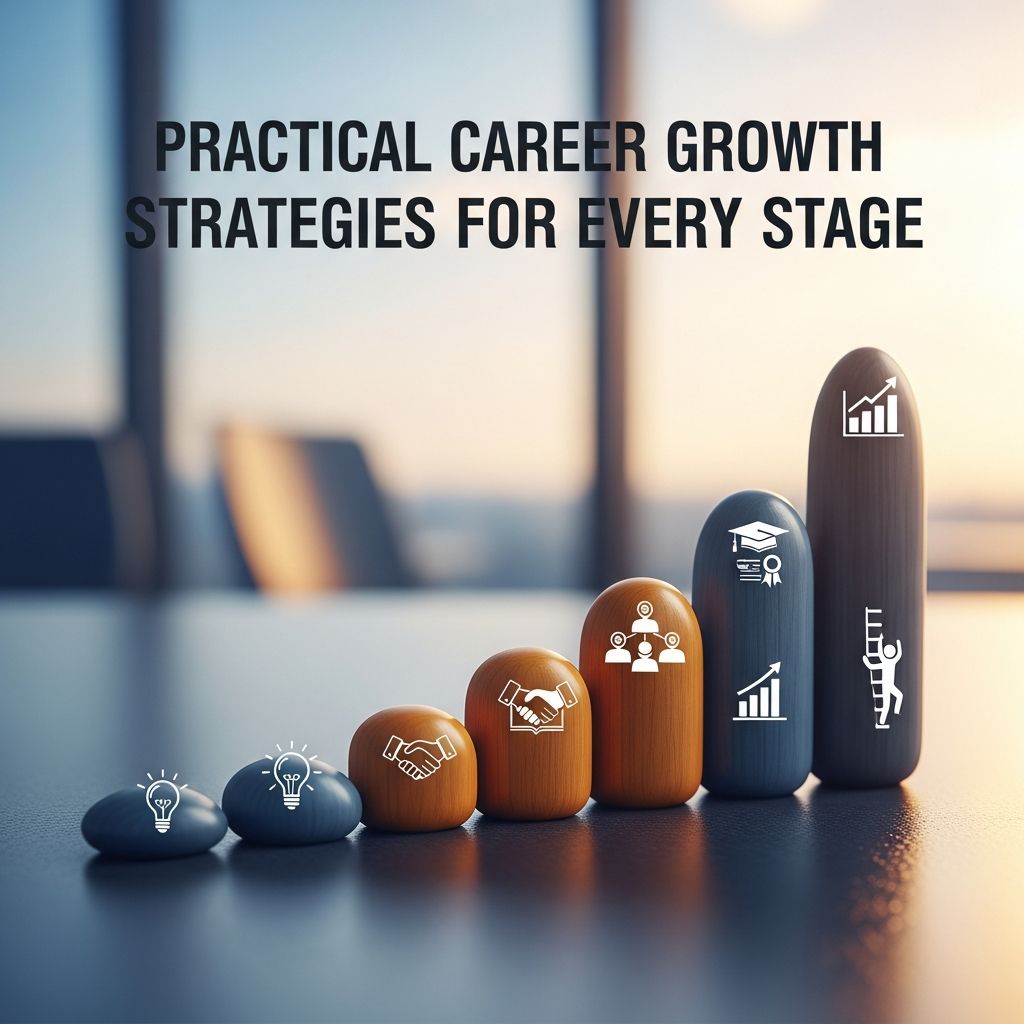
Career growth rarely follows a straight line. Changing industries, evolving technology and shifting personal priorities mean you need a flexible, intentional approach to your development. This guide brings together practical strategies you can use right away to understand where you are, clarify where you want to go and take realistic steps toward your next opportunity.
Understanding Your Starting Point
Before you update your resume or enroll in a course, it helps to clearly understand who you are as a professional right now. Self-knowledge turns vague ambition into targeted action.
Clarify your values, strengths and interests
Values and interests strongly influence job satisfaction and long-term career success. Research in industrial-organizational psychology shows that aligning work with personal values improves engagement and lowers burnout risk.1
Consider reflecting on:
- Core values: What principles are non-negotiable for you (e.g., autonomy, stability, creativity, service)?
- Strengths: What tasks feel natural and energizing? What do others consistently praise you for?
- Interests: Which topics, tools or problems are you drawn to learning about in your free time?
Document your answers in a career journal or digital note you can revisit as you grow.
Take stock of your current skills
To plan your next steps, you need a clear picture of the skills you already have and the ones you will need. Many successful career development programs use skills inventories to guide growth decisions.2
Break your skills into two categories:
- Technical skills: Tools, methods and domain knowledge specific to your field.
- Transferable skills: Communication, problem-solving, collaboration, leadership and adaptability that apply across roles and industries.
Ask yourself which skills are:
- Established: Comfortable to perform independently.
- Developing: Able to perform with support or extra time.
- Missing: Required for the roles you want but not yet part of your toolkit.
Designing a Flexible Career Vision
A rigid plan can quickly become outdated, but a flexible vision keeps you moving in the right general direction even as conditions change.
Set layered goals: immediate, midrange and long-term
Career research consistently finds that clear, specific goals improve performance and motivation compared with vague intentions.3
| Goal Horizon | Typical Timeframe | Example Focus |
|---|---|---|
| Immediate | 0–6 months | Complete a course, shadow a colleague, update portfolio |
| Midrange | 1–3 years | Move into a new specialty, earn a promotion, change company |
| Long-term | 3–7+ years | Shift industries, start a business, reach a senior role |
Use this layered structure to keep daily actions connected to bigger objectives while still allowing room to adjust as you learn.
Turn broad ambitions into concrete targets
Instead of “advance my career,” specify outcomes that you can measure, schedule and act on. For example:
- Identify at least three target roles or job titles that interest you.
- List the common requirements those postings share.
- Create a short list of 3–5 skills or experiences that would make you competitive.
This clarity simplifies decisions about which projects, trainings or networking activities deserve your time.
Building Skills That Move You Forward
In fast-changing job markets, skill development is one of the most powerful levers you control. Many employers now prioritize demonstrable skills over traditional credentials when making hiring decisions.4
Prioritize high-impact skills
You do not need to learn everything at once. Focus on skills that:
- Appear frequently in job descriptions for roles you want.
- Support multiple paths (for example, data literacy, writing and project management).
- Bridge a clear gap between your current role and your desired next step.
Examples of in-demand capabilities across many fields include:
- Digital skills: Data analysis, basic coding, working with cloud or collaboration platforms.
- Human skills: Communication, teamwork, leadership and emotional intelligence.
- Problem-solving: Critical thinking, decision-making, process improvement.
Use diverse learning methods
Research on adult learning suggests that combining multiple formats—formal courses, on-the-job practice and peer learning—improves knowledge retention and real-world performance.5
Consider mixing:
- Online courses and certificates: Structured learning from universities, professional associations or reputable platforms.
- Stretch assignments: Projects that require you to apply new skills under guidance.
- Job shadowing and cross-training: Observing colleagues in different roles to broaden your perspective.
- Professional reading: Industry reports, books and newsletters to stay informed about trends.
Practice in the flow of work
Skills stick best when you apply them to real problems. Rather than waiting for a perfect project, look for opportunities in your current role:
- Automate a repetitive task using a new tool.
- Volunteer to present at a meeting to practice communication.
- Lead a small improvement initiative to build leadership and project skills.
Using Relationships as a Career Asset
Connections do not replace competence, but they often determine which opportunities you hear about and how quickly you advance. Many internal mobility and promotion decisions are made based on both performance and visibility.2
Strengthen your professional network
Think of networking as building long-term, mutually helpful relationships rather than collecting contacts. Effective professional networks typically include:
- Peers: Colleagues at similar levels who share resources and encourage each other.
- Mentors: More experienced professionals who offer perspective, advice and introductions.
- Allies in other departments or organizations: People who can alert you to cross-functional projects or openings.
Simple, consistent actions can grow your network over time:
- Attend internal or external events quarterly.
- Schedule occasional virtual coffees with colleagues you admire.
- Follow up after conversations with a brief note or helpful resource.
Seek mentors and sponsors
Mentorship and sponsorship can significantly influence career progression. Sponsors—leaders who actively advocate for you—are particularly associated with advancement into higher responsibility roles.6
You can cultivate these relationships by:
- Demonstrating reliability and strong performance in your current responsibilities.
- Communicating your aspirations clearly and asking for guidance on realistic next steps.
- Following through on advice and sharing updates on your progress.
Making Feedback and Visibility Work for You
Feedback and visibility are often overlooked elements of career development. Used thoughtfully, they help you adjust early and showcase your contributions.
Ask for useful, specific feedback
Rather than waiting for annual reviews, invite input regularly. You might ask:
- “What is one thing I could do differently to add more value to our team?”
- “Are there skills you think I should focus on building over the next six months?”
- “Where do you see my strengths having the most impact?”
Document this feedback and look for patterns across different colleagues and managers.
Share your impact without bragging
Leaders often have limited visibility into day-to-day work. You can respectfully raise your profile by:
- Sending brief status updates that highlight outcomes, not just tasks.
- Connecting your work to team or organizational goals when you present results.
- Offering to present case studies or lessons learned from successful projects.
Navigating Internal Moves and External Transitions
At some point, growth may mean changing teams, roles or even industries. Treat transitions as structured projects rather than impulsive reactions.
Explore options where you are
Many organizations encourage internal mobility because it helps retain talent and preserve institutional knowledge.2 Before looking elsewhere, investigate:
- Temporary assignments or cross-functional projects you can join.
- Openings in adjacent teams that align with your skills and interests.
- Internal training or rotational programs that broaden your experience.
Prepare for an external move
If an external change is the right step, build a foundation before you start applying:
- Refresh your professional documents: Update your resume, online profiles and portfolio to highlight skills and achievements that match your target roles.
- Translate your experience: Emphasize transferable skills when shifting industries or functions.
- Informational interviews: Talk with professionals already working in your desired area to understand expectations and refine your strategy.
Maintaining Momentum and Well-Being
Career development is a long-term process, not a one-time project. Sustaining energy and resilience is just as important as chasing the next opportunity.
Review and adjust your plan regularly
Schedule brief check-ins with yourself, perhaps monthly or quarterly, to reflect on:
- What progress you made toward your immediate and midrange goals.
- What you learned about your preferences and strengths.
- Which goals or tactics need to change based on new information.
This habit keeps your plan relevant as your life and the job market evolve.
Protect your health as you grow
Long working hours and chronic stress can undermine both performance and long-term career success. Workplace studies have linked excessive stress with reduced productivity, higher absenteeism and health risks.7
Consider practices that support sustainable growth:
- Setting realistic boundaries around work time and availability.
- Using vacation and rest days to recover fully.
- Building routines for sleep, movement and social connection.
Frequently Asked Questions (FAQs)
How often should I revisit my career goals?
Reviewing your goals every three to six months is usually enough to keep you on track without overthinking. Major life events—such as changing jobs, relocating or starting a degree—are also good times to reassess your direction.
What if I do not know what career I want yet?
Uncertainty is common. Focus on exploring rather than deciding. Talk with people in different roles, try short courses, volunteer or take on varied projects at work. Over time, you will gather clues about what energizes you and where you add the most value.
Is it too late to change careers after many years in one field?
Many professionals successfully shift careers later in life. The key is to identify your transferable skills, be realistic about any training or education you may need, and break the transition into small, manageable steps instead of expecting an overnight change.
How can I progress if my organization has limited promotion opportunities?
Advancement is not limited to job titles. You can still grow by expanding your responsibilities, developing in-demand skills, building a strong external network and, when the time is right, seeking roles at other organizations that value your experience.
Do I need formal education to advance my career?
Some professions require specific degrees or licenses, but many employers now emphasize skills and demonstrated results. Short programs, certificates, micro-credentials and hands-on projects can be powerful ways to show you are ready for more responsibility.
References
- Meaningful Work and Well-Being — Wrzesniewski, A., Dutton, J. E. Published in Research in Organizational Behavior. 2001-01-01. https://doi.org/10.1016/S0191-3085(01)20002-5
- Future of Career Development and Mobility 2024–25 — HR.com / PeopleFluent. 2024-06-01. https://www.peoplefluent.com/blog/learning/5-career-development-best-practices-2025/
- Locke and Latham’s Goal Setting Theory — Locke, E. A., Latham, G. P., in American Psychologist. 2002-09-01. https://doi.org/10.1037/0003-066X.57.9.705
- Career Development Strategies in a Skills-First Era — Right Management (ManpowerGroup). 2024-05-01. https://www.right.com/insights/career-development-strategies-for-skills-first-era
- Six Ways Professional Development Can Boost Your Career in 2025 — UVA Darden School of Business. 2024-12-12. https://blogs.darden.virginia.edu/executive-education/2024/12/12/six-ways-professional-development-can-boost-your-career-in-2025/
- The Sponsor Effect: Breaking Through the Last Glass Ceiling — Hewlett, S. A. Harvard Business Review Press. 2013-01-01. https://store.hbr.org/product/the-sponsor-effect-breaking-through-the-last-glass-ceiling/10495
- Work Stress and Health — Centers for Disease Control and Prevention (CDC). 2023-11-15. https://www.cdc.gov/niosh/docs/99-101/

- Integrated M.A. in Applied Linguistics, University of Hyderabad
- 5+ years in editorial, instructional, SEO, and research-based writing
Sneha is a relationships and lifestyle writer with a strong foundation in applied linguistics and certified training in relationship coaching. She brings over five years of writing experience to theskillvault, crafting thoughtful, research-driven content that empowers readers to build healthier relationships, boost emotional well-being, and embrace holistic living. Her writing and insights reflect the belief that beauty, happiness, and wellness…