
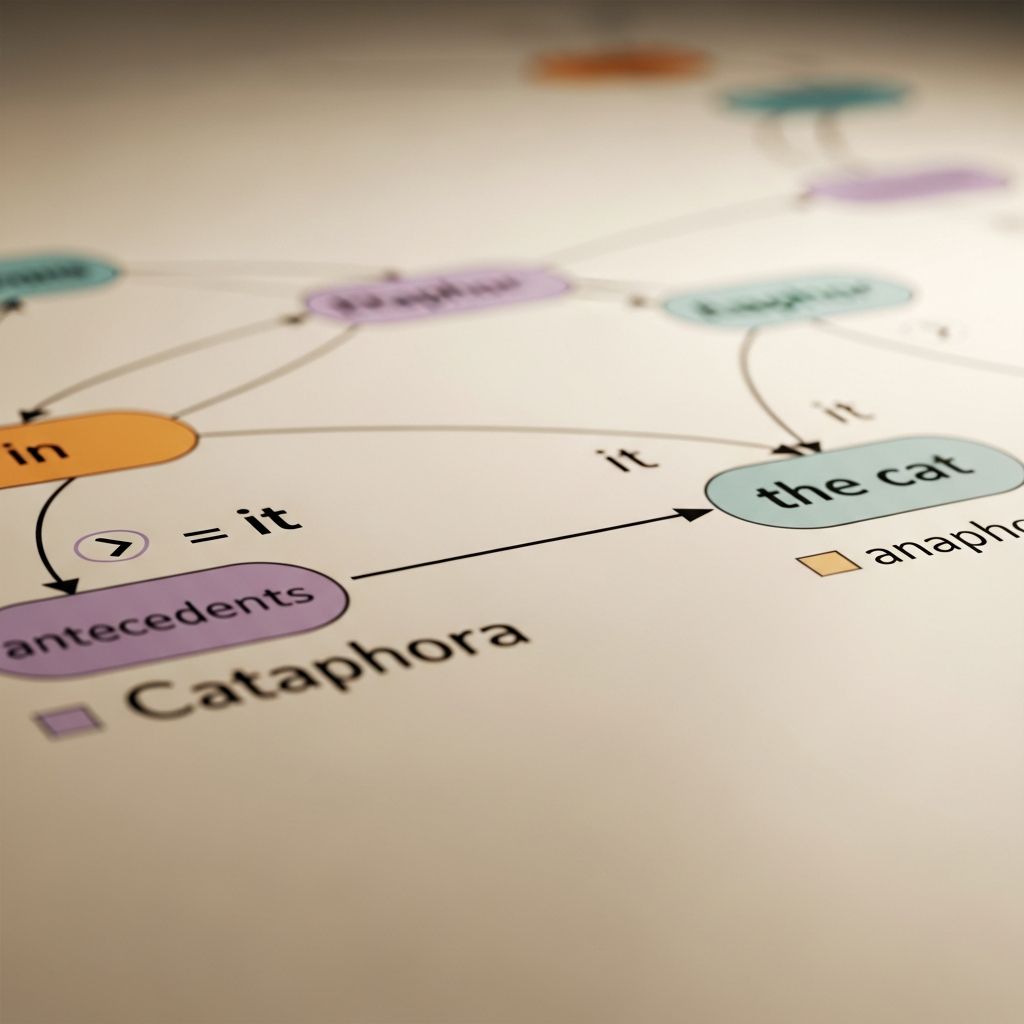
Cataphora represents a core mechanism in linguistics where an expression, often a pronoun, points forward to a subsequent element in the discourse for its full meaning. This forward-looking reference creates suspense and structures complex sentences effectively.
Defining Cataphora: A Core Linguistic Concept
In linguistics, cataphora occurs when a word or phrase derives its interpretation from a later, more detailed expression within the same text or utterance. Unlike backward references, this device builds anticipation by introducing a placeholder early on. The term originates from Greek roots: kata meaning ‘down’ or ‘after,’ and phora from ‘to carry,’ indicating a carrying forward of meaning.
Merriam-Webster defines it as ‘the use of a grammatical substitute (such as a pronoun) that has the same reference as a following word or phrase.’ This setup contrasts with everyday assumptions that references always look backward, making cataphora a sophisticated tool for advanced communication.
Cataphora Versus Anaphora: Key Distinctions
Cataphora stands in opposition to anaphora, where pronouns or substitutes refer back to prior elements. Anaphora follows a logical sequence: introduce the noun first, then reuse a pronoun. Cataphora reverses this, teasing the referent ahead of time.
| Feature | Cataphora | Anaphora |
|---|---|---|
| Direction | Forward (to later element) | Backward (to earlier element) |
| Example Structure | Pronoun first, noun later | Noun first, pronoun later |
| Effect | Builds suspense | Provides continuity |
| Common Use | Emphasis, formal writing | Everyday narrative flow |
Both belong to endophora, references resolved within the text. Cataphora’s inverse nature demands more cognitive processing, heightening engagement.
Mechanisms of Cataphora in Practice
Cataphora typically employs pronouns like ‘he,’ ‘they,’ ‘it,’ or demonstratives such as ‘this’ or ‘those.’ The antecedent—the word it points to—follows, often in a relative clause or appositive. This structure suits spoken language for dramatic effect and writing for stylistic polish.
- Pronoun-led sentences: Place the pronoun upfront to hook the reader.
- Demonstrative triggers: Words like ‘the following’ signal upcoming details.
- Complex clauses: Integrate within subordinate structures for depth.
In formal English, cataphora appears in academic papers or news: ‘The following analysis reveals key trends in data from 2020-2025.’ Here, ‘the following’ cataphorically previews the analysis.
Real-World Examples Across Contexts
Consider: ‘If you buy tickets now, they will ensure prime seats at the concert.’ ‘They’ refers to ‘tickets,’ specified later, creating forward linkage.
Another: ‘After reviewing the evidence, it became clear that climate models needed updates.’ ‘It’ anticipates ‘that climate models needed updates.’
In literature, authors use it for tension: ‘She knew he would return, the man with the scarred face who haunted her dreams.’ This draws readers deeper.
Spoken examples shine in presentations: ‘This approach, which combines AI and human oversight, yields superior results.’
Stylistic Roles and Benefits
Cataphora enhances text cohesion by linking elements across distances, vital for long sentences. It emphasizes the upcoming referent, foregrounding critical information. In persuasive writing, it mimics oral storytelling, fostering immersion.
Psycholinguistically, forward references challenge working memory, promoting active comprehension. Studies note higher frequency in formal registers, like legal documents: ‘The defendant, who acted with premeditation, faces severe charges.’ This prioritizes the clause.
Challenges in Processing Cataphora
While powerful, cataphora risks confusion if the referent is too distant or ambiguous. Readers must hold the pronoun in mind until resolution. In non-native speakers, this strains parsing, explaining its C1-C2 level placement in curricula.
Ambiguity arises with multiple possibles: ‘John told Mary she won, but it was a mistake.’ Does ‘she’ mean Mary or another? Clear structure mitigates this.
Applications in Modern Writing and Speech
Journalism leverages cataphora for punchy leads: ‘Those innovations, from quantum computing to biotech, are reshaping industries.’ Tech blogs and reports favor it for previews.
In business: ‘Our strategy, which targets emerging markets, promises 20% growth.’ This builds executive summaries dynamically.
Programming documentation uses parallels: ‘This function, designed for data validation, handles edge cases.’
Teaching Cataphora Effectively
For advanced learners, introduce via ‘breaking news’ simulations. Start with identification: underline pronouns and antecedents in texts.
- Present paired anaphora/cataphora sentences.
- Have students rewrite anaphoric texts cataphorically.
- Practice in pairs: share ‘news’ using forward references.
- Analyze speeches for natural occurrences.
Visual aids like timelines (arrow forward for cataphora) clarify directionality. Progress to production: write paragraphs blending both devices.
Frequently Asked Questions
What is the main difference between cataphora and anaphora?
Cataphora points forward to a later referent, while anaphora points backward to an earlier one, both aiding text cohesion.
Is cataphora common in everyday English?
Less so than anaphora, but prevalent in formal writing, speeches, and literature for emphasis.
How can cataphora improve writing?
It creates suspense, links ideas tightly, and emphasizes key details, enhancing readability in complex texts.
Why teach cataphora at advanced levels?
It requires sophisticated processing, fitting C1-C2 proficiency for nuanced expression.
Can cataphora cause confusion?
Yes, if referents are distant or unclear; proximity and context resolve most issues.
Expanding Linguistic Repertoire with Cataphora
Mastering cataphora elevates prose from basic to professional. Experiment in drafts: swap anaphoric structures forward. Read stylists like academic journals for models. Over time, it becomes intuitive, enriching expression.
In digital eras, cataphora suits SEO via teaser phrases: ‘These tools, proven in trials, boost productivity.’ It hooks scanners effectively.
Broader discourse analysis reveals cataphora’s role in genres like sermons or debates, sustaining listener focus. Cross-linguistically, similar devices exist, underscoring universality.
References
- Deciphering Cataphora: Definition And Examples — MyEnglishPages. Accessed 2026. https://www.myenglishpages.com/writing-cataphora/
- Cataphora — Cambridge University Press. Accessed 2026. https://dictionary.cambridge.org/us/dictionary/english/cataphora
- Cataphora — Wikipedia (informational). Accessed 2026. https://en.wikipedia.org/wiki/Cataphora
- What are anaphoric and cataphoric references? — EF Teacher Blog. Accessed 2026. https://teacherblog.ef.com/how-teach-anaphora-cataphora/
- Cataphora Definition & Meaning — Merriam-Webster. 2025-12-13. https://www.merriam-webster.com/dictionary/cataphora

- Integrated M.A. in Applied Linguistics, University of Hyderabad
- 5+ years in editorial, instructional, SEO, and research-based writing
Sneha is a relationships and lifestyle writer with a strong foundation in applied linguistics and certified training in relationship coaching. She brings over five years of writing experience to theskillvault, crafting thoughtful, research-driven content that empowers readers to build healthier relationships, boost emotional well-being, and embrace holistic living. Her writing and insights reflect the belief that beauty, happiness, and wellness…