
Exploring Cause-Effect Relationships in Written Communication
When we read or write, we encounter various organizational patterns that help convey information effectively. Among these patterns, the cause-effect relationship stands as one of the most fundamental ways authors explain why events occur and what happens as a result. This text structure goes beyond simply describing what happened—it explores the deeper connection between actions and their consequences, helping readers understand the logic and flow of events.
Unlike sequence structures that focus on the chronological order of events, cause-effect patterns emphasize the reason behind occurrences and their resulting outcomes. Whether in fiction, nonfiction, news articles, or academic writing, this structure helps audiences grasp not just the “what” of a situation but the crucial “why” and “so what” that follow.
Distinguishing Causes from Effects
At the heart of this text structure lies a simple yet powerful distinction: a cause is the reason something happens, while an effect is what happens as a result of that cause. Understanding this fundamental difference is essential for both readers and writers working with this organizational pattern.
Consider a straightforward example: if a student fails to submit an assignment on time because they forgot about the deadline, the cause is the forgotten deadline, and the effect is the late submission. The cause answers the question “Why did this happen?” while the effect answers “What occurred as a consequence?”
What makes this structure particularly interesting is that authors need not present the cause first. In many texts, readers encounter the effect initially, then discover the underlying cause. This flexibility in presentation means readers must actively engage with the material, identifying both elements regardless of their order.
Recognizing Signal Words and Transition Phrases
Writers use specific language patterns to signal cause-effect relationships to their readers. These transition words and phrases serve as guideposts, helping audiences identify when a cause-effect structure is being employed. Recognizing these markers significantly improves reading comprehension and helps writers strengthen their own compositions.
Signal words function in two categories. Cause-related signals introduce information explaining why something happened, while effect-related signals connect to information about what occurred as a consequence. By paying attention to these linguistic cues, readers can quickly locate and understand the relationships between events.
Common cause indicators include:
- Because
- Since
- Due to
- In order to
- Caused by
- If
Frequently encountered effect markers include:
- As a result
- Therefore
- Consequently
- Thus
- So
- Then
- For this reason
When readers spot these terms, they should pause to identify the causal relationship being described. For instance, the sentence “The soccer game was cancelled because of heavy rain” uses the signal word “because” to connect the cause (heavy rain) to the effect (game cancellation).
Single and Multiple Cause-Effect Relationships
Not all cause-effect relationships follow a simple one-to-one pattern. Real-world situations often involve complexity, where multiple causes lead to one effect, one cause produces multiple effects, or chains of causes and effects build upon one another.
In a multiple-cause scenario, several factors combine to produce a single outcome. For example, a student might receive a low test grade due to inadequate study time, classroom distractions, and unclear concept understanding—three separate causes resulting in one effect. Recognizing this complexity helps readers understand that events rarely stem from isolated incidents.
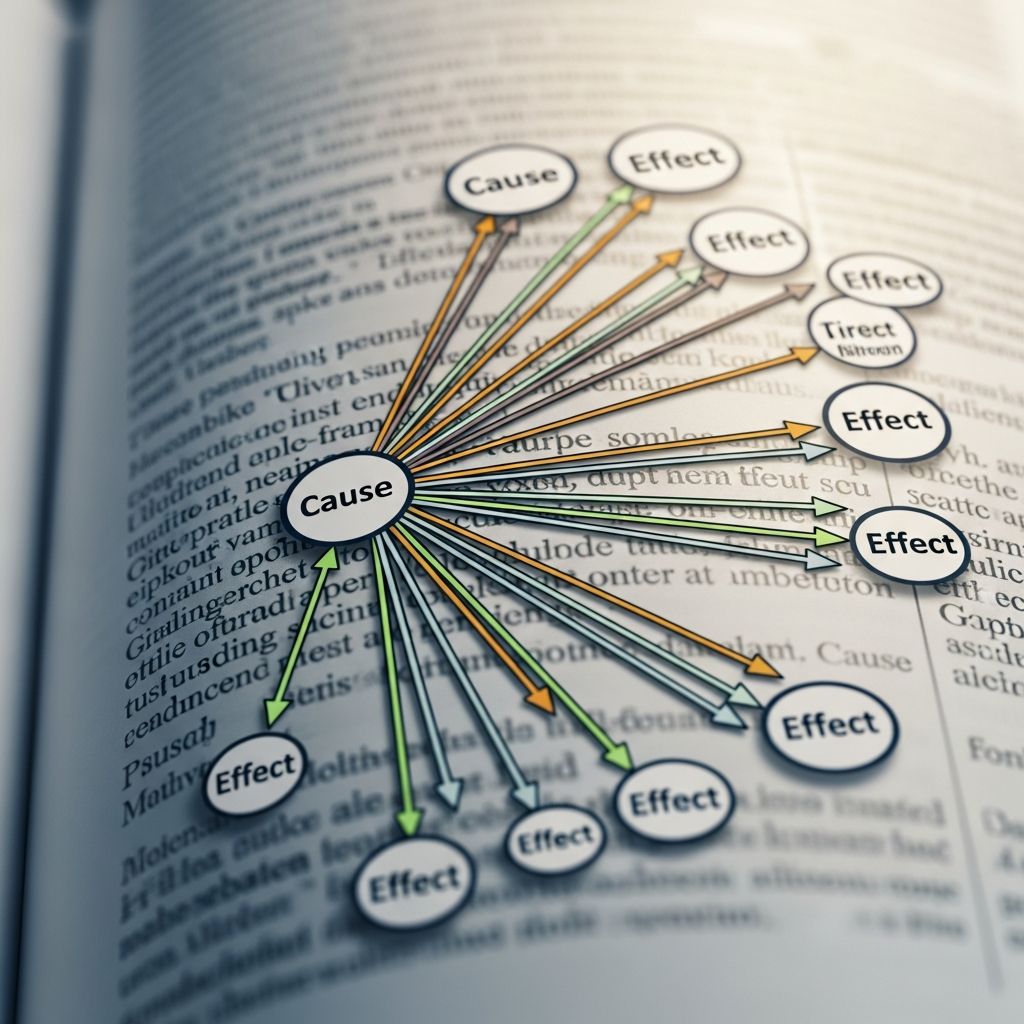
Conversely, a single cause can trigger multiple effects. A natural disaster like an earthquake might cause building damage, power outages, water line breaks, and road closures simultaneously. Understanding this pattern helps readers appreciate the far-reaching consequences of events.
Additionally, cause-effect chains occur when one effect becomes the cause of another event, creating a domino effect throughout a text or narrative. These interconnected relationships require careful reading to trace properly.
Distinguishing Cause-Effect from Similar Text Structures
Several organizational patterns can superficially resemble cause-effect structure, potentially confusing readers and writers. Understanding the distinctions helps maintain clarity and accuracy in identifying text organization.
Sequence structure, for instance, describes events in chronological order but doesn’t necessarily explain why events occur—only their temporal arrangement. A text might say “First, Maria watered the plants. Then, she fed the cat. Finally, she took out the trash.” This sequence lacks the causal reasoning inherent in cause-effect patterns.
Problem-solution structure differs because it presents a challenge followed by potential resolutions, without necessarily explaining why the problem exists or what caused it initially. While a cause-effect text might explain how a problem arose, a problem-solution text focuses on addressing it.
Description structures provide details about a subject, person, or place without establishing relationships between events. Similarly, comparison-contrast patterns examine similarities and differences between items rather than exploring causal connections.
Accurate identification requires close reading of the author’s intent: Are they explaining why something happened and what resulted, or are they simply listing events, describing features, or solving problems?
Implicit Versus Explicit Cause-Effect Relationships
Some texts make cause-effect relationships abundantly clear through obvious signal words and direct statements. These explicit relationships require minimal inference from readers. For example: “Because the weather forecast predicted snow, the school cancelled classes” leaves no doubt about the causal connection.
However, authors often imply cause-effect relationships without using obvious signal words. Readers must infer the connection between events based on context and logic. A text might read: “The power went out during dinner. The family sat in darkness, playing board games by candlelight.” While no explicit signal word appears, the relationship is understood: the power outage caused the family to play games by candlelight.
Implicit relationships demand more active reading and critical thinking. Students and adult readers must carefully consider how events relate to one another, sometimes re-reading passages to confirm their understanding.
Techniques for Identifying Cause-Effect Relationships
Developing systematic approaches to identifying cause-effect patterns strengthens comprehension. Several strategies prove particularly effective for readers of various ages and ability levels.
Graphic organizers provide visual representations of causal relationships, allowing readers to map causes to their effects. Simple two-column charts work well for straightforward relationships, while more complex diagrams accommodate multiple causes or effects. These visual tools help readers organize information spatially, making connections more apparent.
Asking focused questions guides readers toward recognizing relationships. Questions like “Why did this happen?” prompt identification of causes, while “What happened because of this?” targets effects. By systematically questioning the text, readers actively engage with the material rather than passively consuming it.
Highlighting or underlining signal words as they appear helps readers maintain focus on structural markers. This technique trains the eye to recognize organizational patterns quickly and reinforces understanding through active annotation.
Discussion and dialogue with others about cause-effect relationships in texts promotes deeper understanding. Explaining reasoning to peers or teachers consolidates comprehension and reveals gaps in understanding that warrant further exploration.
Applying Cause-Effect Structure to Writing
Understanding how to identify cause-effect relationships naturally extends to producing well-organized writing that employs this structure effectively. Writers benefit from consciously applying these principles to their composition.
Before drafting, writers should determine whether cause-effect organization serves their purpose. If the goal involves explaining why something occurred or showing how events lead to consequences, this structure provides an excellent framework. Clear identification of the central cause-effect relationship guides the entire composition.
During drafting, writers should deliberately incorporate appropriate signal words to guide readers through causal relationships. Strategic placement of transition phrases creates smooth flow and prevents reader confusion about which information represents causes versus effects.
Writers working with multiple causes or effects benefit from organizing information clearly. Listing causes separately before presenting effects, or grouping related effects together, prevents readers from becoming overwhelmed or confused about relationships.
Revision offers opportunities to strengthen cause-effect clarity. Writers should examine whether signal words appear where needed, whether causal relationships are truly explained rather than merely implied, and whether the overall organization helps readers follow the logical progression of ideas.
Cause-Effect Structure in Different Genres and Contexts
While cause-effect structure appears across numerous writing genres, its application varies based on context and purpose. Recognizing these variations helps readers and writers adapt their strategies appropriately.
In narrative fiction, cause-effect relationships drive plot development. Character actions produce consequences that propel the story forward, with each event logically leading to subsequent events. Understanding causality helps readers comprehend character motivation and plot coherence.
Nonfiction informational texts often employ cause-effect structure to explain scientific phenomena, historical events, or social issues. Scientific articles might explain how certain causes produce measurable effects, while history texts explore how past events led to current situations.
News reporting frequently uses cause-effect structure to explain why events occurred and their anticipated consequences. Readers benefit from recognizing this organizational pattern when consuming current events coverage.
Academic writing in various disciplines relies on cause-effect reasoning to present arguments and support claims with logical connections between ideas.
Common Challenges in Understanding Cause-Effect Relationships
Despite its fundamental importance, cause-effect structure presents challenges for many readers and writers. Recognizing common difficulties helps educators and learners address them systematically.
Confusion with sequence structure represents a frequent challenge. Readers might mistakenly assume that because events occur in a particular order, the first event caused the second. Understanding that causality involves a logical connection beyond mere temporal sequence helps prevent this error.
Implicit relationships present another challenge, particularly for emerging readers. When authors don’t explicitly signal causal connections, readers must make inferences that require background knowledge and sophisticated reasoning skills.
Complex situations involving multiple causes and effects can overwhelm readers accustomed to simpler one-to-one relationships. Gradual exposure to increasingly complex cause-effect patterns, supported by graphic organizers and discussion, helps readers develop capacity for handling this complexity.
Distinguishing correlation from causation poses challenges even for advanced readers. Recognizing that events occurring simultaneously or in sequence doesn’t necessarily mean one caused the other requires critical thinking and logical reasoning.
Frequently Asked Questions About Cause-Effect Text Structure
Q: Can cause and effect happen in any order within a text?
A: Yes, authors may present effects first followed by causes, or vice versa. The key is identifying both elements and understanding their relationship regardless of presentation order.
Q: What’s the difference between cause-effect and sequence structures?
A: Sequence describes the order events happen in, while cause-effect explains why events happen and what results from them. Sequence focuses on timing; cause-effect focuses on relationships and reasoning.
Q: How can I teach students to identify cause-effect relationships?
A: Use signal words as entry points, employ graphic organizers to visualize relationships, ask guiding questions about why and what, and provide varied examples from different texts and genres.
Q: Are implicit cause-effect relationships harder to identify than explicit ones?
A: Generally yes, because readers must infer connections without obvious signal words. Building background knowledge and encouraging active questioning helps readers develop skill in recognizing implicit relationships.
Q: Can a single cause have multiple effects?
A: Absolutely. Many situations involve one cause producing several different effects simultaneously or sequentially. Recognizing this complexity helps readers understand real-world situations more accurately.
References
- Cause-and-Effect Text Structure – Fiction and Nonfiction — YouTube Educational Content. Accessed 2026-04-04. https://www.youtube.com/watch?v=J8zMbcG9P8A
- Teaching and Assessing Understanding of Text Structures Across Grades — National Center for the Improvement of Educational Assessment, Karin K. Hess. 2008. https://www.nciea.org/wp-content/uploads/2008/10/TextStructures_KH08_ADA.pdf
- Text Structure Organizer: Cause-Effect — Virginia Literacy Partnerships. 2025. https://literacy.virginia.edu/sites/g/files/jsddwu1421/files/2025-04/Text%20Structure%20-%20Cause%20Effect.pdf
- Cause and Effect Text Structure – How to Explain It — Enjoy Teaching. Accessed 2026-04-04. https://enjoy-teaching.com/cause-and-effect-text-structure/
- Text Structures — Wisconsin Department of Public Instruction. Accessed 2026-04-04. https://dpi.wi.gov/sites/default/files/imce/ela/images/Text%20Structures.pdf
- Teaching Text Structure — Reading Rockets. Accessed 2026-04-04. https://www.readingrockets.org/classroom/comprehension/teaching-text-structure

Medha Deb is an editor with a master's degree in Applied Linguistics from the University of Hyderabad. She believes that her qualification has helped her develop a deep understanding of language and its application in various contexts. Medha specializes in the areas of beauty, health, sports, and wellness and is committed to ensuring that the content on the website is…