
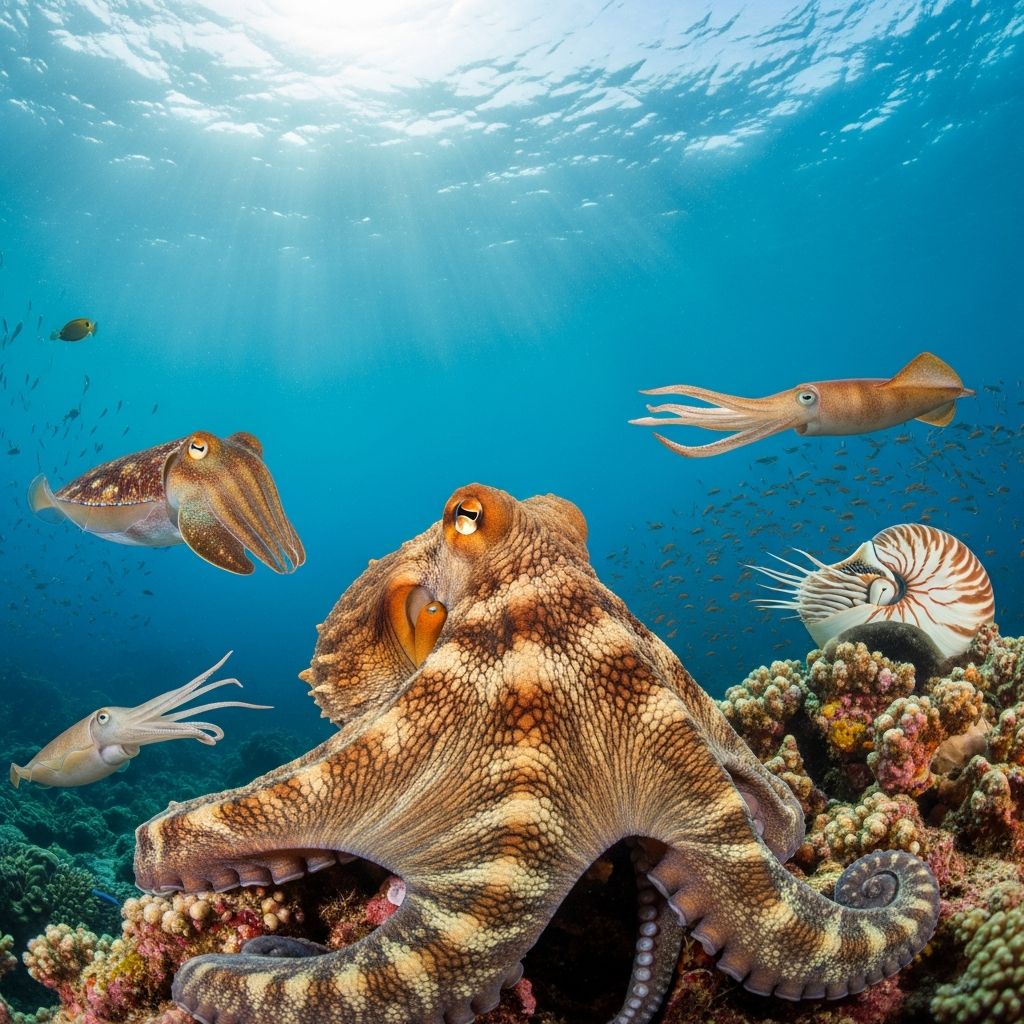
Cephalopods represent one of the most captivating groups of marine animals, renowned for their intelligence, camouflage abilities, and dynamic lifestyles. Belonging to the class Cephalopoda within the phylum Mollusca, these creatures encompass octopuses, squids, cuttlefish, and nautiluses. With approximately 800 extant species, they showcase remarkable diversity, from shallow coastal waters to the abyssal depths.
Evolutionary Origins and Ancient Lineages
The history of cephalopods stretches back over 500 million years to the Cambrian explosion, when they first emerged as shelled mollusks. Early forms like nautiloids dominated ancient oceans, protected by robust external shells. Over time, evolutionary pressures led to the development of the subclass Coleoidea, where most modern species internalized or lost their shells entirely, favoring speed, agility, and brainpower instead.
Today, living cephalopods fall into two main subclasses: Nautiloidea, featuring the chambered nautiluses with external coiled shells, and Coleoidea, which includes the shell-less or internally shelled octopuses, squids, and cuttlefish. This divergence highlights their adaptive radiation, with extinct groups like ammonites and belemnites once rivaling their numbers.
Anatomical Marvels: Body Structure and Adaptations
What sets cephalopods apart is their bilateral symmetry, prominent head, and ring of arms or tentacles encircling the mouth—earning them the name ‘head-footed’ from Greek roots. A siphon propels water for jet propulsion, enabling rapid escapes. Their nervous systems are among the most complex in invertebrates, with large brains and distributed neurons in arms allowing semi-autonomous actions.
Camouflage is a hallmark trait, achieved through chromatophores—pigment cells that expand or contract for instant color changes, texture mimicry, and even polarization. Some species, like the vampire squid, use photophores for bioluminescence in dark depths. Buoyancy control varies: nautiluses use gas-filled chambers, cuttlefish rely on cuttlebones, while squids employ ammonia-filled tissues.
- Key Anatomical Features:
- 8 arms (octopuses) or 8 arms + 2 tentacles (squids/cuttlefish)
- Powerful beak for crushing prey
- Ink sacs for defense
- Three hearts: two for gills, one systemic
- Advanced eyes rivaling vertebrates
Superorders and Major Groups
Modern cephalopods are classified into superorders reflecting their evolutionary paths. Understanding these groups reveals their ecological roles and unique traits.
Octopodiformes: The Eight-Armed Wonders
Octopuses dominate this group, with no shells and exceptional problem-solving skills. Species range from the giant Pacific octopus, spanning 30 feet, to the thumbnail-sized octopus. Deep-sea dwellers like the telescope octopus have oversized eyes for low-light hunting.
Argonauts, or paper nautiluses, craft delicate egg cases resembling shells. The mimic octopus impersonates predators like lionfish or sea snakes, showcasing behavioral camouflage.
Decapodiformes: Ten-Armed Powerhouses
Squids and cuttlefish feature eight arms plus two specialized tentacles for capturing prey. Squids like the ram’s horn squid possess internal coiled shells and live in mid-depths, their light organs puzzling scientists.
Cuttlefish, often called chameleons of the sea, use cuttlebones for buoyancy and display hypnotic skin patterns during courtship. The flamboyant cuttlefish, with vivid colors, is toxic and walks on the seafloor.
Vampyromorphida: Deep-Sea Enigmas
The vampire squid, sole survivor of its order, inhabits oxygen-minimum zones. Neither squid nor octopus, it deploys webbed arms with fleshy sails and bioluminescent ‘pearls’ for counter-illumination.
Nautiloidea: Living Fossils
Nautiluses and allonautiluses retain external shells divided into gas chambers for buoyancy. Endemic to Indo-Pacific reefs, species like the Palau nautilus have changed little in 500 million years, browsing on crabs with 30-90 tentacles.
Habitats and Global Distribution
Cephalopods occupy every ocean, from intertidal zones to hadal trenches. Coastal species like common cuttlefish thrive in temperate shallows, while colossal squids roam Antarctic depths. Vertical migrants like some squids ascend nightly to feed.
| Group | Typical Depth | Example Habitats |
|---|---|---|
| Octopuses | Shallow to 2,000m | Reefs, seamounts |
| Squids | 0-5,000m | Open ocean, upwelling zones |
| Cuttlefish | Shallow coastal | Sandy/muddy bottoms |
| Nautiluses | 100-700m | Slopes off coral reefs |
| Vampire Squid | 600-1,200m | Oxygen-minimum layers |
Behavior, Intelligence, and Reproduction
Cephalopods exhibit play, tool use, and learning. Octopuses escape aquaria, squids hunt in schools. Males often die post-mating; females guard eggs until hatching, sacrificing feeding.
Reproduction involves spermatophores transferred via a specialized arm (hectocotylus). Lifespans vary: 6 months for some octopuses, years for nautiluses.
Ecological Roles and Human Interactions
As predators, cephalopods control populations of fish and crustaceans. They support fisheries, with squid comprising major catches. Research explores their inks for antibiotics and camouflage for tech.
Conservation Challenges
Overfishing, bycatch, and climate change threaten populations. Nautiluses face shell trade; deep-sea species are data-poor. Protected areas and sustainable quotas are vital.
Frequently Asked Questions (FAQs)
What are cephalopods?
Cephalopods are marine mollusks with head-like structures and arms/tentacles, including octopuses, squids, cuttlefish, and nautiluses.
How many hearts does an octopus have?
Three: two branchial hearts pump blood to gills, one systemic heart to the body.
Can cephalopods change color?
Yes, via chromatophores for camouflage, communication, and hunting.
Are nautiluses true cephalopods?
Yes, they are the only extant shelled cephalopods, subclass Nautiloidea.
Why are cephalopods so intelligent?
Their large brains, neuron-packed arms, and complex environments drive high cognitive abilities.
References
- Cephalopods: Octopus, Squid, Cuttlefish, and Nautilus — Smithsonian National Museum of Natural History. Accessed 2026. https://ocean.si.edu/ocean-life/invertebrates/octopuses-squids-and-relatives
- Cephalopod — Wikipedia (informed by primary sources). Accessed 2026. https://en.wikipedia.org/wiki/Cephalopod
- 10 Cephalopod Examples Found in the Ocean — Scuba.com. Accessed 2026. https://www.scuba.com/blog/5-examples-cephalopods/
- 6 Amazing Cephalopods You Didn’t Know Existed — Oceanic Society. Accessed 2026. https://www.oceanicsociety.org/news-and-announcements/6-amazing-cephalopod-species-you-didnt-know-existed/
- Look at all these cephalopods — Monterey Bay Aquarium. Accessed 2026. https://www.montereybayaquarium.org/stories/look-at-all-these-cephalopods

Medha Deb is an editor with a master's degree in Applied Linguistics from the University of Hyderabad. She believes that her qualification has helped her develop a deep understanding of language and its application in various contexts. Medha specializes in the areas of beauty, health, sports, and wellness and is committed to ensuring that the content on the website is…