
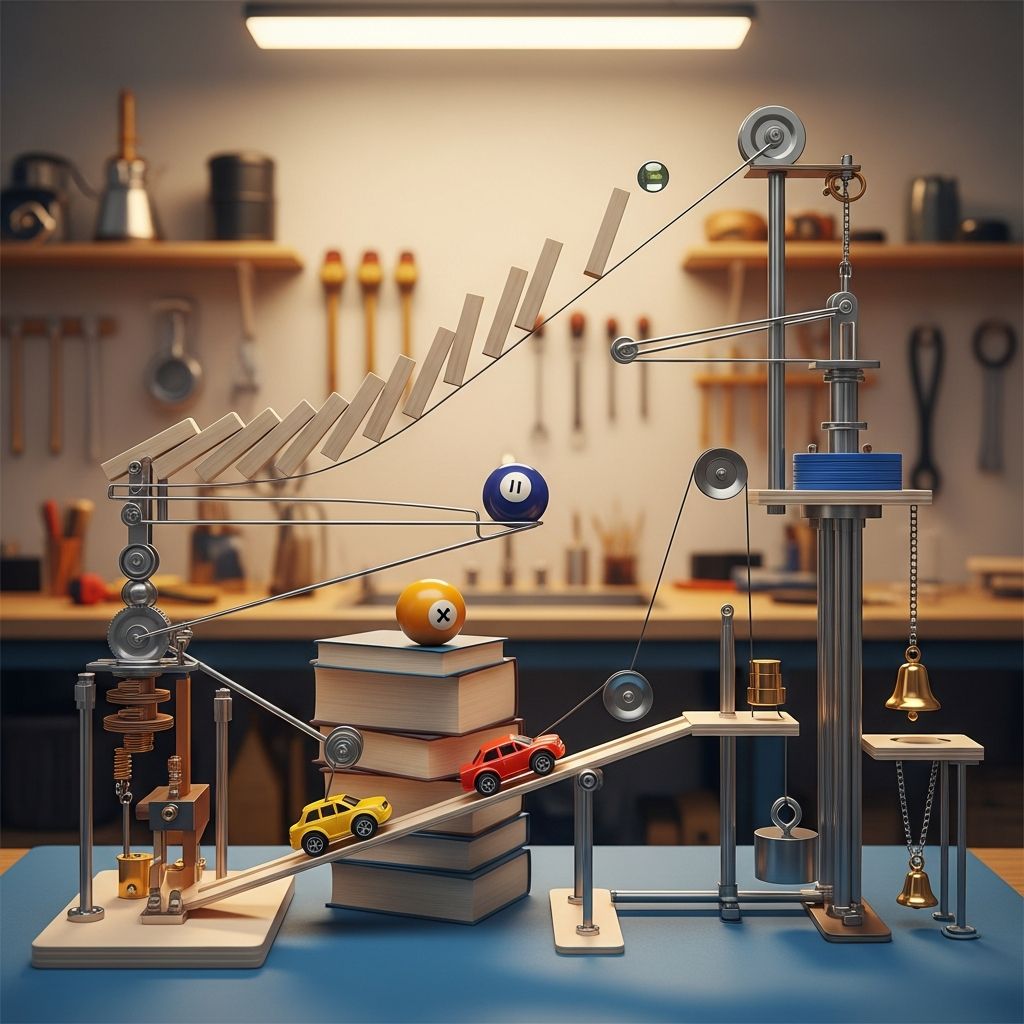
Understanding the Fundamentals of Chain Reaction Contraptions
A chain reaction machine is a deliberately designed apparatus that accomplishes a straightforward objective through an intricate and roundabout series of mechanical steps. Rather than taking the direct approach to complete a task, these machines employ multiple interconnected components that trigger one another in sequence, ultimately achieving a simple goal such as flipping a switch, ringing a bell, or popping a balloon. The appeal of these contraptions lies not in efficiency, but in the creative engineering challenge and educational value they provide.
The concept traces back to American cartoonist Rube Goldberg, whose name has become synonymous with unnecessarily complex machines designed to perform simple tasks. His inventions captured the public imagination through their whimsical designs and appeared in numerous films and television programs, demonstrating how entertaining yet educational these mechanical puzzles could be.
The Physics Principles That Power Your Machine
Understanding the scientific principles underlying chain reaction machines is essential for successful design and construction. These devices serve as practical demonstrations of fundamental physics concepts that students encounter in classrooms worldwide.
Energy Conservation and Transfer
At the heart of every chain reaction machine lies the principle of energy conservation. This law states that energy cannot be created or destroyed; rather, it transforms from one form to another or transfers between objects. When you launch your chain reaction by lifting an object and releasing it, you convert potential energy (stored energy based on position) into kinetic energy (energy of motion). This transformation continues throughout the entire sequence, with energy passing from one component to the next until the final action occurs.
Consider a marble dropping down an inclined plane: the gravitational potential energy it possessed at the top converts to kinetic energy as it moves downward. When this marble strikes another object, that kinetic energy transfers to the next component in the sequence, perpetuating the chain reaction.
Momentum and Impact Forces
The conservation of momentum principle proves equally important in chain reaction design. When two objects collide, the momentum doesn’t disappear; it transfers from one object to another. This becomes particularly evident when using ball bearings or marbles in your machine, as these spherical objects transfer momentum efficiently through clean, elastic collisions. Understanding this principle helps you predict how forcefully one component will strike the next, allowing for better design planning.
Forces themselves—defined as pushes or pulls that cause acceleration in objects—form another critical concept. Recognizing how forces interact with mass determines whether your chain reaction will successfully trigger each subsequent step.
The Six Simple Machines: Your Building Blocks
Every chain reaction machine incorporates combinations of six fundamental simple machines that form the backbone of mechanical engineering. Understanding how each works individually and in combination enables creative and functional designs.
The Six Simple Machines Explained
- Levers: Rigid bars that pivot around a fulcrum, providing mechanical advantage by amplifying force or distance. A broomstick knocking over dominoes exemplifies lever application.
- Inclined Planes: Sloped surfaces that allow objects to roll or slide downward, converting vertical potential energy into horizontal kinetic energy.
- Pulleys: Wheels with grooved edges that guide ropes or cables, enabling force redirection and mechanical advantage. A pulley system can lift heavy objects while requiring less direct force.
- Wheels and Axles: Circular objects rotating around central shafts, reducing friction and enabling smooth motion transfer.
- Wedges: Triangular devices that convert downward force into sideways force, useful for separating or moving objects.
- Screws: Inclined planes wrapped around cylindrical cores, converting rotational force into linear movement.
When combined strategically, these simple machines create mechanical advantage—either by increasing the distance through which force operates or by decreasing the force required to accomplish a task.
Essential Physics Concepts for Your Design
Several specific physics measurements and relationships govern how your chain reaction machine behaves:
| Physics Concept | Definition | Application in Your Machine |
|---|---|---|
| Velocity | The rate at which an object covers distance in a specific direction | Determines how quickly marbles roll down ramps and impact subsequent components |
| Acceleration | The rate of change in velocity over time, including speeding up or slowing down | Governs how quickly objects gain or lose speed during the chain reaction |
| Gravitational Acceleration | The constant rate at which objects fall toward Earth: 9.8 m/s² | Controls the speed of falling objects and objects on inclined planes |
| Potential Energy | Energy stored due to an object’s height or position in a gravitational field | Provides the initial power source for your chain reaction |
| Kinetic Energy | Energy possessed by objects in motion | Powers each successive action throughout your machine |
| Mechanical Advantage | The ratio of output force to input force when using a tool | Determines how much easier machines make difficult tasks |
Planning Your Chain Reaction Machine
Successful machine construction begins with thoughtful planning and design consideration. Rather than randomly assembling components, approach your project systematically.
Selecting an Appropriate Final Task
Your first decision involves choosing what simple task you want your machine to accomplish. Reasonable tasks include moving an object from one location to another, rolling a marble across the room, flipping a switch, or ringing a bell. Avoid overly ambitious objectives like cooking an entire meal, which would require impractical complexity.
Gathering Materials and Components
Chain reaction machines utilize everyday household objects combined with simple mechanical components. Common materials include:
- Marbles or ball bearings for transferring motion
- Dominoes or blocks for sequential triggering
- String and rope for pulley systems
- Wood pieces, PVC pipe, or foam for ramps and supports
- Cups, bowls, or containers for catching and directing objects
- Books or boxes for creating height differences
- Wheels and axles from toy parts or roller skates
- Everyday items like funnels, tubes, and household utensils
The beauty of this project lies in repurposing materials you already have available.
Designing Your Sequence
Sketch out how each action will trigger the next step. Work backward from your final goal, identifying what must happen in the second-to-last step, then the third-to-last, and so on. This reverse-engineering approach helps ensure logical flow and identifies potential mechanical challenges before construction begins.
Building and Testing Your Machine
The actual construction phase involves turning your design into a functional device through iterative building and testing.
The Role of Testing and Refinement
Successful chain reaction machine building relies on the engineering design process, which emphasizes testing and iteration. Build your machine in sections, testing each component before connecting it to the next. This approach identifies problems early and prevents wasted effort on flawed designs. When sections don’t work as planned, modify materials, angles, or component positions based on observation.
Understanding Friction and Resistance
Different surfaces and materials create varying amounts of friction, affecting how smoothly objects move through your machine. Smooth surfaces reduce friction and allow marbles to roll faster, while rough surfaces slow movement and dissipate energy. Experiment with different surface materials to achieve the right balance between smooth transitions and intentional resistance points.
Gravity’s Essential Role
Gravity serves as a key driving force in most chain reaction machines, pulling objects downward and creating the momentum needed for chain reactions. Design your machine to take advantage of gravity whenever possible, using height differences to provide the energy for subsequent steps. This approach makes your machine more reliable and easier to trigger repeatedly.
Common Challenges and Solutions
Several predictable problems arise during chain reaction machine construction:
- Insufficient Force Transfer: If one component doesn’t hit the next hard enough, the chain reaction stops. Increase the height from which objects fall or adjust angles to increase impact velocity.
- Excessive Friction: Overly rough surfaces waste energy. Smooth surfaces or add lubricants to reduce friction where needed.
- Timing Issues: If components don’t arrive at collision points simultaneously, reactions fail. Adjust ramp lengths and angles to control object speeds.
- Structural Instability: Wobbling or shifting components disrupt careful timing. Secure supports firmly and test structural integrity before adding moving parts.
- Energy Loss: Each transfer of energy causes some loss to friction and heat. Design sequences with fewer transfers or higher initial potential energy to maintain momentum throughout.
The Educational Value of Chain Reaction Machine Projects
Beyond creating an entertaining contraption, chain reaction machines serve significant educational purposes. They help students visualize cause-and-effect relationships fundamental to physics. When students observe how each action triggers the next in their own creation, the abstract becomes concrete and memorable.
These projects also reinforce the engineering design process through hands-on problem-solving. Students must think critically and creatively to troubleshoot failures, strengthening analytical thinking skills. Additionally, collaborative chain reaction machine building encourages communication and teamwork as students discuss ideas, make adjustments, and explain their reasoning to teammates.
The project demonstrates how forces cause motion, how energy transforms and transfers, and how even complex systems ultimately rest on simple mechanical principles. Students gain appreciation for the interconnectedness of physics concepts previously learned in isolation.
Frequently Asked Questions About Chain Reaction Machines
How long should a chain reaction machine take to build?
Construction timelines vary dramatically depending on complexity and available materials. Simple machines might take a few hours, while elaborate designs could span several days or weeks. The iterative testing process typically requires more time than initial construction.
What’s the best starting material for beginners?
Dominoes and marbles provide excellent starting points because they clearly demonstrate momentum transfer and energy conservation. Wooden ramps and household items like cups and string offer accessible construction materials for building support structures.
How can I make my machine more reliable?
Reliability improves through redundancy and conservative design. Ensure each transfer step includes more force than theoretically necessary, secure all structural components firmly, and test thoroughly before combining sections. Avoid designs that depend on precisely timed collisions.
Can chain reaction machines incorporate electronic components?
Absolutely. Many contemporary designs combine mechanical chain reactions with electronic sensors, motors, and timers. This hybrid approach allows for more complex and controllable sequences while maintaining the educational benefits of mechanical systems.
What makes a chain reaction machine fail?
Failures typically stem from insufficient energy transfer, excessive friction, timing misalignment, or structural instability. Systematic testing of individual components identifies failure points before combining sections into the complete machine.
Expanding Your Chain Reaction Machine Skills
Once you’ve successfully built your first machine, numerous opportunities exist for expanding your capabilities. Challenge yourself with more ambitious final tasks, experiment with different simple machine combinations, or attempt to create machines that perform multiple actions in sequence. You might design a machine that not only completes one task but triggers a reset mechanism allowing repetitive operation.
Advanced builders explore the intersection of Rube Goldberg machines with digital systems, using motion sensors and programmable controllers to add complexity. Others focus on artistic design, creating visually stunning machines that perform humble tasks with elaborate flair.
Conclusion
Building a chain reaction machine represents far more than a fun weekend project. It embodies fundamental physics principles, reinforces engineering thinking, and demonstrates how simple machines combine to achieve complex results. Whether you’re an educator seeking engaging STEM activities, a student exploring mechanical engineering, or simply someone who enjoys creative problem-solving, chain reaction machine building offers something valuable. The process teaches patience, systematic thinking, and the satisfaction of watching a carefully planned design function exactly as intended. Start simple, test thoroughly, and allow iteration to guide your designs toward increasingly sophisticated machines that transform everyday materials into sources of wonder and learning.
References
- The Whimsical World of Rube Goldberg Devices — Oreate AI. 2024. https://www.oreateai.com/blog/the-whimsical-world-of-rube-goldberg-devices/
- Rube Goldberg Machine Ideas & Examples — Study.com. 2024. https://study.com/learn/lesson/rube-goldberg-machine-ideas-examples-what-is-a-rube-goldberg-machine.html
- Rube Goldberg Machine — Lucy Ostrowski San Marin. 2024. https://lucyostrowskisanmarin.weebly.com/rube-goldberg-machine.html
- Rube Goldberg Machine — Wikipedia. 2024. https://en.wikipedia.org/wiki/Rube_Goldberg_machine
- Exploring Force, Motion and Energy Transfer with a Rube Goldberg Challenge — Lodges Learning. 2024. https://www.lodgeslearning.com/post/exploring-force-motion-and-energy-transfer-with-a-rube-goldberg-challenge
- Build, Innovate, and Learn: The Exciting World of Rube Goldberg Machines — Brains and Motion Education. 2024. https://www.brains-and-motion.com/blogs/news/build-innovate-and-learn-the-exciting-world-of-rube-goldberg-machines-at-brains-motion-education

Medha Deb is an editor with a master's degree in Applied Linguistics from the University of Hyderabad. She believes that her qualification has helped her develop a deep understanding of language and its application in various contexts. Medha specializes in the areas of beauty, health, sports, and wellness and is committed to ensuring that the content on the website is…