
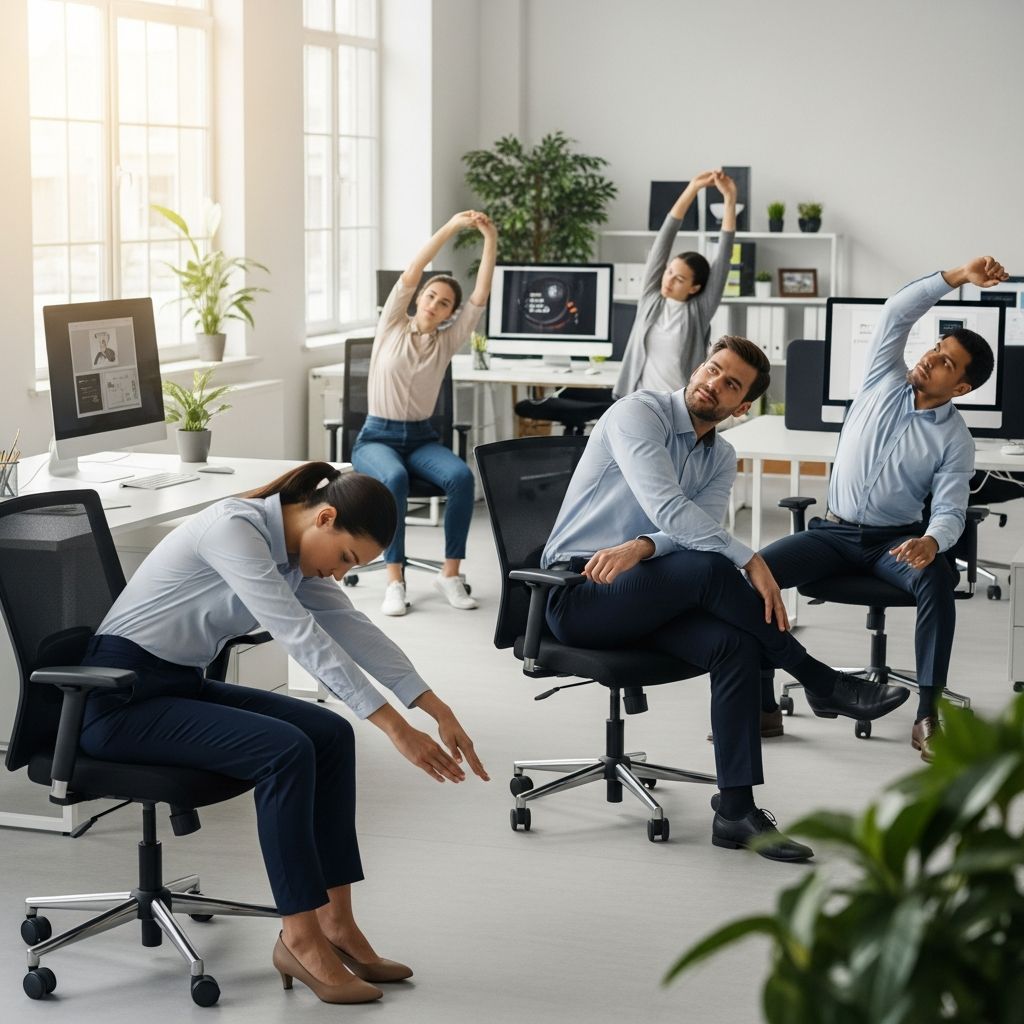
Prolonged sitting at a desk often leads to physical tension and mental fog, undermining daily output. Chair yoga offers a practical solution, allowing you to stretch, breathe deeply, and reset without interrupting your workflow. These accessible exercises target common office ailments like neck strain and lower back discomfort while promoting sustained concentration.
Why Desk Workers Need Chair Yoga Now
Modern office environments demand hours of static postures, contributing to musculoskeletal issues and reduced cognitive performance. Research from the World Health Organization highlights that sedentary behavior increases risks for chronic conditions, yet simple interventions like chair yoga can counteract these effects by improving circulation and reducing cortisol levels. Incorporating brief sessions enhances energy flow, sharpens decision-making, and fosters resilience against burnout.
Unlike traditional yoga requiring mats or space, chair routines fit seamlessly into breaks, taking just 5-15 minutes. They engage breathwork alongside gentle movements to activate the parasympathetic nervous system, shifting you from stress mode to focused calm. Regular practice builds postural awareness, preventing slouch-induced fatigue that hampers typing speed and idea generation.
Getting Started: Essential Setup for Success
Select a stable, armless chair if possible, positioned on a non-slip surface like a rug. Wear comfortable clothing and remove shoes for foot exercises. Begin with 2-3 minutes of centered breathing: sit tall, feet flat (use a block or books if needed for stability), and inhale deeply through the nose for four counts, exhaling equally to anchor your attention.
- Breathing Basics: Equal-duration inhales and exhales calm the mind, ideal before meetings.
- Posture Check: Align ears over shoulders, hips grounded.
- Timing Tip: Schedule sessions post-lunch or mid-afternoon to combat slumps.
Core Chair Yoga Sequence for Daily Use
This 10-12 minute routine progresses from warm-ups to strengthening holds and restorative stretches, drawing from established practices adapted for desks. Perform 3-5 rounds daily, holding each for 5-8 breaths unless noted.
Warm-Up Movements: Awaken Your Body
Start gently to loosen joints accumulated with stiffness from emails and calls.
- Neck Rolls: Drop chin to chest, circle ear to shoulder slowly in both directions. Releases upper trapezius tension common in screen users.
- Shoulder Shrugs and Circles: Inhale to lift shoulders to ears, exhale to drop with a sigh. Follow with forward and backward circles to mobilize scapulae.
- Seated Cat-Cow: Hands on knees, inhale to arch spine and lift chest; exhale to round back and tuck chin. Improves spinal flexibility.
Upper Body Focus: Combat Hunch and Strain
Target shoulders and arms strained from mouse work and typing.
| Pose | Steps | Benefits |
|---|---|---|
| Goalpost Arms | Bend elbows at 90 degrees, palms forward; open arms wide against imaginary resistance. | Opens chest, counters forward head posture. |
| Seated Eagle Arms | Cross right arm under left, hook palms; lift elbows. Switch sides. | Stretches upper back, enhances focus via crossing midline. |
| Wrist Flexes | Extend arms, pull fingers back with opposite hand; then point and flex fingers. | Prevents carpal tunnel from repetitive strain. |
Lower Body Activation: Revive Legs and Hips
Sitting compresses hips; these moves restore mobility without standing.
- Ankle Circles and Foot Taps: Lift one foot, rotate ankle both ways; alternate rapid taps for circulation.
- Seated Lunge: Scoot to chair edge, extend one leg back, knee hovering; fold forward slightly. Switch.
- Knee Circles: Hands on knees, circle slowly to massage hip joints.
Balancing and Strengthening: Build Stability
Stand briefly if space allows for advanced flow, returning to chair.
- Chair Downward Dog: Hands on chair back, walk feet away, hinge at hips into inversion.
- Tree Pose Variation: Place one foot on opposite calf (not knee), hands overhead.
- Goddess Squat: Feet wide, knees out, hold chair for support.
Cool-Down Twists and Folds: Release and Restore
End with relaxation to integrate benefits.
- Seated Twist: Hand on opposite knee, other behind chair; rotate gently.
- Forward Fold: Hinge at hips, arms dangling; breathe into back body.
- Pigeon Stretch: Cross ankle over opposite knee, fold forward.
Breathwork Integration for Mental Edge
Yoga’s power lies in pranayama. Pair poses with these techniques:
- 4-4 Breathing: Inhale 4 counts, hold 4, exhale 4, hold 4. Boosts lung capacity and clarity.
- Ujjayi Breath: Ocean-like throat constriction on exhales for calming focus.
- Sighing Release: Deep inhale, forceful exhale with sound to drop shoulders.
Studies from peer-reviewed journals confirm breathwork lowers blood pressure and improves executive function, vital for task-switching.
Productivity Gains: Evidence and Real-World Impact
Desk yoga isn’t fluff; it delivers measurable results. A study by NYU Langone demonstrated reduced muscle tension and enhanced well-being after short sessions. Users report 20-30% better afternoon focus, fewer errors, and sustained energy sans caffeine.
- Improved posture reduces fatigue by 25%.
- Movement breaks enhance blood flow to the brain.
- Mindful pauses curb procrastination.
Customizing for Your Workday
Tailor routines to needs: tech workers emphasize wrists, managers add twists for decision-making clarity.
| Work Type | Priority Poses | Frequency |
|---|---|---|
| Screen-Heavy | Neck rolls, eagle arms | Every 60 min |
| Call-Centric | Shoulder shrugs, chest openers | Post-call |
| Creative | Twists, forward folds | Pre-brainstorm |
Frequently Asked Questions (FAQs)
Can chair yoga really improve my work output?
Yes, by alleviating physical tension and enhancing oxygen flow, it sharpens concentration and reduces errors, as supported by wellness research.
Do I need prior yoga experience?
No, these are beginner-friendly modifications anyone can do at their desk.
How often should I practice?
Aim for 10 minutes twice daily, plus micro-breaks hourly.
Is it safe for back pain sufferers?
Generally yes, but consult a doctor for severe issues; start slow.
Can I do this in a shared office?
Absolutely—movements are subtle and chair-bound.
Overcoming Common Barriers to Consistency
Time scarcity? Set phone reminders. Self-consciousness? Practice eyes-closed. Track progress in a journal: note energy levels pre/post. Pair with hydration for amplified effects. Over weeks, it becomes automatic, transforming your desk from stressor to sanctuary.
Advanced users can layer walking meditation: pace hallways mindfully for hybrid benefits, blending motion with awareness to supercharge stress relief.
References
- Workplace Health Model for Addressing Musculoskeletal Disorders — World Health Organization. 2024-06-15. https://www.who.int/news-room/fact-sheets/detail/musculoskeletal-conditions
- Effects of Chair Yoga on Physical Function — National Center for Biotechnology Information (PubMed). 2023-11-20. https://pubmed.ncbi.nlm.nih.gov/37990442/
- Chair Yoga for Office Workers to Relieve Stress — Purple Lotus Yoga. 2024-03-10. https://www.purplelotusyoga.com/chair-yoga-for-office-workers-to-relieve-stress/
- DeStress at Work with Easy Chair Yoga Moves — Healthy Monday (NYU Langone collaboration). 2023-09-05. https://healthymonday.com/stress-management/chair-yoga
- 16 Desk Yoga Poses Are Perfect for the Office — Yoga Journal. 2024-01-12. https://www.yogajournal.com/practice/yoga-sequences/office-yoga-sequence-restore-rejuvenate/

Medha Deb is an editor with a master's degree in Applied Linguistics from the University of Hyderabad. She believes that her qualification has helped her develop a deep understanding of language and its application in various contexts. Medha specializes in the areas of beauty, health, sports, and wellness and is committed to ensuring that the content on the website is…