
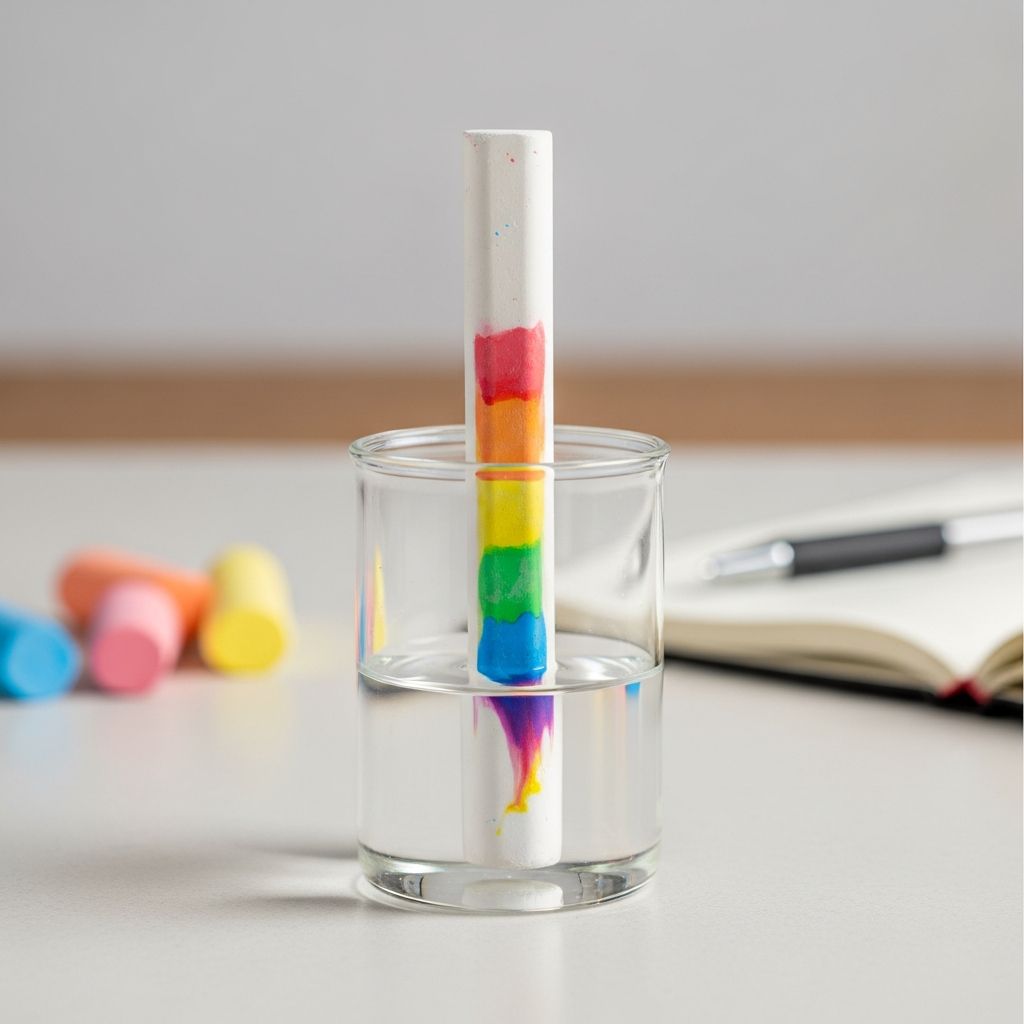
Chalk chromatography offers an accessible way to demonstrate the principles of separation science using common household items. This technique reveals the hidden colors within black ink or mixed dyes, making it perfect for educational settings.
Understanding the Basics of Chromatography
Chromatography is a fundamental analytical method used to separate mixtures based on the differing affinities of components for a stationary phase and a mobile phase. In chalk chromatography, the porous structure of chalk serves as the stationary phase, while a liquid solvent like water or alcohol acts as the mobile phase, carrying pigments through the chalk at varying speeds.
The process relies on capillary action, where the solvent climbs up the chalk, interacting differently with each pigment molecule. Less soluble pigments lag behind, while more soluble ones travel farther, creating distinct colored bands. This visual separation helps illustrate concepts like polarity and solubility in an engaging manner.
Gathering Your Materials
To conduct chalk chromatography successfully, assemble these straightforward supplies:
- White chalk sticks (standard, non-dustless varieties work best for porosity)
- Water-soluble markers (black or colored, such as Crayola or Sanford brands)
- Food coloring or ink dyes
- Rubbing alcohol (50-70% isopropyl) or water
- Small beakers, cups, or jars
- Filter paper, pipettes, or droppers
- Pencil, ruler, and scissors
- Watch glass or plastic wrap (optional for containment)
- Forceps or tongs for handling
These items are inexpensive and widely available, ensuring the experiment is feasible for classrooms, homes, or labs.
Step-by-Step Procedure for Water-Based Setup
Follow this method for a basic water-driven separation:
- Mark a pencil line 1 cm from one end of the chalk stick to serve as the origin point for pigments.
- Prepare an ink solution: Cut filter paper into a small strip, saturate it with marker ink on both sides, place in a watch glass, add 0.5 mL water, and stir for 5 minutes to extract pigments.
- Stand the chalk vertically in a beaker with 3 mL water, ensuring stability. Dip the marked end into the ink solution until absorbed.
- Invert the chalk, add drops of water to the inked end (10 drops total, allowing absorption each time), then place it in the beaker with the inked end up.
- Observe as water rises, separating colors into bands over 5-10 minutes or until reaching a side pencil mark.
- Remove, dry, and record the color sequence and distances traveled.
This column-style approach mimics professional liquid chromatography.
Alcohol Variant for Enhanced Separation
For sharper results, especially with certain inks, use alcohol as the solvent:
- Apply a dot or band of ink/food coloring 1 cm from the chalk’s bottom end.
- Pour alcohol into a cup to a depth of 0.5 cm, below the ink line.
- Position the chalk in the cup; cover with plastic wrap to reduce evaporation.
- Watch colors migrate upward, typically faster than with water. Remove when bands are clear.
Alcohol’s lower surface tension improves pigment mobility.
Expected Observations and Data Recording
Black markers often reveal blue (traveling farthest), red, and yellow bands, varying by brand. Green food coloring separates into yellow and blue components. Record data systematically:
| Dye Type | Band Colors (Bottom to Top) | Distance Traveled (cm) | Time (min) |
|---|---|---|---|
| Black Marker | Yellow, Red, Blue | Blue: 4.2; Red: 3.5; Yellow: 3.0 | 10 |
| Green Food Color | Yellow, Blue | Blue: 4.0; Yellow: 2.8 | 8 |
| Red Food Color | Red (single or mixed) | 3.5 | 10 |
Measure distances from the origin to each band’s leading edge for analysis.
Scientific Principles Behind the Magic
Chalk, primarily calcium carbonate (CaCO3), features microscopic pores that trap pigments selectively. The mobile phase wets these pores via capillary action, opposed by gravity. Pigments with higher solubility in the solvent move faster, while those with stronger adsorption to chalk stay lower.
This is adsorption chromatography, where separation depends on differential partitioning. Factors like solvent polarity, pigment molecular weight, and chalk porosity influence outcomes. Heavier or less polar dyes adhere more, explaining why blues often lead.
Troubleshooting Common Issues
- Chalk tips over: Select straighter pieces or use a supportive holder.
- No separation: Use water-soluble inks; permanent markers won’t work.
- Fading colors: Avoid dustless chalk; opt for traditional porous types.
- Blurry bands: Reduce solvent volume or cover to prevent overflow.
- Slow migration: Try alcohol for quicker results.
Safety note: Alcohol is flammable; use in well-ventilated areas and avoid ingestion.
Educational Value and Extensions
This experiment teaches separation science, applicable in forensics (ink analysis), pharmaceuticals (drug purity), and environmental monitoring (pollutant detection). Extend by comparing solvents, testing plant extracts, or calculating Rf values (distance traveled by pigment / solvent front distance).
Incorporate math: Compute average Rf for replicates. For advanced learners, discuss partition coefficients or tie to real chromatography like HPLC.
Real-World Applications of Chromatography
Beyond classrooms, chromatography purifies water, analyzes food additives, and detects doping in sports. Chalk versions simulate these, building intuition for complex techniques.
Frequently Asked Questions
Can I use colored chalk?
No, white chalk is essential to observe separations clearly without background interference.
What if I don’t have filter paper?
Directly apply marker to chalk, but extraction yields better, uniform pigment loading.
How long does separation take?
5-15 minutes, depending on solvent and chalk length; alcohol is faster.
Is this safe for young children?
Yes with supervision; use water only for ages under 10, avoid alcohol.
Why do colors separate differently in various markers?
Manufacturers use unique dye blends with varying solubilities and polarities.
Can I reuse the chalk?
Dry it completely; residual pigments may affect subsequent runs.
References
- Classroom Chromatography Using Calcium Carbonate: Chalk It Up — Carolina Knowledge. Accessed 2026. https://knowledge.carolina.com/discipline/physical-science/chemistry/chalk-chromatography/
- Chalk Chromatography Experiment Guide — Scribd. 2023. https://www.scribd.com/document/791705668/Expanded-Chalk-Chromatography-Project
- Easy Chalk Chromatography Science Project — Science Notes. Accessed 2026. https://sciencenotes.org/easy-chalk-chromatography-science-project/
- Chalk Chromatography — GMU College of Science. Accessed 2026. https://science.gmu.edu/media/chalk
- Chalk Chromatography Demonstration — YouTube (NKU ChemDemos). Accessed 2026. https://www.youtube.com/watch?v=o5GRfHG3EGs
- 2a: Chalk Chromatography Evaluation — TUHH Kniffelix. Accessed 2026. https://www3.tuhh.de/kniffelix/en/2a-chalk-chromatography-evaluation/

Medha Deb is an editor with a master's degree in Applied Linguistics from the University of Hyderabad. She believes that her qualification has helped her develop a deep understanding of language and its application in various contexts. Medha specializes in the areas of beauty, health, sports, and wellness and is committed to ensuring that the content on the website is…