
The Silent Master: Unlocking Creative Genius Through Constraint
Charlie Chaplin remains one of history’s most influential creative minds, yet his revolutionary approach to filmmaking and performance was built on a foundation of limitation rather than abundance. The legendary silent film star demonstrated that constraints—whether imposed by technology, budget, or artistic choice—can become the catalyst for genuine innovation. His career teaches us that the most powerful creative breakthroughs often emerge not from unlimited resources, but from the ingenuity we develop when working within boundaries.
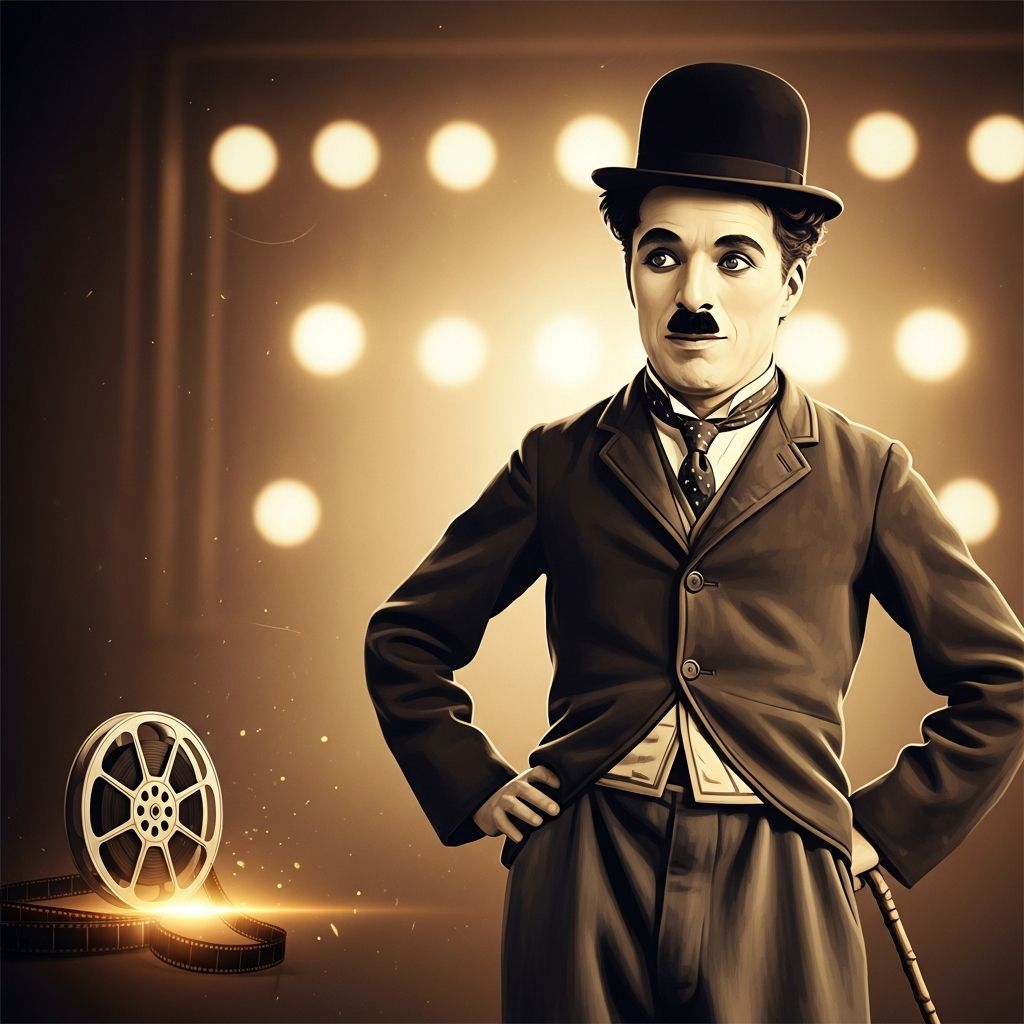
The tramp character that defined Chaplin’s career exemplified this principle. With minimal props, a bowler hat, a cane, and a toothbrush mustache, Chaplin created an instantly recognizable figure that transcended language and cultural barriers. This economy of expression reveals a fundamental truth about creativity: complexity does not equal impact. Instead, the most memorable artistic statements often come from distilling ideas to their essence.
Maximizing What You Already Possess
One of Chaplin’s most enduring creative lessons centers on leveraging existing resources rather than waiting for perfect conditions. He famously stated that all he needed for comedy was a park, a policeman, and an attractive woman—a statement that captures the spirit of resourceful creativity. This philosophy stands in stark contrast to modern tendencies to defer creative work until circumstances improve or resources expand.
Chaplin’s approach demands that creators honestly assess the talents, skills, and materials already at their disposal. Rather than viewing limitations as obstacles, he treated them as raw materials for artistic exploration. This mindset shift transforms creative practice from a perpetual waiting game into an active engagement with present possibilities. The message resonates across disciplines: a writer needs only pen and paper, a musician needs an instrument, a filmmaker needs a camera. The essential creative work begins not when conditions are perfect, but when you commit to using what you have.
This principle extends beyond physical resources to encompass personal capabilities. Chaplin built an entire artistic legacy by perfecting his specific strengths—physical comedy, facial expression, and mime—rather than attempting to master every conceivable artistic form. His singular focus on what he did exceptionally well allowed him to achieve depths of expression that generalists could never reach.
The Architecture of Emotional Engagement
Chaplin’s films operate on a sophisticated understanding of how audiences experience narrative and emotion. Unlike the slapstick comedy of his contemporaries, which relied on absurd physical incidents for laughs, Chaplin’s humor emerged from his character’s response to situations. When the tramp would bump into a tree and raise his hat in apologetic reflex, the comedy arose not from the collision itself but from his attitude toward it. This distinction between exposition and expression fundamentally altered how cinema could communicate meaning.
This approach reveals a deeper principle about creative communication: audiences connect not with events themselves, but with how characters regard and respond to events. A scene gains power through the emotional journey it maps for the viewer, not through spectacle alone. Chaplin understood that he could orchestrate this emotional architecture with precision, layering moments to create an escalating response. He did not simply present situations; he conducted an audience’s emotional involvement as deliberately as a composer arranges notes.
His creative process reflected this understanding. Rather than adhering to pre-written scripts, Chaplin worked improvisationally, discovering moments through experimentation and refinement. He would move elements of a scene here and there, pause, observe the emotional effect, and adjust accordingly. This iterative approach to emotional pacing resulted in films that felt organic and authentic rather than manufactured.
Simplification as a Sophisticated Creative Strategy
Modern creative culture often equates complexity with sophistication. Chaplin’s work inverts this assumption. He possessed the rare ability to address profound philosophical themes—human dignity, economic injustice, the absurdity of social hierarchies—through the medium of silent physical comedy. His films functioned as what he himself called “metaphysical exercises,” yet they remained immediately accessible to audiences worldwide.
This capacity to simplify complex ideas without diminishing their intellectual weight represents an advanced creative skill. Chaplin took big themes and reduced them to their digestible essence, maintaining thought quality while ensuring broad accessibility. The tramp character itself embodies this principle: through a single figure in simple circumstances, Chaplin explored the fundamental human experience of dignity, hope, and resilience in the face of institutional indifference.
The process of simplification demands a deep understanding of one’s subject matter. You cannot effectively reduce an idea to its essence without first comprehending its core completely. Chaplin spent months or even years perfecting individual scenes, taking hundreds of takes to achieve the precise expression or gesture that would convey meaning without words. This meticulous refinement produced apparent simplicity that actually represented tremendous artistic labor.
Physical Expression and Authentic Communication
Long before modern communication theory, Chaplin recognized that movement, gesture, and expression communicate with greater directness and universality than words. His creative philosophy prioritized what the body could convey—through the deliberate walk, the loose bend of the knees, the obstacle overcome—as primary vehicles for storytelling. These physical choices created a visual language that required no translation.
This approach challenges creators to consider how physical and visual elements can carry narrative weight. In an age dominated by text and digital communication, Chaplin’s commitment to embodied expression offers a corrective. His films demonstrate that authentic human communication operates largely through channels beyond language: through facial expression, posture, gesture, and spatial relationship. Modern creators working across any medium can adopt this principle by asking how their work can employ these non-linguistic modes of expression.
The specificity of Chaplin’s physical vocabulary deserves attention. He did not rely on random movement but rather developed a repertoire of intentional physical choices, each calibrated to express particular emotional or narrative information. This suggests that expressive physicality requires the same disciplined study and practice that musicians or dancers apply to their respective arts.
Rejecting Convention in Service of Vision
Chaplin’s career was defined by his refusal to accept existing formulas for what cinema could be or accomplish. He resisted the exaggerated melodrama that dominated popular films of his era, instead pursuing subtle acting and nuanced expression. He perfected his work through hundreds of takes while others accepted faster production schedules. He created feature-length films with carefully crafted plots when shorter comedies dominated the market.
This principle of creative non-conformity requires considerable courage, particularly early in a career when established conventions promise security. Chaplin’s unconventional approach succeeded because it emerged from genuine artistic conviction rather than mere contrarianism. He studied life closely and developed technique from his own logic and observation rather than borrowing others’ methods. This distinction matters: authentic innovation comes from deep engagement with one’s subject, not from superficial rejection of norms.
The willingness to pursue extended development and revision also challenged industry standards. Chaplin approached filmmaking as a novelist writes—sitting with ideas, revising extensively, throwing out sections that do not serve the whole. This patient, iterative method stood apart from industrial filmmaking practices designed for efficiency and rapid production.
The Camera as Invisible Servant
Chaplin’s technical philosophy regarding cinematography reveals another creative principle applicable beyond cinema: the tool should serve the vision, never dominate it. He intentionally designed camera placement and movement to facilitate his performance rather than to showcase camera technique itself. When a camera position draws attention to the camera work rather than to the actor’s performance, he argued, the camera becomes the performance rather than the actor.
This principle extends to any creative field: the technical apparatus—whether paintbrush, instrument, software, or medium—should remain transparent, enabling the artist’s vision to reach the audience without obstruction. Overemphasis on technical capability often produces work that celebrates the tool rather than the content. Chaplin maintained focus on what mattered most: the actor’s ability to move an audience emotionally and intellectually.
This philosophy also implicitly argues against letting available technology dictate creative choices. The tools at hand should be evaluated strictly for their utility in realizing specific artistic intentions. New capabilities should be adopted only when they genuinely serve the work, not simply because they exist.
Patience, Revision, and the Long View
Contemporary creative culture often valorizes speed and productivity metrics. Chaplin’s practice offers a counterbalance. He spent a full year determining how to accomplish a single scene in City Lights, ultimately recording 342 takes before achieving what he envisioned. This commitment to refinement across extended timeframes seems extravagant by modern standards, yet it produced films that have endured nearly a century while countless faster productions have vanished from memory.
The lesson resides not in the specific numbers but in the philosophy underlying such dedication. Chaplin understood that certain creative achievements require time to mature. He was willing to discard extensive work if it did not serve his vision, to experiment freely without pressure to reach production deadlines, and to live with a project for months or years to ensure its quality. This long-term commitment to excellence over expedience represents a fundamentally different approach to creative work.
Finding Universality Through Particularity
The tramp character achieved worldwide fame because it expressed something universally human through a completely specific, particular vision. Chaplin did not attempt to appeal to everyone through bland generalization. Instead, he created a distinctive character with particular mannerisms, limitations, and perspective, and this specificity somehow made him accessible to audiences across all cultures and languages.
This suggests a counterintuitive creative principle: universal appeal often emerges from particular vision pursued with conviction. Creators sometimes dilute their work in attempts to achieve broader appeal, removing the rough edges and specific details that actually generate resonance. Chaplin’s example suggests the opposite: that fidelity to a specific vision, character, or perspective can produce work with profound universal reach.
Frequently Asked Questions
Q: What made Charlie Chaplin’s comedy different from other silent comedians of his era?
A: Chaplin’s humor derived from his character’s attitude and response to situations rather than from the events themselves. While other comedians relied on physical incidents for laughs, Chaplin’s comedy emerged from expression—how the tramp regarded and responded to what happened around him.
Q: How can modern creators apply Chaplin’s creative principles?
A: Modern creators can adopt Chaplin’s approach by working resourcefully with available materials, simplifying complex ideas without diminishing their meaning, prioritizing emotional authenticity over technical showiness, and maintaining patience with refinement and revision rather than rushing to completion.
Q: Why did Chaplin spend so many takes to perfect a single scene?
A: Chaplin believed that the precise execution of subtle gestures, expressions, and timing was essential to conveying meaning without words. Each take allowed him to refine these elements until they achieved exactly the emotional or narrative effect he intended.
Q: What does Chaplin mean by stating he only needed a park, a policeman, and a pretty girl for comedy?
A: This statement reflects his philosophy that creative success does not require elaborate resources or special conditions. Instead, any available environment and basic human elements can become material for compelling storytelling when approached with imagination and skill.
Q: How did Chaplin’s approach to filmmaking differ from industrial practices?
A: Chaplin treated filmmaking like writing a novel—taking time to develop ideas, revising extensively, and discarding elements that did not serve the overall vision. This contrasted sharply with industrial approaches prioritizing efficiency and rapid production schedules.
References
- The Charlie Chaplin Guide to Visual Thinking — Mind Map Inspiration. Accessed January 2026. https://mindmapinspiration.com/the-charlie-chaplin-guide-to-visual-thinking/
- Charlie Chaplin’s Philosophy of Cinema — The Real News Network. Accessed January 2026. https://therealnews.com/charlie-chaplins-philosophy-of-cinema
- What Charlie Chaplin Taught Me About Creativity — Lifehack.org. Accessed January 2026. https://www.lifehack.org/articles/productivity/what-charlie-chaplin-taught-about-creativity.html
- The Walk That Talks — Charlie Chaplin Official Website. Accessed January 2026. https://www.charliechaplin.com/it/films/4/articles/324-The-Walk-That-Talks-
- Charlie Chaplin on Filmmaking — Deep Roots Magazine. Accessed January 2026. https://deeprootsmag.org/2014/01/19/charlie-chaplin-on-filmmaking/
- Charlie Chaplin and the Fundamentals of Storytelling — Writing Cooperative. Accessed January 2026. https://writingcooperative.com/charlie-chaplin-and-the-fundamentals-of-storytelling-53889e40499b

- Integrated M.A. in Applied Linguistics, University of Hyderabad
- 5+ years in editorial, instructional, SEO, and research-based writing
Sneha is a relationships and lifestyle writer with a strong foundation in applied linguistics and certified training in relationship coaching. She brings over five years of writing experience to theskillvault, crafting thoughtful, research-driven content that empowers readers to build healthier relationships, boost emotional well-being, and embrace holistic living. Her writing and insights reflect the belief that beauty, happiness, and wellness…