
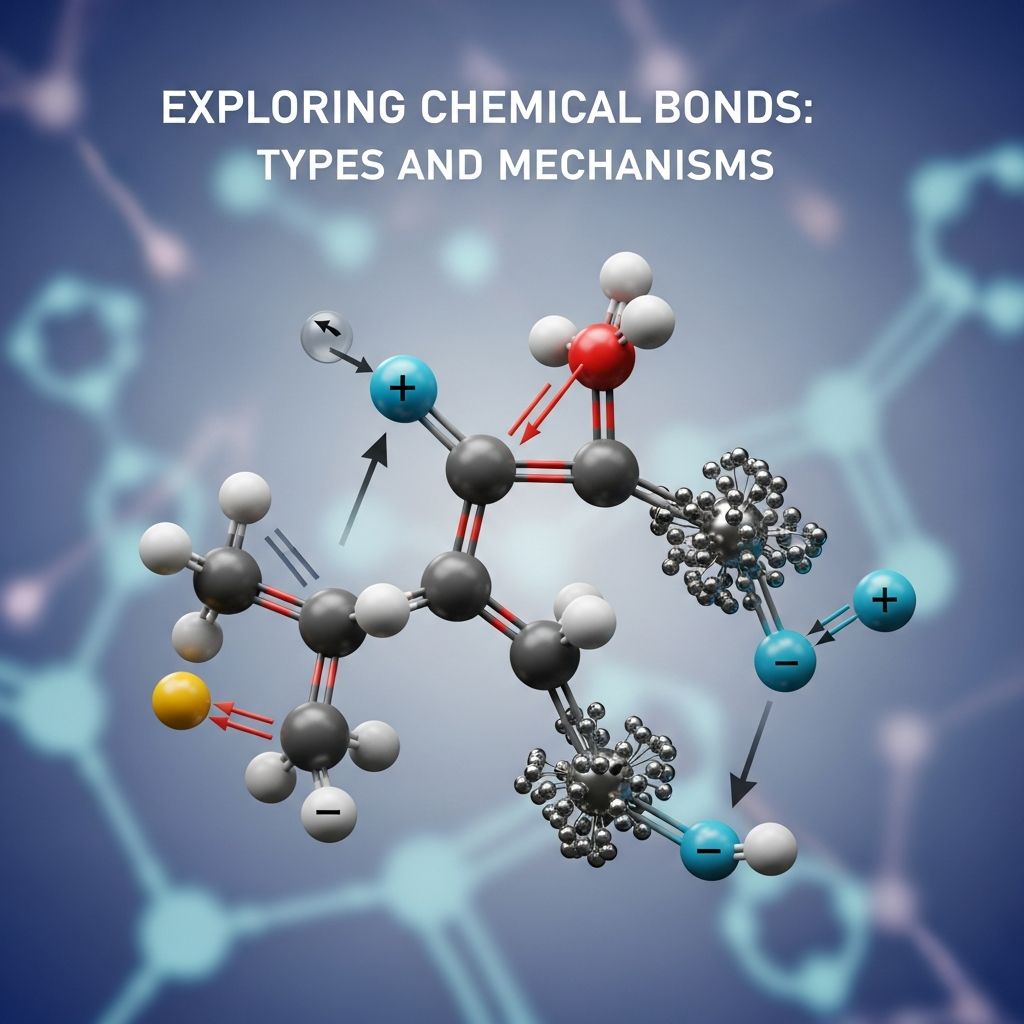
Chemical bonds represent the fundamental forces that hold atoms together to form molecules, crystals, and extended structures, dictating the physical and chemical properties of all matter. These interactions arise from the electrostatic attractions between atoms’ nuclei and electrons, enabling the vast diversity of substances from simple gases to complex biomaterials.
The Essence of Atomic Interactions
At the atomic level, bonds form when atoms achieve stability by filling their outer electron shells, often following the octet rule where eight electrons provide noble gas-like configurations. Primary bonds—ionic, covalent, and metallic—offer strong connections, while secondary bonds like hydrogen and van der Waals forces provide weaker but crucial links in larger systems.
The strength and nature of a bond depend on electronegativity differences between atoms: low differences lead to sharing (covalent), high to transfer (ionic), and delocalization in metals. Understanding these helps predict compound behaviors, from solubility to conductivity.
Ionic Bonding: Electrostatic Attractions
Ionic bonds occur when one atom transfers electrons to another, creating oppositely charged ions that attract each other via electrostatic forces. Typically, this happens between metals (low electronegativity, electron donors) and nonmetals (high electronegativity, electron acceptors).
For instance, sodium (Na) loses one electron to become Na⁺, while chlorine (Cl) gains it to form Cl⁻, resulting in NaCl, table salt. These bonds form crystalline lattices with high melting points due to strong attractions, making ionic compounds brittle solids at room temperature.
- Key Characteristics: High bond energy (strong), conduct electricity when molten or dissolved, soluble in water.
- Applications: Batteries, ceramics, fertilizers.
Ionic compounds exhibit directional bonding in lattices, leading to cleavage along planes, unlike the nondirectional nature of other bonds.
Covalent Bonding: Electron Sharing Partnerships
Covalent bonds form through the sharing of valence electrons between atoms, predominantly nonmetals, allowing mutual stability without charge separation. Bonds can be single (one pair), double (two pairs), or triple (three pairs), with increasing strength and shorter lengths.
Nonpolar covalent bonds occur between similar electronegativities, like O₂ where electrons share equally. Polar covalent bonds, such as in H₂O, show unequal sharing due to moderate electronegativity differences (0.3-1.7), creating partial charges (δ⁺ and δ⁻). Coordinate covalent bonds involve one atom donating both electrons, common in complexes like BF₃·NH₃.
| Bond Type | Example | Electronegativity Diff. | Properties |
|---|---|---|---|
| Nonpolar | Cl₂ | <0.3 | Low polarity, insoluble in water |
| Polar | HCl | 0.3-1.7 | Dipole moment, higher boiling point |
| Multiple | N≡N | Varies | Very strong, short bond length |
Covalent networks, like diamond (C-C bonds), yield extreme hardness, while molecular covalents like CH₄ are gases or low-melting solids.
Metallic Bonding: A Sea of Electrons
Metallic bonds arise in pure metals and alloys from delocalized valence electrons moving freely around positively charged cations, forming a ‘sea’ that enables high conductivity and malleability. No specific electron pairs exist; strength increases with more delocalized electrons.
Copper’s ductility allows wire drawing, and its luster comes from electron mobility reflecting light. Alloys like steel modify properties via impurity atoms disrupting the lattice.
- Traits: High electrical/thermal conductivity, ductility, luster, variable strength.
- Weakest Primary Bond: Yet versatile for engineering.
Secondary Bonds: Subtle but Essential Forces
Beyond primary bonds, weaker interactions stabilize structures. Hydrogen bonds form when H bonds to N, O, or F, creating strong dipoles (e.g., DNA base pairing, water’s high boiling point). Van der Waals forces include dipole-dipole and London dispersion (instantaneous dipoles in nonpolar molecules).
These enable geckos’ adhesion via dispersion forces and protein folding.
Bond Strengths and Compound Properties
Bond dissociation energies rank ionic/covalent strongest (~100-400 kJ/mol), metallic moderate, secondary weakest (1-40 kJ/mol). This hierarchy explains why ionic solids melt high (e.g., NaCl 801°C) versus molecular (ice 0°C).
| Bond Type | Strength (kJ/mol) | Melting Point Example |
|---|---|---|
| Ionic | 700-4000 | NaCl: 801°C |
| Covalent | 100-400 | Diamond: 3550°C |
| Metallic | 100-350 | Cu: 1085°C |
| Hydrogen | 10-40 | H₂O: 0°C |
Real-World Applications Across Industries
Chemical bonds underpin technology: semiconductors use covalent networks, ionic electrolytes power batteries, metallic alloys build infrastructure. In biology, covalent backbones and hydrogen bonds form life’s polymers. Pharmaceuticals design drugs targeting bond disruptions.
Nanomaterials exploit bond tunability for strength without weight.
Frequently Asked Questions (FAQs)
What distinguishes ionic from covalent bonds?
Ionic bonds involve electron transfer creating charges; covalent bonds share electrons. Electronegativity difference >1.7 favors ionic, <1.7 covalent.
Why are metals conductive but ionic solids not?
Metals have mobile electrons; ionic solids need melting/dissolving to free ions.
Can bonds be a mix of types?
Yes, polar covalent has ionic character; many materials show hybrid bonding.
How do hydrogen bonds affect water?
They raise boiling point, enable surface tension, and drive ice’s expansion.
What’s the role of bonds in material strength?
Strong primary bonds yield durability; directional covalent maximizes hardness.
Advanced Perspectives: Quantum Insights
Quantum mechanics refines models: molecular orbital theory describes delocalized electrons in metals/covalent bonds, valence bond theory overlaps orbitals. Lewis structures simplify but overlook resonance (e.g., benzene).
Bond orders predict stability: higher in triples. Spectroscopy measures bond vibrations, aiding identification.
In summary, mastering chemical bonds reveals matter’s blueprint, from micro-molecules to macro-materials, fueling innovation across sciences.
References
- The Main Types of Chemical Bonds — Reagent Chemicals. 2023-05-15. https://www.reagent.co.uk/blog/what-are-the-main-types-of-chemical-bonds/
- Chemical Bond — Wikipedia (informed by primary sources). 2025-01-20. https://en.wikipedia.org/wiki/Chemical_bond
- Chemical Bonds, Types, Characteristics — Ferrovial STEM. 2024-08-10. https://www.ferrovial.com/en/stem/chemical-bonds/
- Types of Chemical Bonds: Crash Course Chemistry #22 — YouTube/Khan Academy Network. 2015-06-29. https://www.youtube.com/watch?v=QXT4OVM4vXI
- Atomic Bonding – CES Information Guide — University of Washington (.edu). 2023-11-12. https://depts.washington.edu/matseed/ces_guide/bonding.htm
- 9.2: Types of Chemical Bonds — Chemistry LibreTexts (.org academic). 2024-09-05. https://chem.libretexts.org/Bookshelves/General_Chemistry/Map:_A_Molecular_Approach_(Tro)/09:_Chemical_Bonding_I-_Lewis_Structures_and_Determining_Molecular_Shapes/9.02:_Types_of_Chemical_Bonds
- Chemical Bonds – Khan Academy — Khan Academy (.org educational). 2025-03-15. https://www.khanacademy.org/science/ap-biology/chemistry-of-life/introduction-to-biological-macromolecules/a/chemical-bonds-article

- Integrated M.A. in Applied Linguistics, University of Hyderabad
- 5+ years in editorial, instructional, SEO, and research-based writing
Sneha is a relationships and lifestyle writer with a strong foundation in applied linguistics and certified training in relationship coaching. She brings over five years of writing experience to theskillvault, crafting thoughtful, research-driven content that empowers readers to build healthier relationships, boost emotional well-being, and embrace holistic living. Her writing and insights reflect the belief that beauty, happiness, and wellness…