
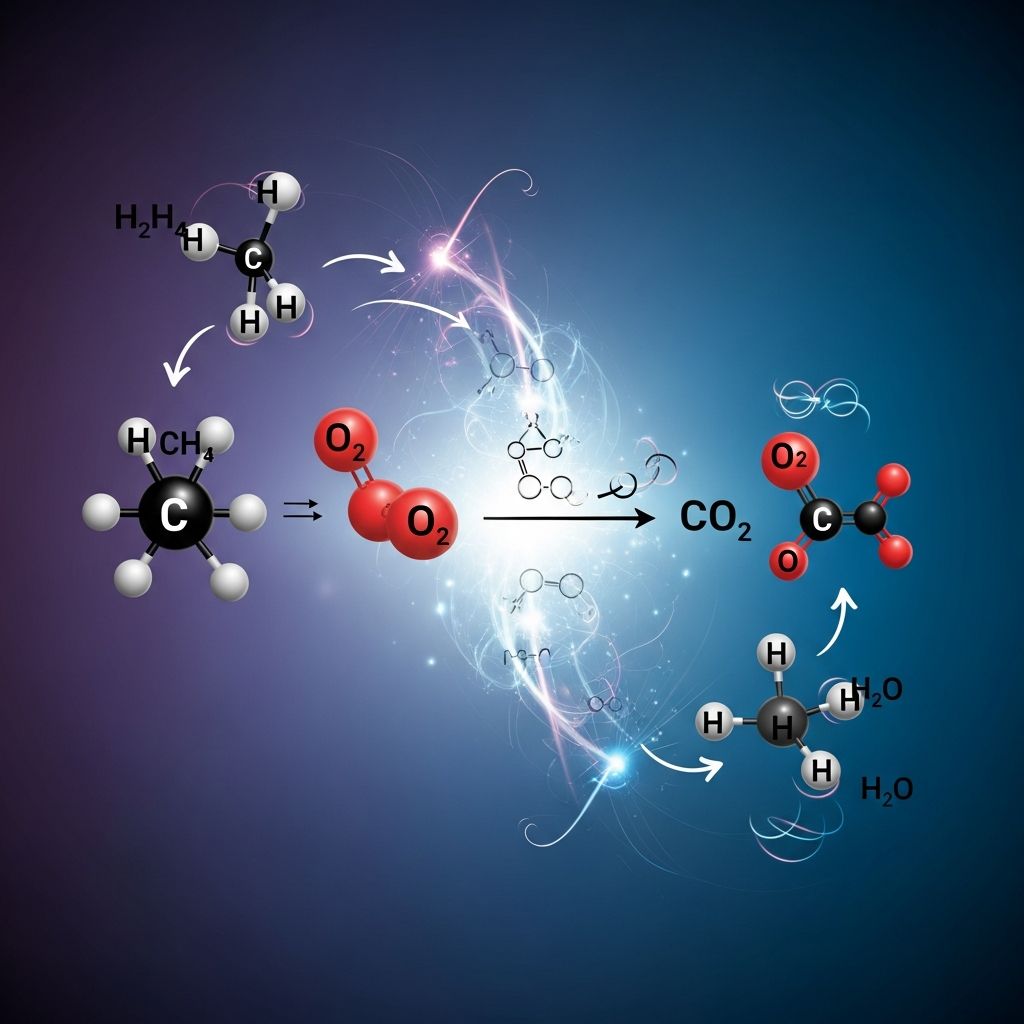
Chemical reactions are fundamental processes in chemistry where one or more substances, known as reactants, transform into different substances called products through the rearrangement of atoms. This transformation involves breaking and forming chemical bonds, resulting in new materials with distinct properties.
Defining Chemical Reactions at the Atomic Level
At its core, a chemical reaction rearranges atoms from reactants to form products without creating or destroying any atoms, adhering to the law of conservation of mass. Reactants are the starting materials, while products are the outcomes of this atomic reshuffling. For instance, iron and sulfur combine to yield iron sulfide, a compound with properties unlike its elements.
Classical chemical reactions focus on electron rearrangements in bonds, excluding nuclear changes, which fall under nuclear chemistry. This distinction ensures that elements remain the same, only their combinations alter.
Chemical Reactions vs. Physical Changes
Chemical reactions differ markedly from physical changes. In physical changes, like melting ice or dissolving sugar, no new substances form; only the state or appearance alters. Chemical changes, however, produce entirely new substances with different compositions and properties.
| Aspect | Chemical Reaction | Physical Change |
|---|---|---|
| Substance Formation | New substances created | Same substance, altered form |
| Atom Rearrangement | Bonds break and reform | No bond changes |
| Examples | Rusting iron, baking cake | Boiling water, cutting paper |
This table highlights key differences, emphasizing that chemical reactions involve irreversible transformations at the molecular level.
Key Components: Reactants and Products
- Reactants: Initial substances that enter the reaction, providing atoms for reconfiguration.
- Products: Resulting substances post-reaction, exhibiting novel characteristics.
- Elementary Reactions: Individual steps within complex reactions, collectively termed the reaction mechanism.
Understanding these components is crucial for predicting outcomes and writing accurate representations.
Representing Reactions: Chemical Equations
Chemical equations symbolically depict reactions, showing reactants on the left, an arrow indicating transformation, and products on the right. For example: \( 2H_2 + O_2 \rightarrow 2H_2O \), where coefficients balance atom counts.
Balancing Equations: Equations must conserve atoms. Unbalanced: \( H_2 + O_2 \rightarrow H_2O \); Balanced by adjusting coefficients to match atoms on both sides.
Signs That a Chemical Reaction Has Occurred
Chemical reactions often manifest observable indicators:
- Color change, like rust turning iron reddish-brown.
- Gas evolution, as in vinegar and baking soda producing bubbles.
- Precipitate formation, where solids appear from solutions.
- Temperature shifts, indicating energy release or absorption.
- Odor changes or light emission.
These signs confirm a chemical change, distinguishing it from mere physical alterations.
Major Types of Chemical Reactions
Chemical reactions classify into several types based on patterns:
- Synthesis: Multiple reactants form one product, e.g., \( 2Na + Cl_2 \rightarrow 2NaCl \).
- Decomposition: One reactant breaks into multiple products, like electrolysis of water.
- Single Displacement: One element replaces another, e.g., zinc displacing copper in solution.
- Double Displacement: Ions swap partners, forming new compounds.
- Combustion: Fuel reacts with oxygen, producing heat and light, as in burning methane: \( CH_4 + 2O_2 \rightarrow CO_2 + 2H_2O \).
These categories aid in anticipating reaction behaviors.
Energy Dynamics in Chemical Reactions
Reactions involve energy changes: exothermic releases heat (e.g., combustion), while endothermic absorbs it (e.g., photosynthesis). Activation energy, the initial energy barrier, determines reaction feasibility.
Understanding energy profiles helps in controlling reactions for industrial or biological purposes.
Chemical Reactions in Nature and Daily Life
Everyday phenomena rely on reactions: digestion breaks down food, photosynthesis converts sunlight to glucose (\( 6CO_2 + 6H_2O \rightarrow C_6H_{12}O_6 + 6O_2 \)), and respiration reverses it for energy.
In industry, reactions synthesize plastics, fertilizers, and fuels. Photosynthesis exemplifies a vital endothermic process sustaining life.
Advanced Concepts: Reaction Mechanisms and Rates
Reactions proceed via mechanisms—sequences of elementary steps. Rate depends on concentration, temperature, catalysts, and surface area.
Catalysts accelerate reactions without consumption, essential in enzymes and automotive converters.
Applications in Modern Science and Technology
Chemical reactions drive batteries, pharmaceuticals, and environmental remediation. In green chemistry, reactions minimize waste and energy use.
Recent advancements include catalytic converters reducing emissions via oxidation reactions.
Frequently Asked Questions (FAQs)
What is the basic definition of a chemical reaction?
A chemical reaction transforms reactants into products by rearranging atoms and bonds, creating new substances.
How do chemical reactions obey conservation laws?
Atoms are neither created nor destroyed; they rearrange, ensuring balanced equations.
What are common signs of a chemical reaction?
Look for color changes, gas production, precipitates, temperature shifts, or light.
Can chemical reactions be reversed?
Some are reversible under specific conditions, reaching equilibrium; others are irreversible.
Why balance chemical equations?
Balancing reflects atom conservation, accurately representing the reaction stoichiometry.
Experimental Insights: Safe Ways to Observe Reactions
To explore safely, try vinegar (acetic acid) and baking soda (sodium bicarbonate): \( CH_3COOH + NaHCO_3 \rightarrow CH_3COONa + H_2O + CO_2 \). Bubbles indicate gas formation.
Another: elephant toothpaste with yeast, hydrogen peroxide, and soap demonstrates rapid decomposition and foam.
These demos illustrate concepts without hazards, ideal for education.
Chemical reactions underpin our world, from cellular processes to stars fusing hydrogen. Mastering them unlocks deeper scientific comprehension.
References
- Chemical reaction – Wikipedia — Wikipedia contributors. 2023-10-01. https://en.wikipedia.org/wiki/Chemical_reaction
- Chemical reaction | Definition, Equations, Examples, & Types — Encyclopædia Britannica. 2023-09-15. https://www.britannica.com/science/chemical-reaction
- Lesson 6.1: What is a Chemical Reaction? — American Chemical Society. 2022-08-10. https://www.acs.org/middleschoolchemistry/lessonplans/chapter6/lesson1.html
- Chemical Reactions Overview — Chemistry LibreTexts. 2023-05-20. https://chem.libretexts.org/Bookshelves/Inorganic_Chemistry/Supplemental_Modules_and_Websites_(Inorganic_Chemistry)/Chemical_Reactions/Chemical_Reactions_Examples/Chemical_Reactions_Overview
- Chemical reactions (video) — Khan Academy. 2023-11-05. https://www.khanacademy.org/science/ms-chemistry/xc370bc422b7f75fc:chemical-changes/xc370bc422b7f75fc:chemical-reactions/v/chemical-reactions

Medha Deb is an editor with a master's degree in Applied Linguistics from the University of Hyderabad. She believes that her qualification has helped her develop a deep understanding of language and its application in various contexts. Medha specializes in the areas of beauty, health, sports, and wellness and is committed to ensuring that the content on the website is…