
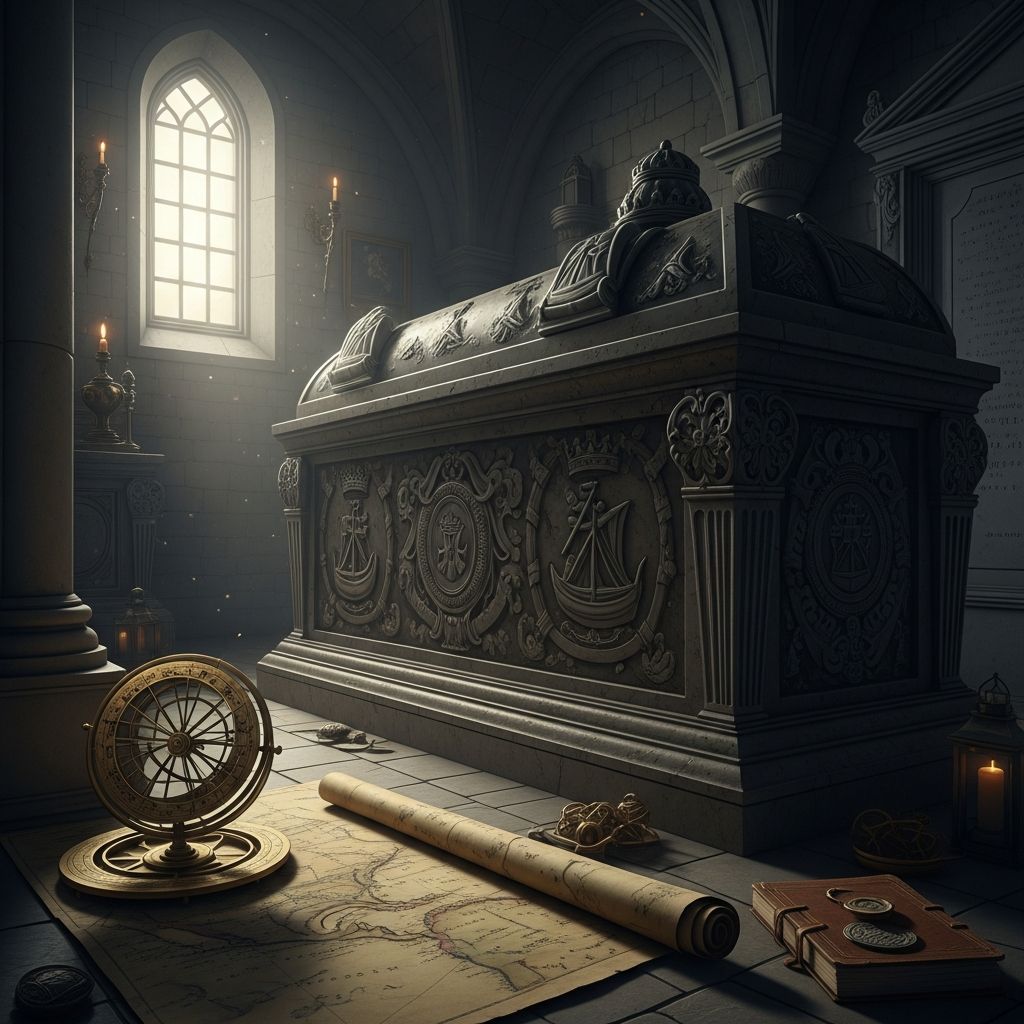
Christopher Columbus, the Genoese explorer whose 1492 voyages reshaped global history, died on May 20, 1506, in Valladolid, Spain. His remains, however, embarked on their own epic journey, crisscrossing the Atlantic Ocean multiple times over nearly five centuries. This saga involves royal decrees, colonial upheavals, and cutting-edge forensic science, culminating in a grand monument in Seville Cathedral—though not without lingering doubts and rival claims from the Dominican Republic.
Death and Initial Entombment in Spain
Columbus passed away amid financial disputes and health decline after his fourth voyage. Buried initially in Valladolid’s Convent of San Francisco, the exact spot remained a mystery until modern geophysical surveys. Researchers using ground-penetrating radar (GPR) in the city’s streets identified subsurface anomalies matching historical descriptions of the convent’s chapel, confirming the site’s location beneath modern pavement.
Just three years later, in 1509, his son Diego arranged for the remains’ transfer to the Carthusian Monastery of Santa María de las Cuevas in Seville. This move honored Columbus’s wish for a more prominent resting place while keeping him in Spain temporarily. Diego himself would join his father there in 1526, intertwining their legacies.
Crossing to the New World: Santo Domingo’s Claim
Columbus had expressed a desire to be buried in the Americas, specifically Hispaniola (modern Dominican Republic), where he served as viceroy. In 1537, Spanish authorities exhumed the remains from Seville and shipped them aboard a caravel to Santo Domingo’s Cathedral. There, they rested for over 250 years, becoming a symbol of Spanish colonial power.
Geopolitical shifts disrupted this peace. In 1795, amid the Haitian Revolution and Spain’s cession of Hispaniola’s western half to France, officials secretly relocated the bones to Havana, Cuba, to safeguard them from potential desecration. This nocturnal operation underscored the era’s tensions, with the remains hidden in a lead-lined casket.
From Havana Back to the Iberian Peninsula
The Cuban leg of the journey lasted nearly a century. Following the Spanish-American War in 1898, when Spain lost Cuba, the remains were repatriated once more, arriving in Seville on November 28 of that year. Placed in the grand Seville Cathedral, they now occupy an elaborate tomb designed by sculptor Arturo Mélida, featuring four kings bearing the sarcophagus.
This return marked the fourth major relocation, each prompted by war, politics, or piety. The cathedral’s crypt became the purported final home, adorned with inscriptions proclaiming Columbus as “Admiral of the Ocean Sea” and “Viceroy and Governor of the Indies.”
Rival Claims Ignite a 19th-Century Controversy
Doubts surfaced in 1877 when renovations in Santo Domingo’s Cathedral uncovered a lead box inscribed with Columbus’s titles: “The illustrious and excellent man, Don Cristóbal Colón.” Dominican authorities hailed it as the true resting place, abandoned during the 1795 transfer. Seville countered that these were merely representative fragments, not the full remains.
This dispute fueled national pride battles between Spain and its former colonies. Pilgrims flocked to both sites, and pamphlets exchanged barbs. The standoff persisted until the 20th century, when scientific inquiry promised resolution.
Scientific Scrutiny: DNA and Forensic Breakthroughs
In 2003, Spanish forensic expert José Antonio Lorente launched a comprehensive study. His University of Granada team accessed bone fragments from Seville Cathedral, comparing their mitochondrial DNA (mtDNA) with those of confirmed relatives: son Hernando and brother Diego, also buried in Seville.
Initial Y-chromosome analysis failed due to degradation, but mtDNA sequencing in 2006 matched the Seville bones to Diego’s, strongly supporting their authenticity as Columbus’s. Dominican refusal to permit testing on their remains left room for speculation—perhaps partial relics remained there.
| Sample Source | DNA Type Tested | Match Outcome | Year |
|---|---|---|---|
| Seville Cathedral Bones | mtDNA | Matches Diego Columbus | 2006 |
| Hernando Columbus (Son) | Y-Chromosome | Inconclusive (Degraded) | 2003-2005 |
| Diego Columbus (Brother) | mtDNA | Confirmed Relative Match | 2006 |
| Santo Domingo Box | Not Tested | Pending/Refused | N/A |
Recent advancements bolstered these findings. In October 2024, Lorente’s team revisited the data with improved techniques, declaring the Seville remains definitively Columbus’s. Cross-referencing with Fernando’s DNA sealed the verdict, though some experts note the possibility of distributed bone fragments.
Technological Aids in Uncovering Lost Sites
Beyond DNA, non-invasive tech pinpointed forgotten graves. In Valladolid, Marcial Castro Sánchez and Juan Luis Sainz employed GPR surveys. Geozone’s GPR Slice software generated 3D models revealing the Convent of San Francisco’s foundations, including the Count of Cabra’s chapel—documented as Columbus’s first tomb.
These scans visualized buried walls and voids, aligning precisely with 16th-century maps. Corroborated by DNA traces from Seville slivers, they etched the initial burial site’s coordinates into history.
Monuments and Memorials Worldwide
- Seville Cathedral, Spain: Primary tomb since 1899; 16th-century Gothic structure housing the explorer’s sarcophagus.
- Santo Domingo Cathedral, Dominican Republic: Houses 1877-discovered box; UNESCO World Heritage site symbolizing early colonial era.
- Havana, Cuba (Historical): Former site at San Cristóbal Cathedral; marked by plaques recalling the 1796-1898 interlude.
- Valladolid, Spain: GPR-confirmed original site; subtle street markers denote the convent’s lost footprint.
Each location draws tourists, blending reverence with skepticism. Museums nearby exhibit voyage artifacts, enriching the narrative.
Historical Context of Frequent Moves
Columbus’s peripatetic remains reflect Spain’s imperial flux. Posthumous honors elevated his status from debtor to icon, with monarchs like Ferdinand and Isabella sanctioning transfers. Colonial losses—from Hispaniola to Cuba—necessitated protective relocations, mirroring the explorer’s own restless voyages.
Religious motivations prevailed too; Carthusian monks preserved sanctity, while cathedrals amplified prestige. These shifts parallel other luminaries, like Napoleon or Mozart, whose graves wandered amid turmoil.
Modern Implications and Cultural Legacy
The saga underscores historiography’s evolution—from lore to lab. DNA has demystified claims, yet fuels debates on identity and ownership. Columbus’s quincentennial in 1992 spotlighted the issue, drawing Vatican interest and international media.
Today, amid reevaluations of his legacy—balancing discovery with conquest—the remains symbolize enduring enigma. Annual ceremonies in Seville reaffirm Spanish stewardship, while Dominican festivals honor their relic.
Frequently Asked Questions
Where was Christopher Columbus first buried?
He was initially interred in Valladolid’s Convent of San Francisco in 1506, pinpointed by recent GPR surveys.
Do DNA tests prove Seville has the real remains?
Yes, 2006 and 2024 analyses matched mtDNA to relatives, confirming Seville’s bones as authentic.
Why won’t the Dominican Republic test their bones?
Authorities cited religious sensitivities, blocking access despite repeated requests.
How many times were the remains moved?
At least seven major transfers: Valladolid to Seville (1509), to Santo Domingo (1537), to Havana (1796), back to Seville (1898), plus interim shifts.
Is there a monument at the original Valladolid site?
A commemorative plaque marks the GPR-verified location under city streets.
References
- Locating the First Burial Site of Christopher Columbus — Screening Eagle (Geozone). 2023. https://www.screeningeagle.com/en/inspection/locating-first-tomb-christopher-columbus-valladolid
- Tomb of Christopher Columbus — Wikipedia (sourced from primary historical records). 2024-10. https://en.wikipedia.org/wiki/Tomb_of_Christopher_Columbus
- Identification of Christopher Columbus’s Remains — EBSCO Research Starters. 2023. https://www.ebsco.com/research-starters/history/identification-christopher-columbuss-remains
- Christopher Columbus’ Tomb — Seville Tickets. 2024. https://www.seville-tickets.com/seville-cathedral/christopher-columbus-tomb/

- Integrated M.A. in Applied Linguistics, University of Hyderabad
- 5+ years in editorial, instructional, SEO, and research-based writing
Sneha is a relationships and lifestyle writer with a strong foundation in applied linguistics and certified training in relationship coaching. She brings over five years of writing experience to theskillvault, crafting thoughtful, research-driven content that empowers readers to build healthier relationships, boost emotional well-being, and embrace holistic living. Her writing and insights reflect the belief that beauty, happiness, and wellness…