
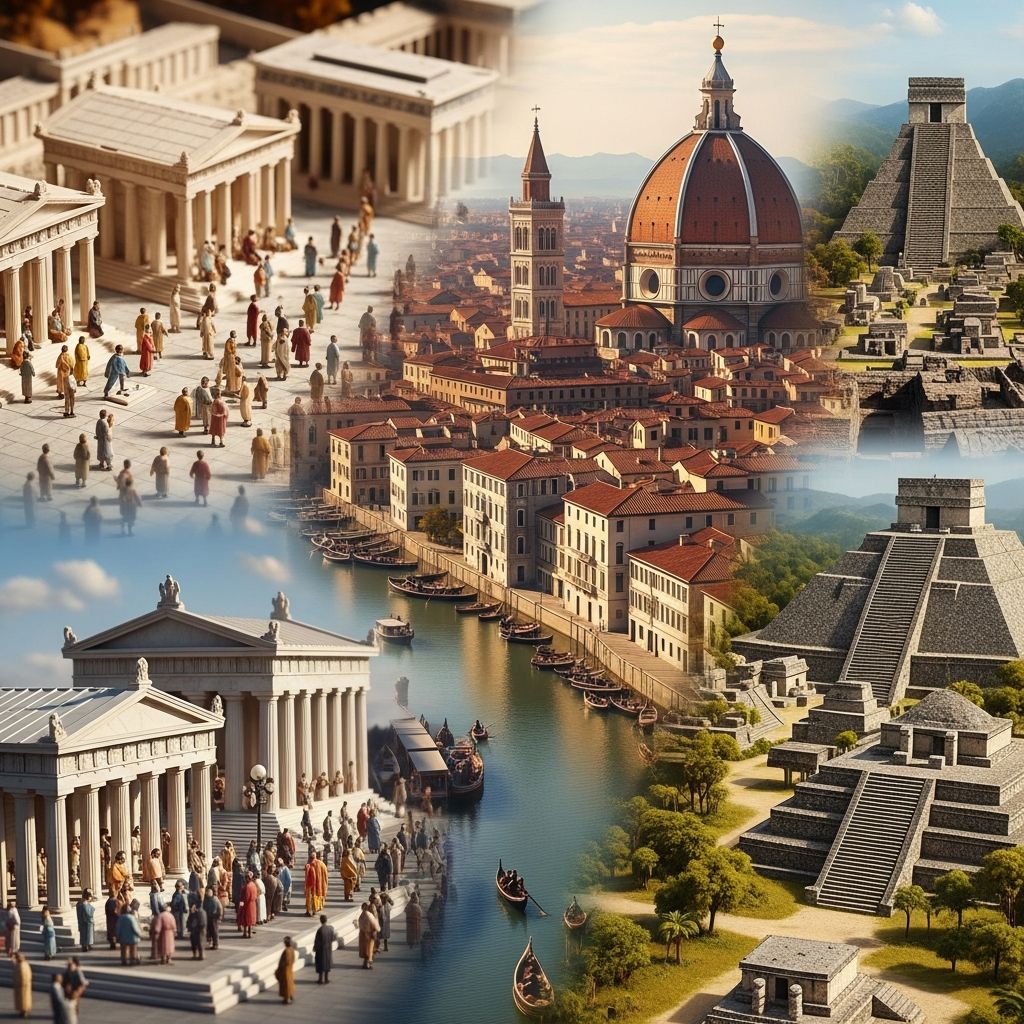
City-states represent a unique form of political organization where a single city exercises complete sovereignty over its immediate territory, functioning as a self-contained hub of governance, economy, and culture. Unlike expansive nation-states, these entities prioritize urban centrality and local control, often fostering intense patriotism and innovation.
Defining the Essence of a City-State
A city-state is fundamentally an independent political unit anchored by a dominant city that governs contiguous rural areas, villages, and resources. This structure emerged as agricultural settlements evolved into urban centers capable of self-sufficiency and defense. The Greek term polis encapsulates this idea, referring to a fortified city and its surrounding lands, typically limited in size to promote tight-knit civic life.
Key characteristics include:
- Political Autonomy: Full sovereignty without external overlords, enabling unique laws and foreign policies.
- Economic Hubs: Control over trade routes, ports, and agriculture for prosperity.
- Cultural Focus: Centers of art, philosophy, and religion radiating influence.
- Military Strength: Defenses like walls and citizen militias to protect independence.
Distinguishing city-states from modern nation-states highlights their exclusivity: nation-states unify diverse regions under shared identity, while city-states emphasize singular urban dominance.
Origins in Ancient Mesopotamia
The cradle of city-states lies in Mesopotamia around 3000 BCE, where cities like Uruk and Ur rose amid the fertile Tigris-Euphrates valleys. These early polities developed writing, ziggurats, and complex bureaucracies, managing irrigation and trade. Uruk, often called the first true city, spanned 5.5 square kilometers with a population nearing 50,000, its temple economy driving surplus production.
Mesopotamian city-states competed fiercely, leading to alliances and wars. Kings ruled as divine intermediaries, blending theocracy with monarchy. This model influenced subsequent civilizations, proving urban sovereignty viable in resource-scarce environments.
The Golden Age of Greek Polis
Ancient Greece epitomizes city-states, with over 1,000 poleis flourishing from 800-300 BCE. Athens and Sparta stand as archetypes: Athens championed democracy and intellectual pursuits, birthing philosophy and theater; Sparta emphasized militaristic discipline and communal living.
| City-State | Government Type | Key Strengths | Notable Achievements |
|---|---|---|---|
| Athens | Direct Democracy | Naval Power, Philosophy | Parthenon, Socratic Method |
| Sparta | Oligarchic Militarism | Army Discipline | Victory at Thermopylae |
| Corinth | Tyranny then Oligarchy | Trade and Commerce | Diolkos Canal |
| Thebes | Monarchy/Oligarchy | Land Warfare | Defeat of Spartans at Leuctra |
Greek city-states shared language and religion but maintained fierce independence, clashing in events like the Peloponnesian War (431-404 BCE). Their rivalries spurred cultural peaks, including the Olympics and epic literature.
Expansion to Phoenicia and Beyond
Phoenician city-states like Tyre, Sidon, and Byblos dominated Mediterranean trade from 1500 BCE, inventing the alphabet and establishing colonies such as Carthage. Carthage evolved into a maritime superpower, rivaling Rome with its navy and mercantile empire.
In the Italian peninsula, Etruscan cities and early Rome operated as city-states before imperial growth. Rome’s transition from city-state to empire illustrates a common trajectory: initial autonomy yielding to conquest.
Medieval and Renaissance Italian Powers
During Europe’s Middle Ages, Italian city-states such as Venice, Florence, Genoa, and Milan revived the model. Venice, a thalassocracy, controlled Adriatic trade via its lagoon republic, governed by a doge and merchant oligarchy. Florence birthed the Renaissance under Medici patronage, excelling in banking and art.
- Venice: Maritime dominance, lasting until 1797.
- Florence: Cultural epicenter, home to Michelangelo and Machiavelli.
- Genoa: Banking innovator, funding Crusades.
These entities thrived on commerce, diplomacy, and condottieri mercenaries, navigating papal and imperial politics.
City-States in Asia and the Americas
Beyond the Mediterranean, city-states dotted Asia. In the Maya civilization (250-900 CE), Tikal and Chichen Itza governed jungle territories through divine kings and trade networks. In ancient India, Sangam-era cities like Pataliputra functioned similarly before imperial consolidation.
Chinese Warring States (475-221 BCE) featured semi-autonomous urban powers like Qi and Chu, precursors to unification under Qin.
Governance Models in City-States
Diverse systems marked city-states:
- Democracy: Athens’ assembly of male citizens.
- Oligarchy: Rule by elite families, common in Corinth.
- Monarchy/Tyranny: Hereditary or seized power, as in Syracuse.
- Theocracy: Priest-kings in Mesopotamia.
This variety allowed experimentation, influencing modern republics.
Economic Engines and Trade Networks
City-states leveraged geography for wealth: ports in Venice and Carthage, silver mines in Athens. They pioneered coinage, guilds, and double-entry bookkeeping, fostering capitalism’s roots.
Military Strategies and Defense
Survival demanded robust defenses. Hoplite phalanxes protected Greek poleis; Venetian arsenals mass-produced galleys. Alliances like the Delian League provided collective security.
Decline and Transition to Nation-States
City-states waned with empires and nation-states. Alexander the Great absorbed Greek poleis; nation-states like France centralized power post-Renaissance. Yet, their legacy endures in federalism and urban autonomy.
Contemporary City-States and Micro-Nations
Today, Vatican City, Monaco, Singapore, and Hong Kong embody city-state traits. Singapore, a sovereign island-city, boasts a GDP per capita over $80,000 through trade and tech. Vatican City holds spiritual sovereignty over 0.44 km².
| Modern Example | Population | Key Feature | GDP Contribution |
|---|---|---|---|
| Singapore | 5.9 million | Global Trade Hub | High-Tech Economy |
| Monaco | 39,000 | Tax Haven | Tourism, Finance |
| Vatican City | 800 | Religious Center | Donations, Stamps |
Legacy and Modern Relevance
City-states pioneered civic participation, innovation, and resilience. In an era of globalization, micro-states like Singapore suggest renewed viability for compact, agile governance models addressing urbanization challenges.
Frequently Asked Questions (FAQs)
What differentiates a city-state from a nation-state?
A city-state is a sovereign city ruling nearby lands, while a nation-state unites multiple cities under national identity.
Are there any city-states today?
Yes, including Singapore, Monaco, and Vatican City, which maintain independence and urban focus.
Why did Greek city-states decline?
Internal wars and conquests by Macedonia and Rome led to their absorption into larger empires.
How did city-states contribute to democracy?
Athens developed direct democracy, influencing Western governance.
Can city-states form empires?
Yes, Rome and Carthage expanded from city-state origins to imperial powers.
References
- City State Definition & Examples — Study.com. 2023. https://study.com/academy/lesson/city-state-overview-examples.html
- City-state — Wikipedia. 2026-04-01. https://en.wikipedia.org/wiki/City-state
- What Is A City-State? — World Atlas. 2022-10-15. https://www.worldatlas.com/articles/what-is-a-city-state.html
- City-state | Politics and Government — EBSCO Research Starters. 2024. https://www.ebsco.com/research-starters/politics-and-government/city-state
- City-state | Definition, History, & Facts — Encyclopædia Britannica. 2025-03-20. https://www.britannica.com/topic/city-state
- Definitions – Empire, Country, City-State, Civilization — MrDonn.org. 2023. https://ancienthistory.mrdonn.org/what-is-an-empire_country_city-state.html
- City-state Facts For Kids — DIY.org. 2024. https://www.diy.org/article/city-state

- Integrated M.A. in Applied Linguistics, University of Hyderabad
- 5+ years in editorial, instructional, SEO, and research-based writing
Sneha is a relationships and lifestyle writer with a strong foundation in applied linguistics and certified training in relationship coaching. She brings over five years of writing experience to theskillvault, crafting thoughtful, research-driven content that empowers readers to build healthier relationships, boost emotional well-being, and embrace holistic living. Her writing and insights reflect the belief that beauty, happiness, and wellness…